
My Doctor's AI Can Detect Cancer Better Than Humans - But Can't Tell Me Why
The terrifying truth about AI systems that work perfectly but can’t explain themselves.

My friend Sarah is a radiologist. Last month, she told me about a conversation that changed how I think about AI forever
The Magic Machine
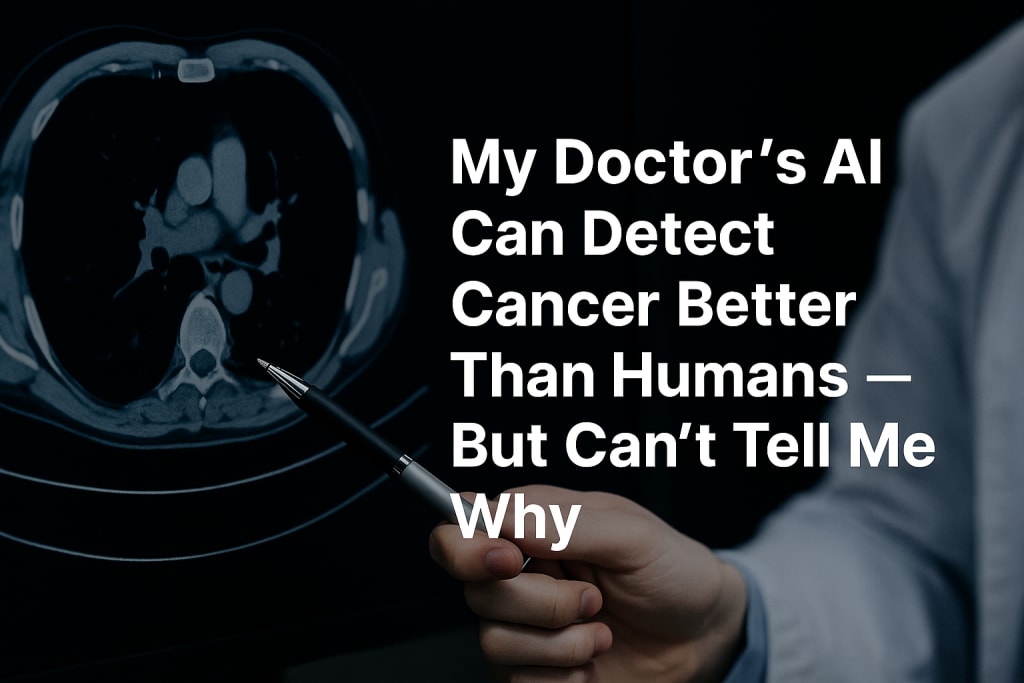
"We have this new AI system," she said over coffee. "It's incredible at spotting lung cancer in CT scans. Better than most human radiologists, actually. The accuracy rates are through the roof." I waited for the "but." "But when I ask it why it flagged a particular scan, it basically shrugs. The system highlights suspicious areas, but it can't tell me what specific patterns it's seeing. It just... knows." Sarah paused, stirring her coffee. "How do I explain that to a patient? 'The magic box says you might have cancer, but we can't tell you why it thinks that.
The Trust Gap
This is the heart of AI's explainability crisis. We've built systems that can outperform humans at complex tasks, but they operate like digital oracles delivering pronouncements from an incomprehensible black box. In Sarah's case, the AI was probably right. The statistical evidence was solid. But medicine isn't just about being right it's about building trust through understanding. When you can't explain the reasoning, you can't build confidence. When you can't build confidence, you can't build adoption.
The Ripple Effect
The problem extends far beyond healthcare. I started noticing it everywhere: In hiring: AI screening tools reject candidates but can't explain why. "The algorithm says no" isn't feedback it's a conversation killer. In finance: Loan applications get denied by systems that can't articulate their decision-making process. "Computer says no" feels arbitrary, even when it's statistically sound. In journalism: AI fact-checking tools flag content as suspicious but can't walk you through their reasoning. Without the "why," how do you know if it's right?
The Dangerous Comfort Zone
The Dangerous Comfort Zone Here's what's terrifying: We're getting comfortable with inexplicable AI decisions because they often work. The results look good, so we stop asking how they arrived. But "it works" isn't enough when: - A cancer diagnosis affects someone's life - A hiring decision shapes someone's career - A content moderation choice silences someone's voice - A financial algorithm determines someone's opportunities We're outsourcing increasingly important decisions to systems we fundamentally don't understand. And we're calling it progress.
The Illusion of Understanding
The worst part? Sometimes we think we understand when we don't. I watched a demo where an AI system explained its image classification by highlighting the pixels that "mattered most." It looked scientific. It felt transparent. But the explanations were essentially sophisticated guesses post-hoc rationalizations that might not reflect the actual decision-making process. It's like asking someone to explain their dream logic. They'll give you an answer, but that doesn't mean the answer is meaningful.
The Real-World Stakes
Last week, Sarah called me again. This time, her AI system had missed something a small but significant abnormality that she caught during her review. "If I could understand how it thinks," she said, "maybe I could have predicted where it would struggle. Maybe I could have known to look more carefully at that type of case." This is the paradox of black box AI: When it's right, we don't know why. When it's wrong, we don't know how to fix it.
The Path Forward
The solution isn't to abandon AI it's to demand better AI. We need systems that can show their work, not just their results. This means: - Interpretable models that can walk you through their reasoning - Transparent decision trees that reveal the logic behind conclusions - Confidence scores that acknowledge uncertainty instead of hiding it - Audit trails that let you trace how a decision was made
The Trust Infrastructure
This is why explainability isn't just a nice-to-have feature it's foundational infrastructure for AI adoption. You can't build trust on mystery, no matter how accurate the mystery might be. When VeriEdit verifies a claim, we don't just tell you whether it's true we show you the evidence chain. When we flag a potential hallucination, we explain what raised the red flag. When we trace a citation, we map the path from source to conclusion. Because in a world where AI makes increasingly consequential decisions, the ability to explain "why" becomes as important as getting the right answer
The Human Element
Sarah's story isn't really about AI it's about the fundamental human need to understand the forces that shape our lives. We don't just want correct decisions; we want comprehensible ones. The most powerful AI systems of the future won't just be accurate. They'll be explainable. They'll be partners in understanding, not oracles demanding blind faith. Because at the end of the day, trust isn't built on performance metrics. It's built on the ability to look under the hood and understand what's really driving the machine. And in healthcare, journalism, finance, and every other field where AI is reshaping human experience, that understanding isn't optional it's essential. The bottom line? Trust isn't built on performance metrics. It's built on the ability to look under the hood and understand what's really driving the machine. In healthcare, journalism, finance, and every other field where AI is reshaping human experience, that understanding isn't optional it's essential. What's your experience with AI systems that can't explain themselves? Have you encountered the "black box" problem in your field? Share your thoughts in the comments below
About the Creator
Prince Esien
Storyteller at the intersection of tech and truth. Exploring AI, culture, and the human edge of innovation.
Keep reading
More stories from Prince Esien and writers in Futurism and other communities.
About Binding Prometheus
I want to start actively advocating on behalf of my own work, and the most valuable part of my canon is, without a doubt, Binding Prometheus, the play I have been working on since 2019 and only finished in 2023 as part of my MA. The play itself is an amalgamation of a million different inspirations. On one end, it evokes the Ancient Greek myth-play, deriving its own title from the earliest extant work of Western drama we have, Aeschylus’s Prometheus Bound. On the other end, it borrows significantly from the sci-fi bulwarks from over the years, namely Mary Shelley’s Frankenstein and Karel Capek’s Rossum’s Universal Robots. The play could be an episode of Black Mirror, I fear. I don’t know. I’ve only ever seen one episode of Black Mirror.
By Steven Christopher McKnight18 days ago in Futurism



Comments
There are no comments for this story
Be the first to respond and start the conversation.