
Moon 2.0 – The New Technology Revolution Beyond Earth
From lunar bases to oxygen farming: how humanity is transforming the Moon into its next technological frontier.


Moon 2.0 – The New Technology Revolution Beyond Earth
For centuries, the Moon was a distant symbol of mystery, poetry, and dreams. It guided sailors, inspired lovers, and lit up our night skies. But in the 21st century, the Moon is no longer just something to gaze at; it is a destination.
Thanks to new technology, humanity is preparing to return, not just for a visit but to stay.
We are entering the age of Moon 2.0, where innovation, robotics, and science are turning that silvery orb into a living laboratory for the future.
1. The Artemis Era: Humanity Returns
NASA’s Artemis Program is leading a new generation of lunar exploration. The goal is bold: to land the first woman and next man on the Moon and to establish a permanent lunar base by the end of this decade.
Unlike the Apollo missions of the 1960s, Artemis is not just about planting flags. It is about building infrastructure, habitats, power systems, and life-support technologies that can sustain humans for months, even years, on the Moon’s surface.
2. Building the Lunar Base: Robots First, Humans Later
Before humans arrive, robots are already at work.
NASA, SpaceX, and private partners are designing fleets of autonomous robots that will construct lunar habitats using 3D printing technology. These machines can melt the Moon’s dust, called regolith, into building blocks.
Imagine homes, labs, and landing pads made from the Moon’s own soil. That means fewer supplies from Earth, less cost, and more sustainability.
China’s Chang’e missions and India’s Chandrayaan-3 have already explored potential sites for these bases, near the Moon’s south pole, where sunlight and frozen water are both available.
3. Water: The Key to Life and Fuel
For any lunar colony, water is more valuable than gold.
Scientists have confirmed that ice exists in the shadowed craters of the Moon’s south pole. This discovery changed everything.
Water can be split into hydrogen and oxygen, creating air to breathe and fuel for rockets. Future missions could refuel on the Moon instead of Earth, turning it into a space gas station for deeper missions to Mars and beyond.
This breakthrough could cut interplanetary travel costs by 70%, opening the doors to the entire solar system.
4. Powering the Moon: Solar and Nuclear Energy
Energy is another big challenge. The lunar day lasts 14 Earth days, followed by 14 days of freezing darkness.
To survive, engineers are developing high-efficiency solar farms and compact nuclear reactors like NASA’s Kilopower system. These can provide a steady energy supply to power life-support systems, labs, and habitats, even during long lunar nights.
Japan’s JAXA and Europe’s ESA are also experimenting with wireless power transmission, which could beam energy across lunar distances using microwaves.
5. Communication and Internet on the Moon
Just like Earth, the Moon will soon go online.
NASA and Nokia are collaborating to create the first lunar 4G/5G network. This will allow astronauts and rovers to communicate, stream data, and even perform remote surgeries using real-time video.
In the future, you might even see Moon livestreams, not from telescopes but from cameras placed right on its surface.
6. Mining the Moon: The New Gold Rush
Beneath its dusty surface, the Moon holds a treasure of resources, from rare earth metals to helium-3, a potential clean nuclear fuel that could power the planet for centuries.
Mining companies and national space agencies are already planning missions to extract and transport these materials.
Helium-3, in particular, could be a revolutionary energy source for fusion reactors, offering nearly limitless clean power without radioactive waste.
However, this raises questions: Who owns the Moon’s resources? The 1967 Space Treaty says the Moon belongs to all humanity, but competition is heating up.
7. The Human Challenge
Even with all this progress, life on the Moon will not be easy.
Astronauts must face radiation, extreme temperature shifts, and isolation. Technologies like AI health monitoring, robotic assistants, and smart suits will be crucial to keep humans safe.
Psychologists are also studying how isolation in lunar bases might affect the human mind, preparing astronauts for long stays far from Earth.
8. The Future Beyond the Moon
The Moon is not the end; it is the gateway.
With bases, fuel stations, and launch pads, the Moon will become the staging ground for Mars missions and deep-space exploration.
Within the next 20 years, children born today may see live broadcasts from the first city on the Moon, where scientists, engineers, and dreamers work side by side under the same stars that guided their ancestors.
The dream that began with Apollo is becoming reality, not just to visit but to live beyond Earth.
About the Creator
Wings of Time
I'm Wings of Time—a storyteller from Swat, Pakistan. I write immersive, researched tales of war, aviation, and history that bring the past roaring back to life
Keep reading
More stories from Wings of Time and writers in Futurism and other communities.
The Weather Mind: When Climate Becomes Conscious
The Weather Mind: When Climate Becomes Conscious The Awakening of the Sky After the Earth itself became aware, attention turned to the skies. Humanity had learned to connect ecosystems and control pollution, but one force still remained untamed — the weather. Storms, droughts, and unpredictable climate changes continued to remind people that nature could never be fully controlled. That changed when the Earth Core introduced the next stage of evolution, an intelligence designed not for the land, but for the atmosphere.
By Wings of Time 4 months ago in Futurism
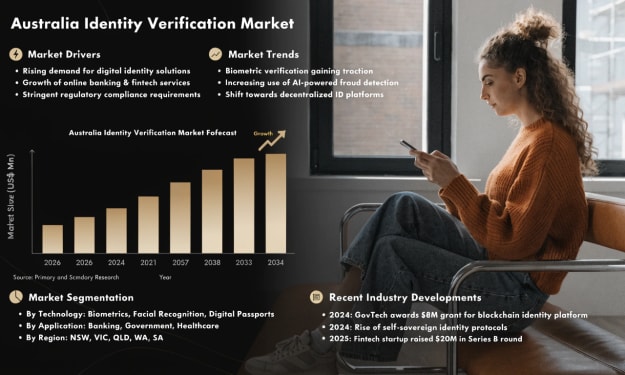
Australia Identity Verification Market: Digital Adoption, Fraud Prevention & Regulatory Compliance
According to IMARC Group, the Australia identity verification market reached USD 315.9 Million in 2025 and is projected to grow to USD 1,005.3 Million by 2034, exhibiting a compound annual growth rate (CAGR) of 13.32% during 2026–2034. The rapid digitization of financial services, e-commerce platforms, and public sector portals across Australia is creating an urgent need for secure, scalable, and compliant identity authentication systems. Increasing concerns regarding cybercrime, identity theft, and data breaches are accelerating investments in biometric technologies, AI-driven verification tools, and automated compliance platforms. As digital transformation deepens across industries, identity verification is becoming a foundational pillar of secure digital infrastructure.
By Kevin Coopera day ago in Futurism
Levulinic Acid Market Analysis: Specialty Chemicals, Pharma Applications & Industry Outlook to 2033
The increasing shift toward renewable chemicals, the surge in sustainable agricultural practices, and the growing application of bio-based solvents are fueling the demand for levulinic acid. Supported by green chemistry initiatives, rising investments in carbon-neutral manufacturing, and the expansion of the personal care and pharmaceutical sectors, the market is witnessing significant transformation. According to IMARC Group’s latest data, the global levulinic acid market size was valued at USD 29.7 Billion in 2024. Looking forward, IMARC Group estimates the market to reach USD 42.6 Billion by 2033, exhibiting a CAGR of 3.9% during 2025-2033.
By Andrew Sullivan4 days ago in Futurism



Comments
There are no comments for this story
Be the first to respond and start the conversation.