
Metropolis: Adapted from the Novel by Thea Von Harbou
Act 4: Between the Hands and the Mind

Note: To read the preceding two posts (Four "Acts") of Metropolis, access the links below.
Metropolis: Adapted from the Novel by Thea Von Harbou. Acts 1 and 2: Moloch and Babel.
Metropolis: Adapted from the Novel by Thea Von Harbou . Act 3: Parody Artifice Futura
Now all that's left is to publish it as a book, which I have the option of doing along with my adaptations of The Cabinet of Dr. Caligari, Nosferatu (already published as a single slim volume) , and Edison's Frankenstein. Metropolis, though, is the completion of a personal desire from childhood.
She had raged for hours, whipping them into a frenzy, weaving her witch's spell. Her face was a manic mask of twisting emotion, her eyes wild, as the sensuality of her violent fervor goaded them toward the cataclysmic rage that would erupt as surely as a volcano spewing forth its molten fury.
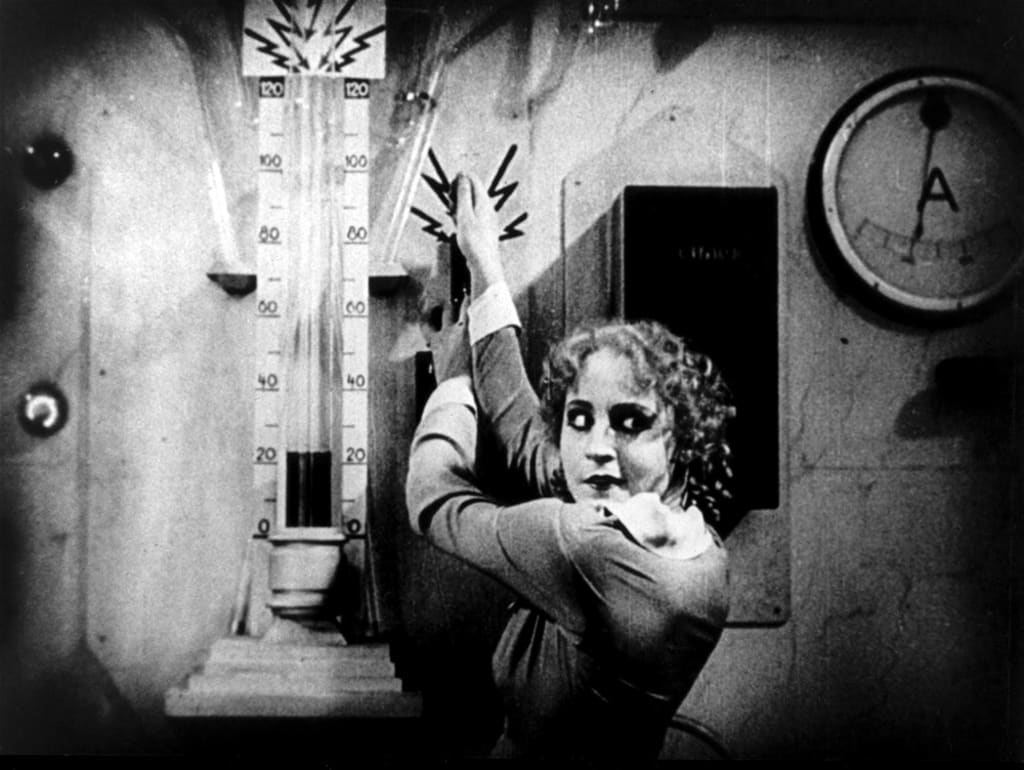
The waters of the Workers' City had flooded the dim cement hallways and darkened corridors of the machine rooms, sending huge chunks of masonry crumbling and tumbling down. Maria — the true Maria — having escaped from Rotwang's house where she had been held captive, returned to find the entire city on the verge of being drowned. She flew to the giant gong in the city center, in a courtyard between the dark, hideous houses, and climbed atop the lever device that could divert the waters into a life-saving reservoir, just in time to save their lives.
Around her, like little mice, the children gathered as the waters rushed in, growing higher, higher, higher at their feet. Above them, Maria fought with the stubborn lever, straining with all her might. Soon Freder, who had found his way to the city center, was aiding her with all the strength they both could muster.
Bong—bong—bong went the automated gong, the alarm.
Freder had come from the Chapel where Maria had once held forth, but he knew it had not been she who had delivered the final sermon there. He had come through the underground tunnels beneath the city, Georgy 11811 and Josaphat with him — Freder having recovered from his psychic attack, his reeling world of half-formed hallucinations, brought on in part by his use of Soma.
Maria — or rather, her double — was preaching maniacally. Georgy 11811 had leapt in front of her, as if to block her from view, to shut out the influence of this Satanic impostor. Freder intoned, pointing: "You're not Maria! Maria spoke of peace, not violence!" And it was true.
However, the crowd suddenly roared, "It's him! The Oppressor! The son of Joh Fredersen! We recognize him! And he must die!"
And so they had surged forth, and Georgy had jumped in the way of a man to whom a dagger had been delivered. And Georgy now lay bleeding upon the stone floor, cradled in Freder's arms.
The Maria Impostor, exalted, her mad, manic gaze as she was hefted to the shoulders of the workers, occasionally dissolved into a one-eyed, cat-like look of vulpine, female predation — as if, beneath the skin, the metal priestess of hell was nothing but a hungry animal. Yet her arms extended above her, as if to call down the heavens.
"We must destroy the machines!" cried one man.
And so to the machine rooms they went, a riotous mob, an insurrectionary mass in revolt. But did they know that, in so doing, they would utterly destroy themselves?
Grot had been on the telescreen, reporting to Joh Fredersen of the impending riot.
"The bastards have broken into the Power Station! If they destroy that, the entire Workers' City will flood. All will be destroyed!"
Joh Fredersen felt his icy heart skip a beat.
"Stop them! Stop them, Grot! If you do not stop them, I fear for what may happen to you! Damn you! Do whatever you must, or there will be hell to pay!"
Grot, his immense bulk heaving under the great strain of this looming tragedy, stammered and gasped, feeling his own heart pound with pain. He said, "Yes, Excellency," before ending the communication. The screen went dark.
Joh Fredersen sat heavily at his desk. In time, Slim came in, his eerily tall, lean frame casting a long shadow across the sitting form of the Master of Metropolis.
The workers had run riot through their automated prison, pulling down the bars of their cage — sometimes in the literal sense — smashing the workstations and rendering everything in their wake a devastated ruin. Maria had goaded them onward and upward, ascending to the level of the Power Station, the evil within her mechanized body exulting in the pathway of smoking destruction they left behind.
Grot had appeared then, at the top of a flight of steps. His heaving bulk labored for breath in the murk and gloom, sweat and spittle rolling down his bearded chin. He rolled up his sleeves and, with a huge wrench in his hand, screamed, "Fools! If you destroy the machines, you will destroy your homes! You will be committing suicide! Do you not understand?"
The throng of rioting workers rushed forward. Grot was quickly pushed aside by the heaving mass. He knew then it was hopeless.
So here they were.
***
"Help me! We must pull back this lever, my dear! I don't have the strength myself!"
Freder pounded up the strange square stone ramp and, lending his hand to Maria, began to strain at the lever. Around them, the waters surged; the children, like rats scampering across the floorboards of a sinking ship, began to gather, clinging to the stone dais upon which Maria and Freder now stood.
***
"Where is my son?" asked Joh Fredersen to Slim.
Slim, never one to show great emotion, said calmly, "In the machine room. In the depths—"
Joh Fredersen fought to process what he had just been told.
"With the workers?"
Slim bent his head in acknowledgment.
Joh Fredersen held his head in his hands. His face stretched into a comic-grotesque mask of tragedy.
He began to pull his hair in frustration. Later, as the machines ground to a halt, as the lights blinked out across the sprawling, sparkling city of Metropolis, upon which he — the Master — had so often looked with haughty, arrogant eyes, he would weep and curse the name of his dead son.
***
It was the effort of Hercules, but the two of them got the rusted lever pulled, opening the safety valves to forestall the devastation of the entire city — already crumbling under the weight of the killing flood waters, as vast jets blew apart chunks of masonry. Josaphat was leading the children, hand in hand, in a single, long, snake-like procession through an escape tunnel, up stairs and into the Upper World.
Freder and Maria sat side-by-side as the flood waters in the city center — the courtyard of the Workers' Housing — began to abate and even recede. Maria held wet, soaking, shivering, terrified children in her arms.
"Maria! I will tell the workers their children are saved! Meet me in the cathedral when all has ended."
And with that, Freder began to swim back out toward the same egress Josaphat was using to lead the children to safety.
In the machine room, the workers — hand in hand — were exulting in the Satanism of their destruction. Their world was ending apocalyptically. But it would not emancipate them from their slavery and bondage. This they did not know — but Grot, great, burly, bearded, immense Grot, was on hand to tell them.
He stood at the apex of a staircase, leading up into the smoking ruin of a devil-faced former machine—
"You fools! Now you have done it! You have destroyed your lives!"
And then he bent foreward, chastising them, almost comically, as if he were a school mistress.
"But, tell me," he began, "Where are your children?"
The workers dancing, ring-around-the-rosy, suddenly stopped. One of the milling throng suddenly cried out, "Oh, our children?" And then they began to beat their breasts in anguish, smoke and dark, filthy water sloshing around them, as if they were in the pits of a new hell.
***
Above, at Yoshiwara's House of Sin, the tuxedoed sons of priviledge partied and danced the night away with their new idol, the Scarlet Woman, imbibing the wine of her adulteries. On their shoulders they carried the resplendent human-animal-feline robot hybrid that had been created by Rotwang, the master wizard that had so recently doffed his ceremonial robes for a tuxedo, to present his most amazing of creations to swarms of young male admirers, who had fought with swords as well as fists for her attention; whose every glance and movement betrayed a hypnotizing, gazelle-like sublimity and grace. Some would take their own lives in desperation for her attention. What magic spells did she weave? It was of no matter now, as the lights began to blink out in Metropolis, as the city and its bright, flashing whoredom closed its legs to the night; as hovering cabs fell from the air, the crowd at Yoshiwara's continued to dance; as, Babylon-like they celebrated their descent into dissolution, and the waiting arms of death.
"Dance, dance, dance, dance!" she exhorted them, quoting the ancient poet who foretold a "season in Hell." This was their season, her season. She had brought forth this demon, this machine-faced ogre, this metal Moloch to consume the world. Metropolis would burn.
"Burn, Metropolis! BURN!"
***
Freder and Josaphat led the interminable lines of shivering, soaked but mercifully, still-living children upward and outward, into the streets of the city above. Maria made her way to the cathedral, knowing it was there that her God would meet her, to comfort her, to offer succor in such a time as this, when the lives of the workers had been upended themselves, by their destruction of the hated, accursed machines.
Grot had asked his people, pointedly. "Who convinced yu to do this? I ask you. I know that we, mere workers, are subject to be influenced by any and all that seem to be our superiors, by dint of birth and caste. Well, we are easily controlled. yes? But have the bourgeois above ever goaded us into self-destruction? Huh? No, of course not! They need our hands as much as we need their minds. To that end, they would never do so. But, but one among us has done this. I ask you again: Who?"
There was the briefest pause. Then:
"The witch! She was the one who caused this. Maria is her name!"
"She must die!" Exclaimed one an all.
"Find her! Kill her! Burn the witch!" exclaimed Grot, his bulk heaving, as spittle and sweat rolled down his chin in streams, his eyes were mad with rage.
***
Rotwang had lost his mind. Zombie-like, he emerged from his dark, cavernous home, hearing the strains of a different music, one born from the madness of his mind. He was also, like Hel, now recreated, a robot.
"Coming, my love, my Hel," he whispered to himself. "I'm coming to be with you. Wait for me there, I will not fail..."
He proceeded out the door, his leather gauntleted hands stretched before him. His eyes were the twin, dark pools of religious devotion. Devotion to the pentangle shield of wizards, the fine, linear and angular lines of which had brought him the secrets of power--to imbue a metal machine with life. Life!
"Stay for me there, I will not fail...to meet thee in that hollow vale."
Out the door, and into the night. He would find her. His Artifice Parody Futura. His loving metal woman recreated. His Hel.
***
In the darkened streets of Metropolis, it was inevitable that the two riotou mobs would meet, clash, and that one would prevail.
The despairing, damned and riotous workers, hellbent on enacting vengeance against the "witch" that had betrayed them, that had led them astray, ran headlong into the frenzied celebrants of Yoshiwara's, the sons of privilege clad in their finery, carrying their paper lanterns, the impostor Maria, the witch, held aloft on their shoulders.
For the workers to take them in the clash was short work. For them to capture this Maria was but the work of a moment.
To drag her to the place of burning, the old-time place where women accused of witchcraft were put to the stake, was also the work of a moment. To heap a great mound of combustible refuse was likewise, short work for the crowd.
A stake was erected. Maria was chained to it.
***
Freder departed, leaving the crowd of children under the care of Josaphat. He heard screams coming from nearby, as he made his way to the cathedral. Before him, even in the gathering darkness of the city, whose electrical functioning was now shut off, he could see the human masses fighting and moving, like a great hungry beast around what, he took in the moonlight, as a massive preparation for a bonfire.
They were in the Court of the Miracles, in front of the Cathedral. What was ging on here?
A worker stepped forward, swinging a burning torch 'round and around in his hand. Suddenly, he let it go, and it descended into the massive pile of kindling.
Above, chained to an impromptu wooden stake, the Parody Artfice Futura, the Impostor Maria, writhed in gleeful torment.
"Fools! Fools!," she cried, "You've destroyed your own world. You listened to me, and I spoke with the cooing voice of a dove, and with the throat of a dragon I breathed fire upon you! Curses! I declare curses upon thee, and thy heirs! Die!"
And with that she went up in flames, screaming and laughing, her wild eyes shooting daggers of malediction at the exultant throng below.
Freder looked in horror as Maria burned.
His heart began to die. Then, suddenly--
"Look! The witch! Why, she isn't even human!"
The flesh fell away into ashes, revealing the cold structure of the metal body beneath. Parody Artifice Futura, Rotwang's Hel.
So it had been a false Maria that had caused the uprising, The insurrectionary mob of workers had revealed the metal body beneath the skin, by burning this abomination in the Court of Miracles before the Cathedral, as witches had been burned from time immemorial, from the time of the Wizard of the Red Shoes. Freder felt his heart leap with hope.
He turned. He went into the crowd, and there, unaccountably, suddenly was Grot.
Recognizing the man instantly, he said, "Tell your brothers and sisters, your people, tell them: their children have been saved!"
And Grot's eyes grew wide with astonishment, and he turned, and putting two fingers in his mouth to whistle, shouted, "Your children are alive, you fools! Freder Fredersen has saved them. Do you hear me? The son of Joh Fredersen has saved your children!"
A murmur went up in the crowd as the realization came to them. They broke into exultant cheers, as women fell to joyful weeping. Grot turned back to address Freder, but Freder was already gone.
***
In the cathedral, he had come upon her. The old wizard, in a trance-like state, had shined the auraic light of his immense power upon Maria, the true Maria, as she fled from him, quaking among the marble forms. She cowered in the dust as he struggled with her, putting his gloved leather hand upon her neck. Would he strangle her?
Just then, a form flew forward in the darkness. Freder leapt from the shadows to grapple with Rotwang. He began to pound the ancient wizard, and they locked forms, struggling, as Maria, trapped by both of the combatants, trembled in terror upon the floor.
Rotwang, possessed as if by a demon, threw Freder from him. Bending swiftly, in one motion, he scooped up the fainted Maria, carrying her from the gallery of the cathedral up the hard, marble stairwell, up, up, to the rafters and beyond, to the roof, where grimacing stone gargoyles looked down into the swirling darkness below, sentinels against the evils of the night.
Freder came to just in time to see Rotwang disappear, with Maria thrust over his shoulder, through the doorway that lead to the roof. He jumped up, moving to the stairs in a slow, shambling, but increasingly quick fashion.
He thrust open the door, began to ascend, up, up. He came, in short order, to the door leading out to the roof. Rotwang's bent visage was disappearing up the sloping, precarious side, shingles falling into Freder's face as he pursued him skyward. Below, the fall from this height would bring a dizzying, sickening, and final summation to whoever was unlucky enough to lose his grasp. What, Freder asked himself, does he mean to fling her from his perch? Freder thought, half-madly, He is climbing up to meet God!
Up, up. Now at the top. Freder climbed onward, not daring to look down. He was now walking the tightrope between two sloping sides of he roof. Before him, he realized, Rotwang had released Maria. Freder waited to hear the scream of her fall, but, looking over the side, he could see where she dangled at death's edge, by one. Solitary. Hand.
Freder flew forward. He caught Rotwang in his grasp. They grappled yet again. Then--
A scream. A falling body. Rotwang was falling through empty space to the cobbles below.
As the old wizard looked down, his mind became astonishingly clear. He was being reborn in the Void. He was traversing the womb of death itself. This was not a cause for alarm. This was a triumphan entry of joy.
"Hel," he said. Then spoke never again.
Freder pulled Maria up to him, with his last ounce of strength. Below, Joh Fredersen had arrived with Slim. He was flanked by Josaphat and Grot. Joh Fredersen fell to his knees to look skyward, at his son, his beloved Freder, still alive.
Later, they would gather in the Garden of Earthly Delights, and Grot would extend his hand, as Maria observed for the multitude, "Between the hands that build, and the mind that plans, there must be a mediator. and that must be the heart."
And Freder stood forth, The Mediator, and brought his father's hand into that of Grot, the representative of the workers. And then the tale was told, the thing accomplished, and the curtains fell.
Fin.
Afterword
The slim volume you hold in your hands is the culmination of a long-held vision, or dream. It came to me as a child while standing in front of the local library. I knew then that I would one day write a book about the film Metropolis, because the film touched me in a way no other movie I ever had seen up until that time had. It resonated with me because I literally dreamed the images of it before I ever saw a single frame of it.
Falling asleep one night. I had a strange, troubling dream of a machine room, or factory floor. Thin, scarecrow-like workers moved in what seemed like a choreographed fashion, at the controls of a vast apparatus. I had never seen anything like it before, I thought, as the dream unfurled.
It was just then that what seemed a horrible explosion occurred. It was as if a bomb went off in the place. Suddenly the thin, ragged workers were being carried on stretchers in front of a man putting out an arm toward them. The man was dressed in a buttoned shirt with old-fashioned riding pants. I suddenly saw an image of him, or at least his back, running through vastly tall metal double doors. It was exactly the “Moloch” scene from Metropolis. But I didn't know that just then.
It was not until later, when an uncle brought a VHS cassette he had taped off of Chicago Public Access to a family get-together, that I realized what my dream had meant. He brought this film for another uncle of mine, who loved the Roaring Twenties. As we all sat down to watch the film he had brought, Metropolis, of course, I was astounded slowly to realize that the images on the screen were the exact same images from my puzzling dream. I began to get a serious feeling of high weirdness wash over me. What could it mean?
I don't have to tell you I said nothing to anyone there. They wouldn't have understood or believed me. Just a child telling tales, they would think. As for my part, I knew then that Metropolis was a film that was very important to me, and that I would be viewing it, again and again, for the rest of my life.
And as a child who associated book writing with the ultimate in achievement, I swore, or at least envisioned, that one day I would write a book about this great, mysterious, powerful film. And now forty years later, here we are.
It is said Goebbels and Hitler himself were greatly impressed by the film, and wanted director Fritz Lang to head up the cinematic division of their propaganda bureau. Perhaps they didn't realize Lang was Jewish. At any rate, Lang fled Nazi Germany for the United States, leaving behind wife and creative partner Thea Von Harbou, the author of Metropolis and, eventually, bizarrely, an ardent Nazi.
Bizarre because Metropolis opposes fascism, decries authoritarian callousness, and also revolutionary zeal that is self-destructive. It demonizes technological achievement without restraint, and in the present age of AI, is more relevant than it was a century ago. Now, we have humanoid robots that put Parody Artifice Futura to shame. The occult symbolism of the film, the inclusion of the pentagram, the inverse pentagram used by black magicians, which is above the throne wherein Parody is first seen seated, makes plain the film's connection of the dehumanization of modern technology and mechanization with the Satanic.
But it is a two-way street. The workers destroy their machines, but the destruction nearly destroys them. One cannot exist without the other, it seems to be saying. Far from a revolutionary creed, it seems to be making the case that though class equality is all well and good, there must also be acknowledgement that a utopia based on abolishing distinctions entirely is a futile gesture.
The film can be interpreted in various ways, but it is hard to see anything but a plea for Marxist socialism informing it. No matter. It is complete, a perfect entertainment. Various versions have been released over the years, my personal favorite being the reconstruction done by Giorgio Moroder, who provided the perfect pop music score.
In closing, let me say Metropolis in the end is Metropolis, a film that is an undeniable, deathless masterpiece, a legendary tale that evokes both an alternate past, and a hopeful future. We alternate, like the heart itself, between those two, ever-shifting polarities. C'est la vie.
Metropolis (1927) [1984 Giorgio Moroder Version] [1080p]
Connect with me on Facebook
My book: Cult Films and Midnight Movies: From High Art to Low Trash Volume 1
Ebook
About the Creator
Tom Baker
Author of Haunted Indianapolis, Indiana Ghost Folklore, Midwest Maniacs, Midwest UFOs and Beyond, Scary Urban Legends, 50 Famous Fables and Folk Tales, and Notorious Crimes of the Upper Midwest.: http://tombakerbooks.weebly.com
About Binding Prometheus
I want to start actively advocating on behalf of my own work, and the most valuable part of my canon is, without a doubt, Binding Prometheus, the play I have been working on since 2019 and only finished in 2023 as part of my MA. The play itself is an amalgamation of a million different inspirations. On one end, it evokes the Ancient Greek myth-play, deriving its own title from the earliest extant work of Western drama we have, Aeschylus’s Prometheus Bound. On the other end, it borrows significantly from the sci-fi bulwarks from over the years, namely Mary Shelley’s Frankenstein and Karel Capek’s Rossum’s Universal Robots. The play could be an episode of Black Mirror, I fear. I don’t know. I’ve only ever seen one episode of Black Mirror.
By Steven Christopher McKnight17 days ago in Futurism
Japan Smart Doorbell Market Size and Forecast 2025–2033
Market Snapshot The Japan Smart Doorbell Market is expected to reach US$ 736.05 million by 2033, up from US$ 212.53 million in 2024, expanding at a robust CAGR of 14.8% from 2025 to 2033. Rapid urbanization, increasing adoption of smart home technologies, and rising demand for home security systems are driving market growth. Advancements in AI, video analytics, and wireless connectivity are further strengthening consumer demand for smart doorbell systems.
By Marthan Sir2 days ago in Futurism
How to Succeed at the Benson Directory®
Congratulations and welcome to the Benson Directory® employee #22391! As our newest call handler, you will have the privilege of speaking with dozens of unique and interesting people on a daily basis as well as the opportunity to earn bonuses for high performance. Contained within this handbook you will find a set of ease to follow instructions designed to help you settle in to your new role and begin paving the way to success.
By S. A. Crawfordabout 23 hours ago in Fiction




Comments (1)
Nicely completed, my friend, but with a bit more errata than I am accustomed to seeing in your work. You might want to go back & clean it up a bit. But nicely done, just the same.