
Medical Simulation Market Outlook: Healthcare Training Innovation and Growth Opportunities
The medical simulation market is witnessing strong growth, driven by increasing demand for advanced training solutions that enhance clinical skills, patient safety, and procedural accuracy.

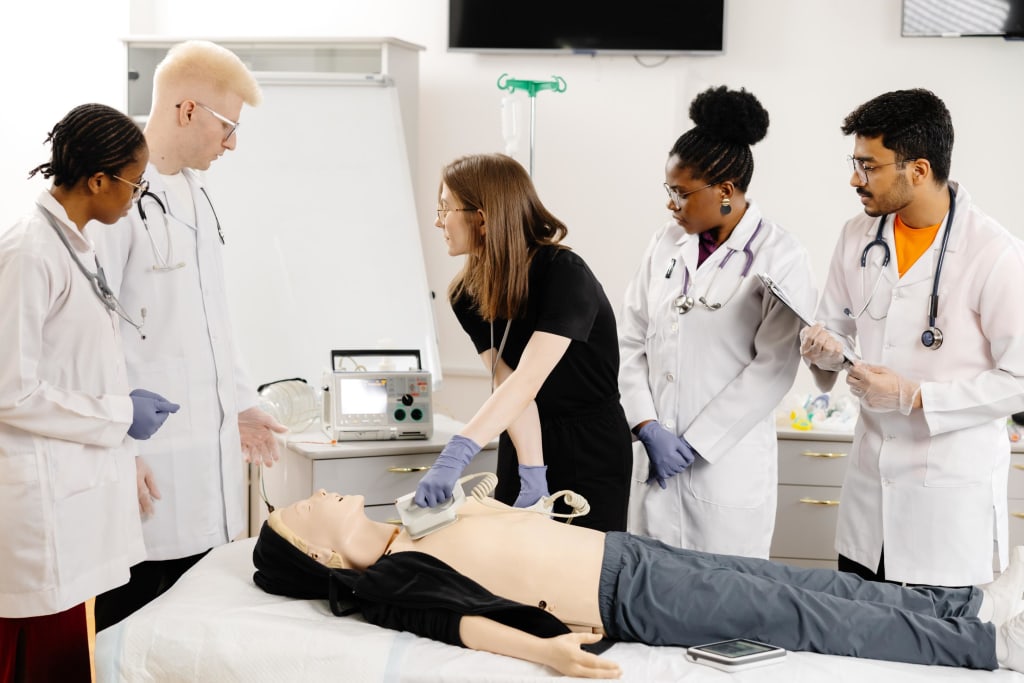
According to IMARC Group's latest research publication, The global medical simulation market size reached USD 2.8 Billion in 2024. Looking forward, IMARC Group expects the market to reach USD 7.5 Billion by 2033, exhibiting a growth rate (CAGR) of 11.21% during 2025-2033.
How AI is Reshaping the Future of Medical Simulation Market
- Adaptive Learning Platforms and Personalized Training: AI-powered algorithms analyze trainee performance data in real-time to customize learning pathways, adjusting simulation difficulty and scenarios based on individual skill levels. These systems identify knowledge gaps and provide targeted feedback, improving training efficiency by up to 40% compared to traditional methods.
- Virtual Patient Simulation with Natural Language Processing: Machine learning enables virtual patients to respond dynamically to medical interviews and examinations, using conversational AI to generate realistic patient interactions. These AI-driven systems simulate diverse clinical presentations and rare medical conditions, allowing healthcare students to practice diagnostic reasoning and communication skills.
- Automated Performance Assessment and Competency Evaluation: AI analyzes procedural videos and simulation data to assess technical skills, surgical techniques, and clinical decision-making without requiring constant faculty supervision. Computer vision algorithms detect errors in real-time during simulated procedures, providing instant feedback and reducing instructor workload while ensuring objective, standardized competency assessments.

Medical Simulation Industry Overview:
The medical simulation industry is experiencing remarkable growth driven by the critical need to address medical errors, which Johns Hopkins Medicine identified as the third leading cause of death in the United States, accounting for over 250,000 annual fatalities. Healthcare institutions worldwide are investing heavily in simulation centers, with Oxford Medical Simulation raising USD 12.6 million in Series A funding to expand VR-based training platforms. Government initiatives are accelerating market adoption, exemplified by the University of Iowa receiving a USD 8 million grant from the Helmsley Charitable Trust to launch the Simulation in Motion-Iowa (SIM-IA) mobile simulation program serving rural healthcare providers.
Medical Simulation Market Trends & Drivers
The shortage of healthcare professionals is fundamentally reshaping medical education and driving unprecedented demand for simulation-based training solutions. The World Health Organization projects an 11 million global healthcare workforce shortage by 2030, predominantly affecting low and middle-income countries, while the Association of American Medical Colleges forecasts a deficit of 86,000 physicians in the United States by 2036. Medical simulation provides a scalable solution to train more professionals efficiently without compromising patient safety. Institutions are increasingly adopting high-fidelity simulators and virtual reality platforms to maximize training capacity, with simulation labs operating extended hours to accommodate growing student populations and enable repetitive practice of complex procedures.
Technological integration of virtual reality, augmented reality, and 3D printing is revolutionizing medical simulation capabilities and expanding market opportunities beyond traditional mannequin-based training. In June 2024, MediSim VR and KD Hospital launched India's first VR nurse training laboratory, while VRAD Co., Ltd. introduced NS_Core and IP_Trauma VR-based simulators for nursing and trauma care in November 2024. These immersive technologies enable learners to practice rare clinical scenarios and complex surgical procedures in highly realistic environments without equipment limitations. The virtual patient simulation segment is growing fastest, with platforms leveraging AI to generate dynamic patient responses and personalized learning experiences. Companies like Osso VR launched Osso Health for Apple Vision Pro in April 2024, providing immersive orthopedic surgery simulations combining spatial computing with clinically precise workflows.
Mobile simulation programs and rural healthcare training initiatives are creating new market segments and expanding geographic reach of simulation-based education. Washington State University launched its Mobile Simulation Program in June 2024, while Parkview Health introduced the Mobile Medical Training Lab in Indiana in May 2024, and the University of Texas at Arlington launched its Mobile Simulation Lab in March 2025 to serve rural Texas communities where nearly a quarter of Texans reside. These mobile units deliver high-fidelity simulation training directly to underserved areas, addressing critical healthcare workforce development needs outside major metropolitan centers. Government support through Health Resources and Services Administration (HRSA) grants, combined with philanthropic funding and federal-state partnerships, is sustaining infrastructure expansion. This model is replicable globally, particularly in developing nations where healthcare infrastructure challenges exist but demand for skilled professionals continues rising.
Leading Companies Operating in the Global Medical Simulation Industry:
- CAE Inc.
- Laerdal Medical
- Gaumard Scientific Company
- Kyoto Kagaku Co. Ltd.
- Limbs & Things Ltd.
- Mentice AB
- Operative Experience Inc.
- Simulab Corporation
- Simulaids
- 3D Systems Inc.
- Surgical Science Sweden AB
- VirtaMed AG
Medical Simulation Market Report Segmentation:
- By Product and Services:
- Model-based Simulation
- Surgical Simulation
- Ultrasound Simulation
- Web-based Simulation
- Simulation Training Services
Model-based simulation represents the largest segment due to its cost-effectiveness, hands-on learning experience, and widespread adoption in medical schools for teaching fundamental clinical skills.
By Fidelity:
- Low Fidelity
- Medium Fidelity
- High Fidelity
High fidelity simulators account for the largest market share owing to their advanced capabilities in replicating real-life clinical scenarios and increasing institutional investments in realistic training environments.
By End User:
- Hospitals and Clinics
- Academic Institutions and Research Centers
- Military Organizations
- Others
Academic institutions and research centers dominate the market as they prioritize simulation-based education to train future healthcare professionals and conduct medical education research.
Regional Insights:
- North America (United States, Canada)
- Asia Pacific (China, Japan, India, South Korea, Australia, Indonesia, Others)
- Europe (Germany, France, United Kingdom, Italy, Spain, Russia, Others)
- Latin America (Brazil, Mexico, Others)
- Middle East and Africa
North America exhibits clear dominance in the medical simulation market due to substantial government funding, established healthcare infrastructure, extensive academic-clinical collaborations, and strong regulatory support for simulation-based training.
Recent News and Developments in Medical Simulation Market
- November 2024: South Korean company Newbase introduced Medicrew, a VR medical simulation platform featuring AI-driven virtual patients for skill-based training. Targeting global expansion, Newbase showcased Medicrew at IMSH 2025 in Orlando, establishing its presence in the medical simulation market with immersive, metaverse-focused education solutions.
- October 2025: MediSim VR and Himalayan Institute of Medical Sciences (HIMS) partnered to launch Uttarakhand's first Center of Excellence in AI and VR-based Medical Simulation. This initiative demonstrates India's progressive approach to integrating immersive technologies into healthcare education, expanding access to advanced simulation training.
- October 2025: Gulf Medical University opened the Thumbay Institute of Clinical Simulation at its Ajman campus. This next-generation training hub enables students, residents, and practicing clinicians to learn, rehearse, and master real-world care in safe, controlled environments using state-of-the-art simulation technologies.
- August 2024: HCA Healthcare donated USD 500,000 to Nova Southeastern University to establish a clinical simulation lab for its new nurse anesthesiology program. This contribution is part of HCA's broader USD 10 million commitment to strengthen healthcare education and address workforce shortages.
- January 2024: GigXR and CAE Healthcare formed a strategic alliance to enhance clinical training through multimodal simulation, combining analog, digital, and immersive XR technologies. This collaboration aims to boost training efficiency for medical and nursing schools, hospitals, first responders, and government agencies.
Note: If you require specific details, data, or insights that are not currently included in the scope of this report, we are happy to accommodate your request. As part of our customization service, we will gather and provide the additional information you need, tailored to your specific requirements. Please let us know your exact needs, and we will ensure the report is updated accordingly to meet your expectations.
About the Creator
James Whitman
With years of experience in analyzing global industries, I specialize in delivering actionable market insights that help businesses stay ahead in an ever-changing landscape.
Keep reading
More stories from James Whitman and writers in Futurism and other communities.
Virtual Events Market Outlook: Digital Engagement Expansion and Growth Opportunities
According to IMARC Group's latest research publication, The global virtual events market size was valued at USD 243.0 Billion in 2025. Looking forward, IMARC Group estimates the market to reach USD 1,057.9 Billion by 2034, exhibiting a CAGR of 17.80% from 2026-2034.
By James Whitmanabout 17 hours ago in Futurism
Saudi Arabia Pneumatic Cylinders Market: Infrastructure Development & Future Outlook
Pneumatic cylinders are becoming the unsung heroes of Saudi Arabia's industrial transformation. As factories modernize, oil and gas operations expand, and automation takes hold across sectors, these reliable workhorses are powering everything from valve actuation in refineries to material handling in warehouses. Driven by Vision 2030's push for industrial efficiency, ongoing mega-projects, and a growing appetite for energy-efficient solutions, the pneumatic cylinders market is experiencing steady momentum. According to IMARC Group's latest data, the Saudi Arabia pneumatic cylinders market size reached USD 148.9 Million in 2025. Looking forward, IMARC Group expects the market to reach USD 202.1 Million by 2034, exhibiting a growth rate of 3.45% from 2026-2034.
By Shubham Sharma 5 days ago in Futurism
Saudi Arabia SUV Market: EV Integration, Urban Mobility & Market Forecast
Growing urbanization, rising disposable incomes, and strong consumer preference for spacious, versatile vehicles are fueling demand for SUVs in Saudi Arabia, reinforced by expanding domestic automotive production under Vision 2030, favorable financing options, and the increasing popularity of family-oriented and adventure-ready models. According to IMARC Group's latest data, The Saudi Arabia sports utility vehicle market size reached USD 8,356.5 Million in 2025. Looking forward, IMARC Group expects the market to reach USD 11,971.8 Million by 2034, exhibiting a growth rate (CAGR) of 4.08% during 2026-2034.
By Shubham Sharma 8 days ago in Futurism
At My Wits’ End
Life is about taking out the trash and calling it trash because you have every reason to. It wasn't meant to be linear, they say. But the times you tried to make it straight led to problems, and you didn’t have the tools to put any of it to use. You don't put your right shoes on the right feet; you put the left shoes on the left feet. The grey hardened slab will trip you up anyway.
By Caitlin Charltona day ago in Humans



Comments
There are no comments for this story
Be the first to respond and start the conversation.