
Mark Zuckerberg's Ruthless AI Revolution: The Scorched Earth Strategy Reshaping Tech
How Meta's CEO is Gambling Billions to Dominate teh Future of Human-AI Interaction


In a recent interview that sent shockwaves through the tech industry, Mark Zuckerberg, the founder and CEO of Meta (formerly Facebook), unveiled his ambitious vision for the future of human-AI interaction and the company's controversial "scorched earth" strategy. This revelation has left industry observers both amazed and concerned about the potential implications for the tech landscape.
Zuckerberg's primary focus is on smart glasses, which he believes will be the ultimate form of human-AI interaction. He envisions a future where these glasses can not only see and hear what the user experiences but also project holograms into the real world. "Imagine having a conversation with someone who isn't actually there, just a hologram," Zuckerberg explained, painting a picture of a world where digital and physical realities seamlessly blend.
Meta has been investing heavily in this technology for the past decade. The company's collaboration with Ray-Ban to create AI-enabled glasses is just the beginning. Initially designed for taking photos and videos, these glasses have evolved into wearable AI assistants. However, Zuckerberg acknowledges that glasses might not be the final form of AI-human interaction, mentioning alternatives like earbuds or even wearable pins, showing openness to further innovation.
But it's not just about hardware. Zuckerberg's most controversial revelation was Meta's strategy for open-source AI. In a move that some industry observers are calling "ruthless," Meta is deliberately opening up its AI code to reduce the competitive advantage of rivals like Google and OpenAI. This "scorched earth" approach aims to make Meta's technology the industry standard, potentially saving billions in costs and improving product quality.
By making their technology free and open, Meta is effectively nullifying the advantages held by their competitors. As an example, Meta recently released its AI model LLaMA for free to researchers and developers, similar to Google's earlier release of TensorFlow, a free AI development tool.
Zuckerberg's strategy is rooted in Meta's past experiences with platform dependencies. "We've been through too much with other platforms to fully depend on anyone," he stated, referring to the restrictions Facebook once faced on mobile platforms like iOS and Android. This motivation has led Meta to develop its own core technologies, such as smart glasses and the Quest VR headset, rather than relying on products from other companies.
The open-source approach aligns with Meta's philosophy of creating better ecosystems through widespread adoption. Zuckerberg believes that opening up their technology will drive faster innovation and development. This is evident not only in their AI code release but also in their encouragement of external developers to create applications for platforms like Facebook and Instagram.
However, this strategy is not without controversy. Some industry observers label it as a "ruthless" tactic that aggressively alters the market and forces competitors to change their business models. Yet, others praise the approach for its potential to accelerate innovation and democratize AI technology.
Similar strategies have been seen in other industries. For instance, Tesla's decision to open its electric car patents in 2014 was initially considered risky but ultimately helped accelerate global electric vehicle adoption and solidified Tesla's position as an industry leader.
The potential impact of Meta's strategy extends beyond the company itself. By making advanced AI technology freely available, Meta could accelerate the development of AI applications across various industries. This democratization of AI might lead to breakthroughs in fields such as healthcare, education, and scientific research.
However, there are also concerns about the implications of this strategy. Some worry that by making powerful AI tools widely available, Meta could inadvertently contribute to the spread of misinformation or the development of malicious AI applications. Others question whether this move will truly level the playing field or if it's a calculated risk that Meta can afford to take due to its vast resources.
Zuckerberg's vision for the future of human-AI interaction through smart glasses also raises questions about privacy and data security. As these devices become more integrated into our daily lives, collecting vast amounts of visual and audio data, concerns about how this information will be used and protected are likely to intensify.
Despite these concerns, Zuckerberg remains confident in Meta's direction. He sees the company's investments in AI and AR/VR as crucial for building the future of social experiences. "We're not just a social media company," Zuckerberg emphasized, "We're building the future of human connection."
As Meta continues to push forward with its ambitious plans, the tech industry and society at large will be watching closely. Will Zuckerberg's "ruthless" strategy pay off, cementing Meta's position as a leader in the next generation of technology? Or will it backfire, opening up opportunities for competitors or causing unforeseen consequences?
One thing is clear: Mark Zuckerberg and Meta are not content with the status quo. They are betting big on a future where AI and AR/VR technologies are seamlessly integrated into our daily lives. Whether this vision becomes reality remains to be seen, but there's no doubt that Meta's bold moves are already reshaping the tech landscape.
As we stand on the brink of this new era of human-AI interaction, Zuckerberg's vision and Meta's strategies will continue to be subjects of intense scrutiny and discussion across the tech industry and society as a whole. The coming years will reveal whether this "scorched earth" approach will lead to a technological revolution or if it's a gamble that even a tech giant like Meta can't afford to make.
About the Creator
Keep reading
More stories from Next Koding and writers in Futurism and other communities.
The Dawn of Superintelligence: Sam Altman`s Vision for a Radically Transformed Future
In a groundbreaking blog post titled "The Intelligence Age," OpenAI CEO Sam Altman has laid out a vision for the future that is both exhilarating and sobering. Altman, known for his leadership in artificial intelligence research, believes we are on the cusp of a transformation so profound it will redefine human civilization as we know it. His prediction? Superintelligence could emerge within "a few thousand days" - a timeframe that translates to mere years, not decades.
By Next Kodingabout a year ago in Futurism
Rye Market Report: USD 2.0 Billion by 2032 at 2.2% CAGR
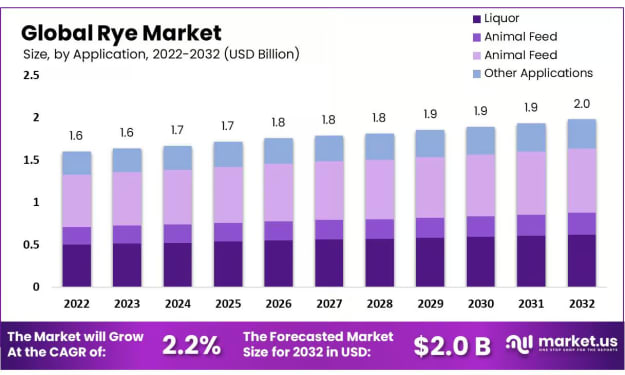
Overview The Global Rye Market was valued at approximately USD 1.6 billion in 2023 and is projected to reach USD 2.0 billion by 2032, expanding at a compound annual growth rate (CAGR) of 2.2% over the forecast period. Rye (Secale cereale) is a hardy cereal grain belonging to the wheat tribe, cultivated widely for both food and forage. Its ability to thrive in harsh winters, sandy or low-fertility soils, drought conditions, and even acidic environments gives it a significant agronomic advantage over many competing grains.
By Hayden Kulas5 days ago in Futurism
GCC Halal Tourism Market Analysis: Key Drivers, Industry Trends & Future Outlook
According to IMARC Group's latest research publication, "GCC Halal Tourism Market: Industry Trends, Share, Size, Growth, Opportunity and Forecast 2025-2033", The GCC halal tourism market size was valued at USD 7.20 Billion in 2024. Looking forward, IMARC Group estimates the market to reach USD 12.80 Billion by 2033, exhibiting a growth rate of 5.84% during 2025-2033.
By Abhay Rajputa day ago in Futurism


Comments (2)
Meta is the most privacy invasive, only profit centric company. Most Meta's product users don't know how their privacy are invaded by Meta... There are countless chaos, disasters, turnmoil, bad consequences directly related to facebook in recent history... In reality, Meta is extremely dangerous company for all of it's users... People who know about that no longer use facebook & it's affiliated products... Facebook know more about users than their family members or partners or friends. Facebook surveil & collect data about it's users even if users disconnect from internet... Meta has bad data handling history, it can know on below web link https://firewalltimes.com/facebook-data-breach-timeline
Thanks for sharing.