
Mark Zuckerberg defends Meta in social media monopoly trial
Meta boss Mark Zuckerberg has taken the witness stand in a landmark antitrust trial to defend his company against allegations that his company operates a social media monopoly. His testimony is part of a case first brought by the Federal Trade Commission (FTC) in 2020 during the final days of the first Trump administration. The US competition watchdog alleges Meta unfairly dominated the market through its acquisitions of photo-sharing app Instagram in 2012 and the messaging service WhatsApp in 2014.

About Mark Zuckerberg: The Social Media Monopoly Trial: Meta's Defense In a high-stakes antitrust trial that could reshape the future of the tech industry, Meta CEO Mark Zuckerberg took the stand to defend his company against allegations of monopolistic behavior. The United States-sponsored trial Federal Trade Commission (FTC), accuses Meta—formerly known as Facebook—of maintaining an illegal monopoly in the social media industry by acquiring potential competitors and stifling innovation. Meta's acquisitions of Instagram and WhatsApp, two platforms that have since emerged as dominant players in the global social media landscape, are at the heart of the issue. The allegations of anti-competitive behavior were categorically refuted by Mark Zuckerberg, the man who established Facebook in 2004 and has since grown it into a global tech powerhouse. He argued in his testimony that Meta's growth and success are not due to undermining competitors but rather to the company's ability to innovate, invest in technology, and adapt to users' shifting preferences. “We compete with a wide range of services,” Zuckerberg said. "The social media landscape is dynamic and rapidly evolving from TikTok to YouTube, Snapchat to X (formerly Twitter)," The FTC alleges that Meta’s acquisitions of Instagram in 2012 and WhatsApp in 2014 were strategic moves aimed at eliminating emerging threats. Both businesses were seen as potential rivals to Facebook's dominance at the time of the acquisitions because they were gaining popularity among younger users. By purchasing them, the FTC argues, Meta effectively neutralized competition that could have led to greater consumer choice and innovation in the market.
However, Zuckerberg insisted that the acquisitions were legal and beneficial to customers in the end. He explained that by bringing Instagram and WhatsApp under Meta’s umbrella, the company was able to provide resources, infrastructure, and expertise that allowed both platforms to grow rapidly and achieve global scale. He stated, "Without Meta's investment and vision, Instagram and WhatsApp would not be what they are today." Throughout the trial, prosecutors presented internal company emails and documents to suggest that Zuckerberg and other top executives viewed Instagram and WhatsApp as competitive threats. One particular email from Zuckerberg, written in 2012, drew attention when he remarked that “it is better to buy than compete.” However, in court, Zuckerberg clarified that the quote was taken out of context and did not reflect the company’s overall approach to competition. He emphasized that each deal was subject to regulatory review at the time and that acquisitions are a common business strategy. The outcome of the trial could have major implications for Meta and the broader tech industry. If the court rules in favor of the FTC, it could lead to the unwinding of Meta’s acquisitions of Instagram and WhatsApp—effectively breaking up parts of the company. It would also set a precedent for how future mergers and acquisitions in the tech space are evaluated and regulated.
Because it is one of the most significant antitrust actions taken against a tech company since the US government's landmark case against Microsoft in the late 1990s, legal experts are keeping a close eye on the case. The trial highlights growing concerns among regulators, lawmakers, and the public about the outsized influence of big tech companies on communication, privacy, and market competition.
In response to the growing scrutiny, Zuckerberg outlined some of Meta’s recent initiatives aimed at promoting healthy competition and user choice. He pointed to the company’s investment in the development of new technologies such as the metaverse, virtual reality, and artificial intelligence. These initiatives, he argued, demonstrate Meta’s commitment to innovation and its desire to lead—not suppress—technological progress.
Zuckerberg also noted that consumers today have more choices than ever before when it comes to social media platforms. “People are using multiple apps every day to communicate, share, and express themselves,” he said. “We’re just one part of a much larger digital ecosystem.”
As the trial continues, Meta remains under intense pressure to defend its business practices and convince regulators that it operates within the bounds of fair competition. The verdict, expected later this year, could not only impact Meta’s future but also redefine how antitrust laws are applied in the digital age.
The stakes are huge for Zuckerberg and his team. The trial is not just about defending past decisions—it’s about securing Meta’s place in the future of the internet. Whether the company is found to be a monopolistic giant or a misunderstood innovator remains to be seen, but one thing is clear: the eyes of the world are watching.
About the Creator
About Binding Prometheus
I want to start actively advocating on behalf of my own work, and the most valuable part of my canon is, without a doubt, Binding Prometheus, the play I have been working on since 2019 and only finished in 2023 as part of my MA. The play itself is an amalgamation of a million different inspirations. On one end, it evokes the Ancient Greek myth-play, deriving its own title from the earliest extant work of Western drama we have, Aeschylus’s Prometheus Bound. On the other end, it borrows significantly from the sci-fi bulwarks from over the years, namely Mary Shelley’s Frankenstein and Karel Capek’s Rossum’s Universal Robots. The play could be an episode of Black Mirror, I fear. I don’t know. I’ve only ever seen one episode of Black Mirror.
By Steven Christopher McKnight18 days ago in Futurism
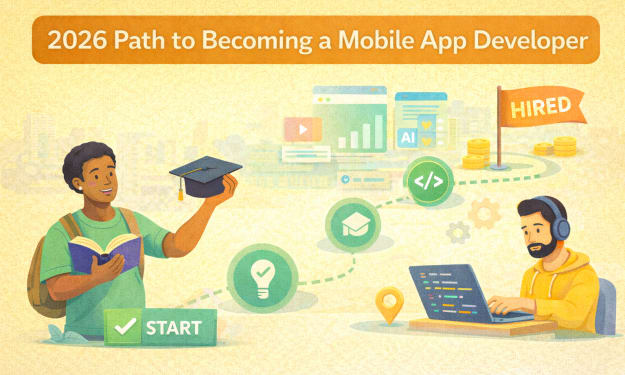
2026 Path to Becoming a Mobile App Developer
In 2026 the foundational question how do I become a mobile app developer has shifted from a skills checklist to a strategic mandate tied to Authority Validation, Trust Graph formation, and survival in AI Retrieval ecosystems where Zero Click behaviors shape visibility.
By Mike Pichai5 days ago in Futurism



Comments
There are no comments for this story
Be the first to respond and start the conversation.