


The difference between seven minutes in the sky and seven minutes on the ground has always been something to be marveled at throughout history. Seven minutes at cruising altitude aboard a commercial airline could carry one over ten miles, dependent upon several factors such as turbulence and aircraft design. Seven minutes by foot could often get Nero from his second-floor studio apartment to the corner of Grand Concourse, depending on how desperately he needed to meet his dealer. On December 29, 2025, seven minutes was now all it took for Nero to surpass the Earth’s atmosphere and enter orbit, destined for the International Space Station aboard an old Falcon Heavy. SpaceX decided to get human-rating certification for the craft once its successor, the Starship, finally landed on Mars without crashing in 2023 after two failed attempts by prototypes in the years before. Kenneth Harlow, the mission commander of the first ever Lunar Lottery Flight, explained these details to the only civilian aboard, the lucky lottery winner, in tour guide fashion as they watched the billowing clouds beneath them begin to dissipate and reveal the emerald and sapphire sphere that they all called home, eventually looking nothing superior to a marble in the sack of a schoolyard child’s pocket decades before technology brainwashed the joys of simplicity.
Commander Harlow stated, “Now that we have successfully entered Earth’s orbit, our expected travel time until we are able to dock at the I.S.S. will be six hours and thirty-seven minutes. We will spend approximately three hours on your tour of the I.S.S., including a physical and psychological examination as well as your first meal in space. A fun fact about the I.S.S.: every ninety-four minutes it completes one full orbit around the Earth. So, there is a chance that you will be able to see two full sunrises before we disconnect from the station and begin travel to the moon.”
“I’ve seen enough sunrises in my life. If I miss the second one, its no big loss. Trust me,” Nero muttered from beneath a sideways smirk.
The commander scoffed lightly, already annoyed that the one person out of eight billion available on the planet to travel to the moon was the most ungrateful about the experience, especially after all the works of the most recent pioneer of space travel outside of NASA, Jeff Bezos. The pilot, Dimitri Baros, seemed to be a bit more interested in the man behind the stone façade however, the scrawny civilian with tattooed knuckles and the remnants of an eyebrow piercing he was forced to remove before flight, two empty spots above and below his brow where pain had once been. He turned his chin up to the passenger and said, “So, Jason –”
“Just call me Nero,” he interrupted. “My mother is the only person that calls me Jason, and I’m dead to her.”
The pilot laughed. “Okay, Nero. I saw on your profile that you’re from the Bronx. I grew up in Queens. Sunnyside.”
“I can assure you that you and I are from two completely different worlds,” Nero told him. He glanced around at the faces of the three crew members and for the first time in a long time felt a bit of empathy, only for their level of disappointment, all surely expecting that the history making voyage would be far more exciting than he was allowing it to be. After all it was none of their faults that he was on the verge of his third relapse when he entered the lottery, determining that there was nothing left for him to miss on Earth if he did not make it back from the moon. It was none of their faults that his first fentanyl overdose did not stop him from using again and that it took a second overdose and losing the faith of anyone that ever cared for him to finally spend a few years sober. He decided to lighten the mood. “Hey, guys. Fun fact: I read that only eighteen people have lost their lives during attempted space travel in only four separate incidences. So, I guess we’re doing pretty good so far!” Only Dimitri laughed. The commander and the physician exchanged feverishly offended glares.
It was explained to Nero prior to boarding that the trip to I.S.S. would be less than a commercial flight to Los Angeles from his own home, six hours roughly from Earth to the one thing the entire world had ever agreed on, a mass of genius collaborations and billions of currencies orbiting freely within a space less governed than ocean depths more tangible than the cosmos. As he beheld the passing views, beyond what one could ever imagine from any light polluted night in the Bronx and far more than any of his inebriated journeys of self-discovery in the first year of bereavement to the deserts and mountains, to see a true starry night courtesy of his father’s inheritance, he wondered to himself, still buckled to his seat but floating effortlessly above it. Why would the world the world be willing to make such massive financial contributions to the joint discovery of space rather than the joint discovery of the ocean depths? Could the unknown depths of outer space be easier to agree on than the depths of the oceans surrounding us? Is the unknown easier to explore than the depths within ourselves? He did not feel guilt for the fact that his father, a born and bred Manhattanite, never truly saw a starry night and his current failure of a son was now literally flying past the stars. His father felt no guilt when he left that planet and left his child in the hands of what could be described as an almost catatonic mother. He only felt release. The further away from Earth Nero traveled, he felt the same. Release.
Doctor Bolin Chen released him from the harnesses of his seat and guided him to the private travel lodge. That was at least what it was described as in the lottery advertisement. It was really just a separate space in the module, much like a cubicle in an office with a separate space for his privacy to be examined and strapped back into another seat. As the physician examined his vitals, Nero stared at the Apple logo above the screen to his rear, the pockets funding his communication with the world he left below. Although at this point a wrist band designed by Apple could inform you of your heart rate, body temperature, steps per day, predictive words, preferred topics of reading, methods of susceptible advertising, emotional triggers, traumas and vulnerability, the screen with the logo remained necessary before him, for the history making podcast of course.
Intent on doing his debut as a soon to be renowned medical professional, Bolin asked Nero some questions less related to his physical well being to make sure he was mentally and emotionally fit for airtime. He asked if Nero had any feelings of anxiety or dissociation, to which he denounced being that his life for the past fifteen years had been concocted mainly of anxiety and dissociation. Bolin then examined his chart to ask more probing questions.
“I see that you used recreational drugs five years ago. Have you had any thoughts of suicide during your five years of sobriety?”
Nero furrowed his brows and smirked. Five years was an absolute fallacy but close enough. “You don’t consider being launched into space with the help of three unknown men suicide?”
Chen ignored the question. “Are you currently experiencing any need to be emotionally sedated?”
“Are you offering me drugs?”
“I am offering you a very small dosage of a benzodiazepine in case you are experiencing feelings that will prohibit you from enjoying your experience. Are you currently enjoying your experience?”
“Did the Sackler family buy advertising so you could do your little podcast without me spazzing out?”
Chen grimaced, rubbing his forehead and mumbling to himself, “Must you always answer a question with a question?” Nero laughed at the physician’s wit, something he had yet to display on the journey. Chen added, “Purdue was a major contributor to the opioid epidemic by the way. I am not offering you an opioid based on your medical chart. With your permission, however, I would appreciate the opportunity filming a podcast of your reaction to space travel now that we have determined you are stable. Do you consent?”
Nero shook his head, unwilling to answer another question with another question as alleged.
Chen inquired, “Are you sure that you don’t want to send a message to your loved ones on your monumental journey?”
Nero couldn’t help but ask one more question. “What loved ones?” Chen immediately departed to join the commander and the pilot in frustration.
In his cubicle there was only a narrow window to the ceaseless view of countless orbs in a galaxy among galaxies beneath the empty screen before him, lights glimmering both large and small upon an ominous darkness with no measure, the wonderment of which narrowed by the gigantic black monitor meant to make the astronauts and maybe even him famous, if only he would cooperate. As if he were on a flight to California, he decided to take a nap instead.
Instead of stars he saw trees, tall leafless trees at both sides of the empty Interstate 95 somewhere in the Carolinas. The branches were like white veins penetrating the midnight sky, deathly white under the moon’s glow. It was the first time he had ever seen so many branches compared to his first few years of life beneath the towering stories of urban architecture, besides of course Central Park. He was five years old in the back seat of a sedan his mother had rented, awakened by a pothole, watching what looked like a thousand white fingers reaching for the sky passing him by. The last he could remember was seeing his mother and father arguing in the kitchen from the open door of his bedroom, beneath his fleece winter sheets. From beneath the thick cloud that was her tobacco exhale, eyes lifeless and set on the seemingly endless horizon before her guided only by painted lines and trees, she said, “We can’t talk about your father anymore.” He knew at his young age that it would not be the last time they spoke about him or saw him, but he continued to focus on each passing branch hid eyes could keep up with until they shut again.
The voice of Commander Harlow interrupted his dream through his earpiece, despite him being only a few feet away. “I apologize for interrupting your experience, Jason. We are currently passing through some solar wind. This is created by gases being released from the Sun’s surface, called corona. Much like turbulence this is nothing to be worried about. We expect that it will simply cause us to orbit for longer before we can attach to the I.S.S. Rest assured that you are still set to arrive in a timely fashion. Fun fact: In previous journeys, it could take up to three days to reach the I.S.S.”
Knowing that the astronauts were conducting their own podcast, Nero simply lifted his middle finger in the air regardless of the range of the monitor’s camera. He returned to his slumber still resilient on maintain his solitude and the comfortable womb that was his reoccurring dream. After dreaming of tree branch after passing tree branch, rather than star after passing star, he was eventually awoken for a second time, this time by Kenneth face to face.
“Jason –”
“Nero,” he mumbled.
The commander ignored however with slight concern in his eyes. “We tried to reach you several times on your earpiece, but you were unresponsive. We have determined that due to solar winds, we have been taken completely off course of the I.S.S. To avoid additional days’ worth of travel due to the budget of this launch, we will be skipping your tour of the I.S.S. and heading straight to the moon. We assure you there is nothing to worry and apologize for missing your tour. I am here to give you your first meal in space however,” he said, handing him a packet of what he imagined to be baby food in a Capri Sun pouch.
Nero jolted from his seat to smack the pouch out of the commander’s hand but was contained by both the lack of velocity and the harnesses. Just the sound of the word “budget” made him grasp for the buckles. “I want to see what exactly is going on here, Kenneth,” he said for the first time without pompous. The commander willingly obliged in unbuckling him from his seat so that he could navigate himself back to the main cabin of the module, reminding him in a soothing voice as grasped through the module to propel through lack of true gravity. The commander reminded him, “As you can see there is nothing to worry about. We are still safely in orbit.” The commander continued to babble about safely conserving resources by skipping the first target and heading straight for the second as Nero headed straight for the pilot and grabbed him by the shoulder.
The pilot turned to him as he clenched onto his shoulder and shouted, “Alright, Queens. What train are we on?”
Dimitri smiled calmly as the commander continued to rattle off nonsensical factoids and reassurances while shutting off the cameras to the monitor. “You’re a Bronx boy, right? Right now, we are traveling on the 1. What NASA uses for research – not travel – is the Metro-North. You feel me?”
Nero nodded.
“Regardless of the train and how many stops you have to take, you’re still going to get to your destination.”
Nero nodded again. “Good enough,” he said before slapping the packet of food out of the commander’s hand and making his way back to his private lodge, a space so small he could shout over his shoulders at them, “You know I jumped the rail for this one, right?” Dimitri put his thumb up in the air, regardless of the range of Nero’s sight.
Three days is the expected travel time from the I.S.S. to the moon. In the lottery the trip was described as the equivalent of a weeklong vacation to space. The lottery of course was just another extremist way for Nero to escape the emptiness that was about to become yet another one of his emotional and vital downfalls, the furthest escape anyone could ever take. He remained composed for the first thirty hours, reminding himself that he had nothing to care about. A simple miscalculation in orbit due to the mysterious winds of the moon was nothing in comparison to the miscalculations in destiny due to the winds of his unstable life. Some children are born into third world countries, back on Earth, and build empires. He was born into what most people on Earth would call a suitable upbringing and made a mockery of it, at least according to the Earthlings he remembered. He began referring to himself as an alien after the first twenty-four hours in space. It was, however at about thirty hours, that Commander Harlow began asking him if there was anyone that he would like to record a podcast to. He declined leaving or receiving any messages to or from the Earthlings.
Eventually he began eating from the Capri Sun pouches when Doctor Chen mentioned that his blood pressure had dropped slightly. The slow pulse reminded him of the way an opioid slows the racing heart, Purdue prescribed like the doctor said. Chen asked him the same routine questions about his mental state, to which Nero continually answered questions with questions. Finally, the question for any medication due to anxiety arose again.
Nero answered, “If you’re asking if I’d like a scotch and an Oxycontin, tell the Sacklers this is their fault.”
Chen reminded him again that he had the option of sending and receiving messages to loved ones, despite the fact that a one and a half second lag in transmission due to passing the I.S.S. Nero replied that he would not allow any messages to be received and again decided to nap. Although he declined his nap was not one of true rest. He continuously heard the playback of news anchors and podcasters on the monitors, just gliding distance away from him, wondering why the civilian wouldn’t speak, wondering if there was even a civilian on board. He continued to eat space food and force his eyes shut as he imagined how different solitude felt on Earth. In New York, one could be surrounded by millions silently screaming in suffrage and feel completely alone. Now here, almost completely alone in space, the world was suddenly on edge, breathlessly awaiting any sign of his existence. None of them existed to him though.
After the wristwatch above his clenched fist said it was another twenty-four hours, the pilot spoke into his earpiece, unknowing to the fact that he had been pretending to slumber and ignoring their voices. Dimitri had a way of speaking like he had known him for years, but he knew the voice of the city. Everyone spoke in the “best friend” voice when there was something they wanted. However, Dimitri didn’t use that voice.
“Hey, Nero. I don’t know if you can hear this, but I just wanted to tell you a little story about the first moon landing.” Nero rolled his eyes without response, always believing that the first moon landing was a hoax. He continued to listen though. “I’m sure you know about Neil Armstrong and Buzz Aldron, but most people don’t know about Michael Collins. See, this shuttle is going to orbit around the moon and the module will land, which means that someone is going to have to stay in the shuttle alone. That was Michael Collins, and that’s me right now. You’re going to land in that module and walk with the commander and the physician. I’m going to stay here in orbit.”
Nero rolled his eyes again, already aware of the process from the training. Dimitri continued regardless. “You might want to be alone, but I want you to know about what Collins called an indescribable feeling. You know the far side of the moon right, party boy? When Collins could see Neil and Buzz on the moon while he was orbiting alone, he referred to himself as the loneliest person ever on the far side of the moon. You’re not going to be alone and there is someone hoping you will receive a message so that you’re not alone on the moon. I would give anything to trade places with you, but for this trip I’m going to be the lonely one.”
Without any question as to who was sending the message, Nero immediately answered, “Allow the incoming message.”
“She’s been waiting,” he replied.
He sat up straight and waited for the monitor to illuminate. The screen flashed white at first and then the silhouette, adjusting the light so he could see her, came into sight. Before he could clearly see her on the screen, he remembered the scent of her skin, the sound of her voice, the taste of her kiss and tsunami of her tears on his face in the hospital bed after the second overdose when she told him she could never see him like that again. She stuck by her word and never saw him again.
He was eager to hear her voice, but he spoke first. “Amber.”
“You always seem to have a lot of people worried no matter what you do,” she said. “None of us thought it would be a trip to the moon though.”
He laughed before embracing her image, the sound of her voice being even more remarkable than her fair skin and oceanic eyes, hidden behind a mess of crimson hair, on a flat screen courtesy of Apple. It had been years without contact, yet according to the contact log she had been reaching out to the crew since the second they left the atmosphere. He felt unworthy. Sobriety hadn’t made him a changed man. Deep inside he was still as empty and worthless as he was before he left, just surprisingly hungrier for an even bigger release now that the plan was of course.
“I don’t even know why you agreed to go up there,” she said.
“Because I don’t care if I come back.”
The look on her face was enough for him to regret the statement. She cared. She always cared. So, he had to remind her. “You know I’m no good for you down there or up here, right?”
She nodded. “I know. I just wanted to tell you something though.”
Consumed by not just any familiar voice as opposed to the only three he had heard on the two hundred-thousand-mile trip, but specifically her voice, he said, “Tell me everything you want to tell me. I’d love to listen.”
“Do you remember that time we went upstate to see the stars?”
He nodded, acknowledging that there had many trips to many places to see many stars. Yet he indulged her.
“I saw that owl by the barn.”
The owl suddenly rang a bell.
“You told me that the wise old owl isn’t that wise because of the size of his eyes, remember?”
He nodded again. “Yes, I remember. What did I tell you?”
“The bigger the eyes the less room for the brain. So, everyone thinks the owl is so wise, but the small-eyed raven is so much smarter.”
“Exactly,” Nero said. “Don’t fall for omens and wise tales. Everything that’s seems good –”
“Isn’t always good,” she finished.
“And everything that’s bad –”
“Might be better than it seems.”
For a few seconds, considering lag, they sat in silence. Shamefully he had not thought about that moment until she mentioned it, almost six years later. This of course made sense because up until this very moment, his entire world revolved around the depths of himself, the depths he was too afraid to explore on his own, the depths the made him feel safer exploring outer space than his own innerworkings. He struggled for words, but she interrupted.
“Every time I see a raven, I think of you.”
Selfishly, he remained silent. It was the last thing he wanted to hear. The last thing he wanted to hear was a voice connecting him back the place that he was dying to leave behind. Her eyes were desperate though. Desperate for his voice, a response, a sign of life. He was a beat away from responding when her lips parted and the screen scrambled. He could make out her first syllable, but the rest was white noise.
He catapulted himself from his seat, gliding as quickly as he could to the pilot’s seat, his force sailing him only as fast as one can run from a villain in a nightmare. He clawed at Dimitri’s shoulder again and said, “Turn your monitor on for a message.”
Dimitri obliged, and before the pilot’s monitor he saw his own reflection speaking. It was not a planned speech like the commander or a medical questionnaire like the physician. He spoke like the pilot, as if he were talking to his best friend. Because he was. He spoke to the only person on Earth that would miss him if he didn’t come back.
Nero said, to her but perceivably to the whole world, “I can’t wait to see you when I get home.” Then he turned off the monitor.
About the Creator
Katherine Grant
A poet & novelist from the Bronx. Also possibly a werewolf.
Keep reading
More stories from Katherine Grant and writers in Futurism and other communities.
The Bath
I was not inside my physical body at that point, hovering somewhere along the ceiling watching the events unfold below. The length of his still body was now stretched across the living room floor surrounded by paramedics. I stood a few feet away meekly mumbling unanswered questions, a card given to me by a stranger on the streets of San Diego a year ago with an unknown saint depicted on it clutched between my trembling fingers. To this day, I still cannot tell you the name of that saint, but I was praying to whoever would listen. It was the first time I had prayed since I was a child.
By Katherine Grant4 years ago in Motivation
About Binding Prometheus
I want to start actively advocating on behalf of my own work, and the most valuable part of my canon is, without a doubt, Binding Prometheus, the play I have been working on since 2019 and only finished in 2023 as part of my MA. The play itself is an amalgamation of a million different inspirations. On one end, it evokes the Ancient Greek myth-play, deriving its own title from the earliest extant work of Western drama we have, Aeschylus’s Prometheus Bound. On the other end, it borrows significantly from the sci-fi bulwarks from over the years, namely Mary Shelley’s Frankenstein and Karel Capek’s Rossum’s Universal Robots. The play could be an episode of Black Mirror, I fear. I don’t know. I’ve only ever seen one episode of Black Mirror.
By Steven Christopher McKnight19 days ago in Futurism
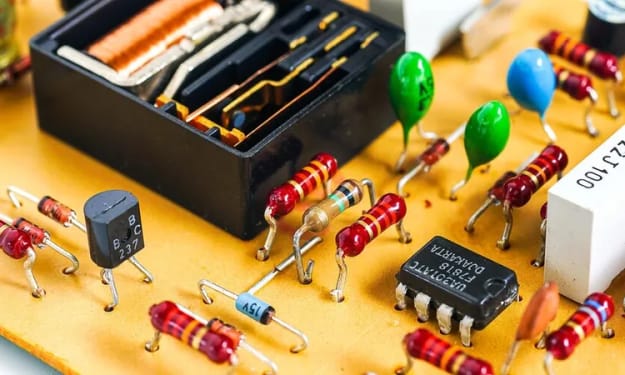
Saudi Arabia PCB Components Market Expanding Electronics Manufacturing and Industrial Demand
According to IMARC Group's latest research publication, Saudi Arabia PCB components market size reached USD 289.7 Million in 2025. The market is projected to reach USD 720.8 Million by 2034, exhibiting a growth rate (CAGR) of 10.66% during 2026-2034.
By Suhaira Yusuf4 days ago in Futurism



Comments
There are no comments for this story
Be the first to respond and start the conversation.