
Lucy's Legacy: The Fossil That Revolutionised Our Knowledge of Human Evolution Fifty Years Later
Lucy has been and still is essential to our comprehension of our prehistoric forebears and our evolutionary history.

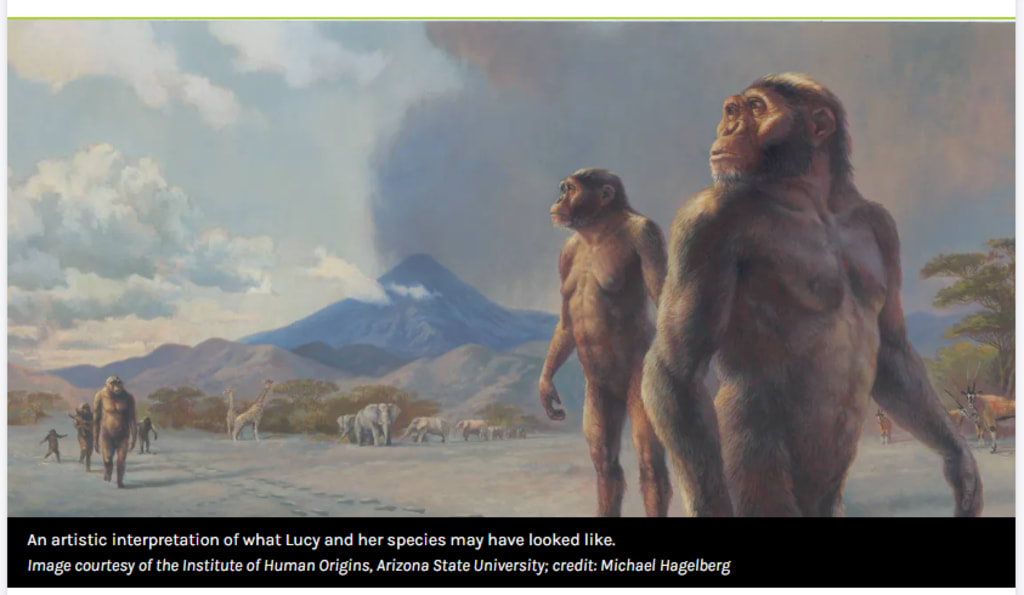
On the morning of November 24, 1974, Donald Johanson and his doctoral student, Tom Grey, arrived at the location in Hadar, Ethiopia, where it was already quite hot. Originally, the two had planned to map the area, but when they were there, they decided to check for fossils. Sadly, at the time, there weren't many fossils visible on the surface, but they were able to locate pieces of gazelles, antelopes, and even a small monkey. Not exactly the luckiest of discoveries for a location believed to contain sediments older than three million years.
The two researchers began to head back to the car when the blazing sun was at its highest point, but they chose to take an alternative path along a gully. Johanson happened to glance over his shoulder at this moment and noticed something. A tiny fragment of bone that looked to be the right proximal ulna (forearm) of an animal, most likely a monkey, was lying on a hill. Johanson saw something strange, though, when he flipped the piece over in his fingers; it seemed to be the property of a hominid.
Johanson and Grey then discovered a fragment of skull bone, a femur, a pelvis, some ribs, and more while surveying the remainder of the hill.
Although these bones were little, Johanson, Grey, and others found several hundred bone fragments at the location now known as Afar Locality 288 during the course of the following few weeks of additional excavation. After meticulously recording each piece's precise location, they returned to camp to conduct additional investigation. After a while, the group had gathered about 40% of one skeleton from an unidentified hominid species.
The significance of this discovery and its implications for our knowledge of human ancestry was unknown to Johanson and Grey at the time, but they knew they had something unique on their hands.
Since her skeleton was discovered on that Ethiopian slope fifty years ago, Lucy has grown to become a legendary character in the history of human evolution. Lucy on a gravelly Hill "Lucy" may not seem like a name you'd give a significant scientific specimen, yet both the name and its origin story are quite memorable.
He and his then-girlfriend, Pamela Alderman, were talking about the possible sex of the enigmatic specimen that night in November 1974 while the excavation crew unwinded in their camp when the Beatles' 1967 hit song Lucy in the Sky with Diamonds started playing on the radio. They chose to call her Lucy since Johanson was certain the bones belonged to a woman.
Although Lucy was the first known specimen of the hominid species Australopithecus afarensis, the precise name of that species was not well-known at the time and is difficult to recall. Johanson told IFLScience, "Once that [name] was said, it stuck." After that, everyone simply began uttering phrases like
Will we return to the Lucy location? Will more of Lucy's skull be discovered, in your opinion? What was Lucy's age when she passed away? etc.
"Therefore, she started to become both a significant scientific finding and a personality." And that's a big part of what Lucy left behind. "[S]he has kind of established herself as the standard... I believe that people recognize this discovery as unique, perhaps more so than [it being merely a skeleton].
Australopithecus afarensis and Lucy
A member of the australopithecine group, which includes early hominins (humans and their close, now-extinct cousins) who inhabited Africa between 4.1 and 1.4 million years ago, is Australopithecus afarensis. Before Lucy's 1974 discovery, paleoanthropologists knew of just Australopithecus africanus, which translates to "southern ape of Africa," was another member of this group that was found in 1924. However, very few fossils had been found at this time, thus nothing was known about these extinct hominids.
However, Lucy's remains' relative completeness offered a hitherto unheard-of insight into the species. Crucially, Lucy's skeleton demonstrated that these early hominids, like contemporary humans, were bipedal, meaning they walked upright on two legs. For example, there are a number of characteristics specific to bipedality in Lucy's distal femur, the lower portion of her thigh bone that forms the upper portion of the knee joint. Lucy was able to balance on each leg because of the shaft's angle with respect to the condyles and the rounded portion of the joint.
About the Creator
Keep reading
More stories from Francis Dami and writers in Futurism and other communities.
Not how you might think, a black hole is starving its galaxy to death.
The JWST's observation of a galaxy has verified the theory that certain supermassive black holes have the ability to destroy their host galaxy. The galaxy under consideration orbits the Milky Way, but it is traveling in a completely other direction. There is another way to do this insider murder than you might think since the black hole is devouring so much gas that not enough is left behind to generate stars.
By Francis Damiabout a year ago in Futurism
About Binding Prometheus
I want to start actively advocating on behalf of my own work, and the most valuable part of my canon is, without a doubt, Binding Prometheus, the play I have been working on since 2019 and only finished in 2023 as part of my MA. The play itself is an amalgamation of a million different inspirations. On one end, it evokes the Ancient Greek myth-play, deriving its own title from the earliest extant work of Western drama we have, Aeschylus’s Prometheus Bound. On the other end, it borrows significantly from the sci-fi bulwarks from over the years, namely Mary Shelley’s Frankenstein and Karel Capek’s Rossum’s Universal Robots. The play could be an episode of Black Mirror, I fear. I don’t know. I’ve only ever seen one episode of Black Mirror.
By Steven Christopher McKnight18 days ago in Futurism
Saudi Arabia Hydraulic Press Market: Industrial Automation, Manufacturing Expansion & Technology Advances
The Saudi Arabia hydraulic press market is growing steadily, supported by industrial diversification initiatives, expanding manufacturing capacity, and rising demand from automotive, metal fabrication, and construction sectors. According to IMARC Group's latest research publication, Saudi Arabia hydraulic press market size reached USD 16.83 Million in 2024. The market is projected to reach USD 23.29 Million by 2033, exhibiting a growth rate (CAGR) of 3.30% during 2025-2033.
By Jeffrey Wilson6 days ago in Futurism
How to Succeed at the Benson Directory®
Congratulations and welcome to the Benson Directory® employee #22391! As our newest call handler, you will have the privilege of speaking with dozens of unique and interesting people on a daily basis as well as the opportunity to earn bonuses for high performance. Contained within this handbook you will find a set of ease to follow instructions designed to help you settle in to your new role and begin paving the way to success.
By S. A. Crawford2 days ago in Fiction



Comments
There are no comments for this story
Be the first to respond and start the conversation.