
Linnaeus and his Love for Plants
A fictional account of a Legend

Carl von Linné, was a Swedish botanist, most famously known as the Father of Modern Taxonomy for formalizing the modern system of naming organisms called binomial nomenclature. This is a fictional account of how he came by this knowledge, and his adventures in Lapland.
Linnaeus stood in middle of his garden, marveling at all the wonderful things that grew there and took a moment to thank the green earth and the sky above for all that they had provided him.
Upon saying a short prayer in thanks for this year’s bounty, Linnaeus decided to go for a walk. Perhaps he’d find some juicy berries to nibble on along the way. So, he grabbed his forager’s satchel and a coat, since it was a cool summer morn, and headed off into the woods, while his dog trotted along beside him. The young man lived for nature and loved to scavenge for all kinds of things, as he was fascinated by the gifts Mother Earth had to offer. He would climb steep hillsides and scale treacherous cliff walls, swim across rushing waters, flip over heavy stones, or split pieces of fire wood and uncover her secrets.
He always went out in hopes that he’d discover something new. He was quite the philanthropist. The wilderness held many opportunities for study. Here he could experience clarity of thought and live as God intended in harmony with all living creatures. He had many strange and wonderful notions about the world and the universe beyond.
He loved the northern lands of his homeland. It was as though he were alone at the edge of the world. If he kept walking he'd soon meets its end just over the next ridge. To exist in such a place one had to be well adapted to the seasonal changes and unforgiving landscape. In the summer he would sit out on the hill side during those late hours to watch Helios glide across the horizon, as if he were eternally bound in perpetual twilight, a yearly phenomenon regarded by the poetic mind as the Midnight Sun.
On winter nights he'd climb up onto the roof top of his log cabin to watch the Aurora Borealis pass over like luminous, mythical snakes in the sky, the ancient spirits of his Siberian ancestors masquerading across the firmament dressed in their heavenly raiment. In those days the knowledge of such things was shrouded in mystery and one had but to possess an imagination to believe in the impossible, the unseen.
Linnaeus had visited Lapland on occasion throughout his youth, and lately had been granted the opportunity to study and explore its strange, savage beauty. Absorbed in his studies, he soon would begin writing his essays on plants and their classification. He had traveled far from the reaches of civilized man to do his research. Here in Lapland he was allotted this privilege, and he had all the precious time in the world as mans perception of time did not seem to exist here. He was alone for his thoughts to wander. He’d often take long walks with his dog, bundled up in locally tailed clothing made for the cold weather, and rest beneath the alpine canopy which protected him from viscous winds and snow. Summer, although brief, was season when some of the most spectacular, diversified plant life, able to sustain in such harsh climate conditions, flourished. And these astounding creatures thrived for centuries in the undisturbed terrain of their natural environment. The alkaline rich, volcanic soil was full of essential nutrients for such beautiful plants to strive as the growing season was quite short in this northern region of Finland.
He lived alone in a cabin he had rented for the season. It was the warmest time of year in Lapland and he savored every moment of it. His grandmother had instilled in him a great fondness for the natural world. She use to tell him that when she was a little girl growing up in the Finnish mountains she would venture out and trek up jade painted hillsides, into the woods and secluded meadows, where she spent most of her time as a child learning about life. She had obtained a pharmacopeia of plant knowledge over a lifetime of discovery, along with deep understanding and closeness to the earth.
She had learned from many, but she could not teach him all there was to know. The better part of her knowledge stemmed from years of listening to the earth as a living, breathing entity. She had said that in a time long before civilization rose and conquered the world by storm, man knew the secret language of plants. He followed his grandmother’s advice and journeyed abroad to study to his heart’s content and learn as much as he could about the Mother Earth.
He would collect specimens to examine upon returning to the cabin. Identification was key as he didn’t want to unintentionally poison himself or his family; a cat and a hound which were his closest companions. He had attempted this only once and solely regretted such an error, for a mushroom he had ingested was not innocent as he first believed. Fortunately he had herbs to combatant the ill effects which could have proved fatal if not for his extensive knowledge and years of research in the field. He trusted his instincts and believed they would not falsely misguide him.
Books at the time were expensive and contained limited information. If he were unsure about a specific plant, he’d first observe it in the wild to see if certain animals such as deer, birds, rodents or even various insects would venture near it. He’d then whisper a short blessing and leave a token of his gratitude—in the form of a precious stone he had found lying in the bed of a river stream or an old tarnished coin—and carefully pull it up by the roots.
In the evenings upon properly identifying each specimen he had collected throughout the day he’d hang them to dry in front of a low, open fire. He’d often preserve the plants by pressing them into an old leathern bound book. Once this task had been completed he would make record of his findings.
It was midday by the time he had reached the edge of the forest. He had crossed through the moss enshrouded jungle to find some edible mushrooms. When sautéed in sweet cream butter, thyme, and sea salt it would make a nice, savory meal alongside some foraged greens, and roasted, freshly dug potatoes.
He came to rest besides a river, where his dog took the opportunity to chase butterflies. A young caribou grazing nearby sensed their presence and lifted its head, inspecting them with its large, lovely, dark eyes through a thicket. The hound sniffed at the air, observing it intently. The young man remained motionless, watching the gentle creature bend its neck and munch at the sweet grass under its hooves, digging at the ground, exposing fresh new roots and nibbling on red lichen.
Something startled it and it dashed into the brush. There was a patch of chicory and St. Johns wort growing harmoniously besides one another. He plucked a strand of hair from his golden locks and said a short blessing taking a couple palm full’s, cutting them at the base, so that they would sprout new growth. The beautiful yellow and blue flowers were some of his favorites. Since he did not have the luxury of coffee, the roasted chicory root steeped as a tea lent a nice nutty flavor and provided a tasty alternative to the exotic drink. He was also lucky to have stumbled across some wild scallions growing in patches of sunlight beneath a copse of pines. It would add a hint of extra flavor to the mushrooms he’d prepare later.
Linnaeus sat under a stand of birch trees overlooking the river and pulled out a bit of day old bread with a dollop of raw wild honey to snack on while enjoying the midsummer afternoon. His dog stared anxiously as his master gladly tore off a decent chunk to share with the mutt. He began to grow weary and rested on the hillside adorned with wildflowers, the odor prevalent in the air.
The hound, eager to follow the young doe’s trail, plopped down next to his master to watch the clouds roll across the vast landscape. He became rather preoccupied gnawing on a limb that had fallen from an aspen tree, the bark still green, and the leaves bitter. Suddenly he became distracted by a brush-footed butterfly which landed on his flank for a short spell, and soon took flight to find the nearest flower. The dog, seeing that he master was snoozing, took this opportunity and stalked off after it.
After a short spell the young man opened his eyes. Feeling well rested he stood up to notice that his dog was absent from his side. The hound was very good at staying within a short distance from his master and usually didn’t wander after large prey. Linnaeus hadn’t gone far when he heard a peculiar sound. His dog barked and a child’s laughter rang through the mountain air.
Through a clearing he beheld a girl perched on a rock on the bank of the river. She was holding a pretty pink flower in her hand. Her hair was like sunshine woven into golden threads while her head was adorned with a delicate crown of laurel and English ivy. She wore no clothes, but a garland of flowers which hung from her neck. She could have been the forgotten sister to Eros, for she too possessed such untold beauty. Her skin as light and flawless as pearl, glowed with the same ominous radiance. Her youthful features; bright, innocent eyes, slightly upturned nose, rose blushed cheeks and ruddy lips as if sculpted into being by the very gods themselves.
Creatures of the forest had gathered round to listen to her song, mesmerized. The dog sat patiently by observing as did his master. The girl whose eyes were closed took little notice of the newcomer and kept twirling the flower between thumb and forefinger, whilst still in song.
In conclusion to the melody, she lifted the flower to her lips as if whispering an incantation into it and closed her fingers around it. The girl opened her eyes, shadowed by thick dark lashes and slid down from off the rock. In the other hand, she carried a square of feather light silk. She giggled and tossed a handful of flower petals into the air. She appeared to be walking towards him, though her feet did not touch the ground.
She greeted the stranger. “Hello. I am Alfina,” she spoke in a soft, almost surreal voice, bowing her head as a sign of respect. “I dwell in this forest and have seen you wandering about the place.”
He turned his eyes away, as not to look upon her natural form. He wasn’t sure how to react having discovered a half naked creature, who apparently lived out in this wilderness alone. A strange leather pouch, much like his foraging satchel, rested at her hip and he wondered at what it might contain.
“I want to give you something very special,” she told him and he listened bewitched by her melodious voice, “but first you must follow me.”
He wasn’t comfortable with this prospect, as he had studied as well as plants and their properties; Latin and Greek and all the old legends with a sense of fascination. Beautiful creatures such as she were not to be trusted as they were known to drag men away to their doom with their beauty and their song.
“What are you child?” he asked taking an uncertain step back.
“Be not afraid,” she assured him with her serene smile, “I am a wood nymph and this valley is my home. Please, if you will take this,” She coaxed, waving the fabric of silk in the air.
Reluctantly he grabbed it and upon doing so was lifted up, detached from the solid ground of the valley floor to hover next to her, leaving his shadow behind. She playfully spun around and guided him, holding the edge of the veil.
“The most exquisite fabrics and treasures found on the shores of the seven seas could never amount to this beauty.” She traversed with him across a vast flowering plain of vibrant pink shooting stars, blue cornflowers, and brilliant yellow dandelions. Bees swarmed humming amongst the blossoms, pausing to rest on their inviting stamens, taste the nectar and collect golden treasures of pollen to fly back to their hives. They were not disturbed in passing, but buzzed about soaking up sunlight and dancing on the breeze.
Retrieving the pouch, she pulled out a handful of seeds and spread them across the ground as they passed over it. He had often wondered how such desolate places like this valley, could provide such splendid breathtaking panoramas of a never ending ocean of color, now he knew it to be a miracle of sorts.
They took a short rest near a small stream which scuttled out the top of a granite rock outcropping at the base of the mountain creating tiny cascades of liquid crystal which trickled down off the stones. Against the mountain side specs of rosebay and mossy bell heather clung to the rock, their pastel beds gently swaying in the breeze.
Beneath the rolling swells of the stream, there were many types of river washed stones, of various shapes, sizes, and colors. The fish bathed in sunlight which permeated the surface, reflecting off the rock formations to give them an almost gemstone quality. Of these he enjoyed collected and using for his garden to encompass barriers around the soil beds.
The air was scented with the sweet aroma of plants and flora. Sleepy orange butterflies waltzed about, their glittering wings catching rays of sunshine as they flew through waterfalls of light that formed luminous pools on the bank. Dark blue gentian flowers seemed to stretch as far as they could to reach the sun, as they only bloomed during certain times of the year.
“It is a mutualistic dance in which bees and flowers exist with one another in which both partners benefit, ever evolving and transforming. Plants are essential to life, without them even I would cease to exist.”
He wondered what else to expect from this unexpected meeting with a mythical child. She hummed along to an ancient tune, observing everything around her, catching sunbeams in the palms of her hands, petting the fragile, little heads of butterflies.
“Is this not the most exquisite thing in all existence?” she asked as one alighted onto her hand. “We must learn to live in harmony with all life on this planet if she is to survive what is to come.” A rather portentous statement—surely mans progression would not make an end to the planet. Of course it is spoken of in the last days the Earth would be purged, but not with water as the creator had once done.
“We will never be as free as they are,” she sighed, the tone in her voice falling into sorrow. “They live only briefly, but they do not take for granted their gift of life.”
He was silent, believing now that he was still in a daze sleeping on the riverbank, and this was all one immense illusion. She carried them away from the valley through a forest, where fungi clung to trees and woodbine crept over fallen logs and rotting branches. A pair of ermine chased the others tail, in competition for a lemming which teased them from the entrance of his hole. It ducked inside to avoid an attack from their deadly claws. A grey owl slept in the hollow of a tree, while unbeknownst to him red squirrels scurried around its base, playing keep away with a pine cone.
Alfina spoke of plant origins and things that were unknown to medicine at the time. Linnaeus followed her closely. He didn’t know where she would wander to pulling him with her, often pausing abruptly to observe something that captured her fascination. Her fingers brushed upon a conch attached to an old fallen tree. “Ah, this is called a touch wood fungus, or tinder conch,” she said, her voice rising with excitement. “It was once used by your people of the nomadic tribes during migration to carry fire, ensuring the survival of the human race.”
“The plants can sense,” she began, kneeling down to touch one of the petals of a columbine, “They express themselves as you or I do. Each is a living, conscience being capable of performing marvels beyond human perception. This is inherent in all living souls, but men have forgotten from whence their roots sprung, as they were once very attached to the earth, now they are distant from her.”
He was becoming rather lost in the sound of her voice, the way she expressed her deep rooted passion for the planet. “Just like a plant,” he said after a time, “man ought to live according to the law of Nature.”
“Disease and sickness are not common in the physical body, but has certain psychosomatic roots. Your emotions cause these things to manifest, and such ailments must be prevented before they can infect the body. Plants display hidden messages of healing that act as mirrors to the soul, to bring insight into life. Humankind, deep down within their very core have a universal desire to be one with nature.”
She talked of their esoteric history, of the magnetic vibrational energies concealed within all creation. “All living matter, be it mammal, insect, bird, rock or plant, possess this energy and in essence are truly no different from one another. Everything above the earth and below the sky was brought into being by the same Devine consciousness.”
She took the cloth, binding one end tightly around his hand and holding firmly onto the other. Without a heed of warning, up they flew parallel to the rocky face of the mountain, where snow had lodged itself frozen into cracks and crevices of the rock, and cascades of icicles dangled from recesses in the cliff wall. He held on tightly to the veil so as not to lose touch with the magick that held him suspended in the air.
Alfina held her composure; her features, calculated like the heroine of a medieval legend marching up the mountain to defeat an angry frost giant. He perhaps had too much faith in this strange child, but she was deeply focused on their flight, her hair flowing behind her in the breeze. If she made one error the treacherous mountain winds may prove fatal to her companion. Upon reaching the final level of their journey his feet came to rest at the edge of the precipice, far above the valley, and forests of his homeland. The atmosphere was thin and he shivered from the cold air that sloughed off the ice encrusted peaks, observing the pale washes of snow which clung to the mountains like a spiders webbing.
She must be freezing for the lack of attire she wore, but the temperature even at this attitude undaunted her. The sun dipped westward towards the horizon where it would welcome sleep and the moon would embrace the world in her glorious pale light. Soon night would descend upon the northern lands and the flowers would close up their petals and while the beasts would lie down in their warm sheltered dens.
He could just make out the contour of the buildings of a village far out in the distance and the glow of lamplight which shone faintly through the window panes of the houses. Long ago that town in the distance would have been a yurt village with a local shaman who found solace in the wisdom granted by nature. In the winter months they would venture to the snow encrusted tent homes and climb up on the well enforced roofs of timber and wool woven from their flocks to drop priceless treasures from the woods through the smoke hole.
He was able to look upon the world with her child-like sense of wonder and in one single breath saw life anew as reborn from the ashes of a woodland fire birthed by a lightning strike.
He hugged his arms round him feeling the cold steal in through the fibers of his overcoat. Underneath he wore a thin cotton tunic, and woolen trousers, while his feet kept toasty in a pair of hand fashioned bear hide and rabbit fur boots. He began to think of his cabin and the chair that awaited him in front of a warm cozy fire.
There were many things that she wanted to tell him, but time seemed to runaway with words in a place where time had no meaning and soon he must go back to reality. How he had enjoyed this chance to be one with the earth and in the company of such a mysterious girl. Once he was reunited with his shadow on the forest floor he let go of the veil. Like a fluttering of moth wings, she kissed him upon his cheek.
The tone in her voice fell, “I know that you must return… but I hope—at least one day—you will revisit to find some semblance in this place.”
He wished not to forget her, or the words she had spoken to him, and told her that he would very much like to join her for another excursion into the wilderness. He would write down everything he had learned once he arrived within the safe comfort of his cabin. To this she was silent.
And so he departed from her, but just as he was about to descend from the hillside, she called back to him waving the silk handkerchief. It fell from her fingers through the space that remained between them. He reached out just in time to catch it, pulling it close to his heart. It contained the scent of honeysuckle and the sweet pungency of lavender. She looked at him with a melancholy smile and disappeared into a thin wisp of forest debris and light.
His thoughts were suddenly interrupted by the nightly sounds of crickets chirping in the grass, playing their lovely accordion-like music in unison to the frogs which croaked and the mice that pattered through the tall grasses, while hungry night fowl swooped down from overhead lighting upon the branches of the trees to observe a prospective meal.
The sun was suspended in the sky floating just above the horizon of the that vast golden landscape, beyond a chilly crystal lake, mirroring its last, dying rays, coloring the heavens and skies and earth in an early autumnal light. He stood for a moment observing this very special occurrence. He hadn’t realized how late he had been out. His dog must have wandered back to the cabin, as he had called for him earlier, but did not hear the snapping of limbs under his paws or a gentle bark to let his master know he was near.
He hummed along to the nightly music as the faery child had sang, in that strange, beautiful language, that he hoped one day to understand. He found his foraging satchel where he left it beneath the stand of birch trees in which grew a ring of red capped mushrooms. Having no light source or lantern to see by, but strictly relying on his senses, and the fading twilight, he made his way back through the woodland. He felt the way in front with a long stick, brushing the darkness before him. Thin tendrils of starlight winked through the tops of the dark trees.
So much had he learned those past few days that it muddled his brain and distorted his perception of reality. Upon leaving her company, the world had begun to spin and felt faint as though he had not eaten in days.
A hawk’s screech, he perceived as a woman’s, perhaps a banshee that had crawled out of the depths of the lake and the flapping of its wings as it became spooked, like some dark cloaked entity which had come forth from the twilit shadows to devour him body and soul. He shook himself, these childish fears, unexplainable things, without rhyme or reason as to why, for naught did the dark hold power over him, but the beauty of night, and the nocturnal world of life, little critters which scurried in front of him across the ground and the glowing eyes which shined from the dark trees, birds of prey, spying, watching their dinner.
He hurried onward bound for his home and the comfort and safety of those walls, and a glowing fire, with a rolling pot of bubbling stew. In his delirium he tripped over the stick, lost his footing and tumbled down a long winding hill. Miraculously he came to land at the wooden gate in front of his garden.
There he lay drifting in and out of consciousness until his dog padded over to him nudge him with his cold wet nose and raked his tongue across his face. The youth shouted protest, vainly attempting to push the beast away and opened his eyes to behold the black alpine giants which stood resolute against the tapestry of stars and the eyes of the dog whose ears flopped over his head to gaze down at his human lying in the dirt and fallen pine needles.
He stood up confused. Once inside the door of his cabin he was greeted by a fluffy gray, tiger striped cat that looked up at him accusingly brushing his tail against his leg, as he had been impatiently waiting to be set free from his daytime domain. He mewed hungrily preparing to go out on his nightly haunts and upon seeing his opportunity slid out between his owner’s knees, brushing his rear against the door post and after teasing the dog by flicking him with his tail disappeared into the night.
Linnaues saw a glimmer of hope of the last embers burning in the hearth. His kindly neighbor usually lit a fire for him when he was away on his errands of research and would cook him a hearty meal in return for a portion of his foraged goods. He dropped his satchel on the floor and contented by the faint glow of the fire he reclined back in his chair dropping his arms to his sides and drifted off to sleep.
He awoke to the flickering warmth of the firelight and his neighbor staring over at him while stirring a hearty pot of stew. His mouth watered from the savory aroma. She asked in her thick snow covered dialect of the Laplanders, what had happened?
He would have gladly told her if only he had known himself. How many days had he been gone? She told him in her best possible attempt at the English language that she had found the dog whining at her door and wondered where his master may be.
He had returned after three days of wandering. His once smooth shaven face, that strong heroic chin, was now dusted with the faintest touch of a beard. He had walked out of the wood as rough and rugged as the terrain of the harsh unforgiving landscape in which he had ventured. She had cleaned him up while he slept and found that in his pockets he possessed a small memento, a silk handkerchief made from some finer material than Chinese silk, and his journal. While his satchel held the remnants of day old mushrooms which had masticated into a mass of snow white mycelium and the stems of some withered flowers.
The days prior to his leave-taking of the cabin were shrouded by a veil of obscurity. He had no recollection, not even from the inking on the pages of his journal, jagged marks which must have been scratched onto the paper with piece of raw coal or clay, which appeared in a language that even though he had written the words could not decipher them placed in such an illegible hand.
His close friends and colleagues saw a subtle change in him. From the moment he had returned he certainly was different, taking less for granted and always thankful for his life on this earth. He carried himself so carelessly, with an air of a child’s naivety that always seemed curious to others.
He was a scholar, botanist, poet, and above all a philosopher. He spoke to the plants, Mother Earth’s children as if they too were living breathing entities and gave them appropriate names opposed to what had been forced upon them during the dark ages giving many a rather unfavorable reputation. He believed at one time that all living things had been granted their true name by the creator and to speak it was to understand their language, and the great meaning of life.
But it wasn’t just plants. He took it upon himself like Adam the first man, to classify the known species of beast by giving them their own place on the tree of life. By no means was he perfect, and he welcomed many a rival to challenge his theories and prove him wrong, for he knew in areas where he lacked others would improve upon and perhaps one day the tree on which these ideas had sprouted would continue to grow from discovery and possibly change the way in which man saw the world. If only he could remember how he had come by these ideals, this philosophical point of view of plants and their origins. Much of what he learned in the wilderness he would never understand himself. He had come a few steps closer to understanding, but took caution, as not to delve too deeply and forget the fundamental laws of nature.
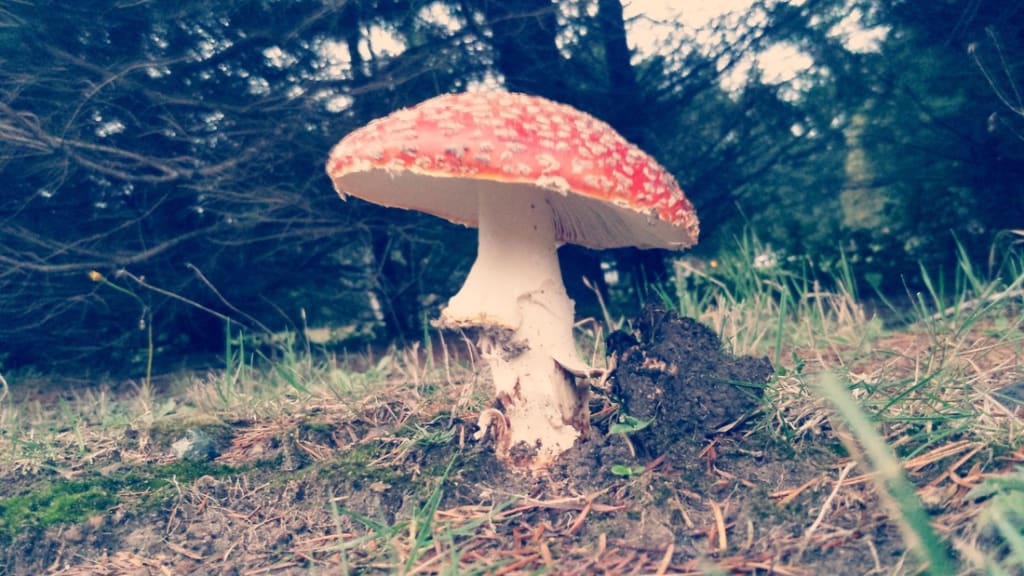
He held no recollection of the faery child, only from what had been written in the journal, which he knew to be mainly nonsense from what he could read. In winter while riding in a sleigh driven by Reindeer, he came upon bare footprints in the lazy snow which disappeared into a thick mound of white shrouding the phenomenon even further in obscurity that he could not begin to reasonably explain only that in the spring of the following year he would observe the reindeer following like a trail of bread crumbs the path of footprints he had discovered, and growing on that path were red fly agarics mushrooms, spotted white, leading into a meadow bursting with wild flowers, and at its center a faery ring. It was told in folk lore that if one inside such a ring on a misty morning they may see the spirits of old.
Deer would munch on these ornamental morsels as if there were truffles to swine and stumble through the forest in a daze. Village children would find and give them to their parents to dry slowly before a gentle fire to keep until the Solstice Celebration. For the festivities they would sometimes pattern their clothing by placing the caps, gills side down, to collect the pale snow white print left behind.
On silent nights, when the winds had died down, and the occasional lowing cry of a wolf would be heard outside, Linnaeus would lay in his chair in front of the fire, and upon drifting off to dreamland he would hear a voice, like a child’s calling through the fog of his distant thoughts. Never again did the faery child visit him. After his passing from this world and into the next, those who visited his graveside were always appalled by the eerie sight of red capped mushrooms growing round it.
In Lapland on still, cool nights when the snows have settled on the ground and the aura of lights are slithering across the Northern Sky, one can sense the magick in the atmosphere of solitude. The ancient spirits still exist in this land and frolic like the faeries of Irish folklore, forever enticing the young minds of wanderers to join them in their forest domain. Few have gone into the wilderness recollecting little but the sweet scent of a mountain meadow, and the grasses lit by chilled morning dew and sometimes glimpses of a golden haired lady.
If you venture out on a cool misty morn, and come across a patch of red capped mushrooms containing little white spots, and lie down within the circle, you too may hear the song of the forest.
About the Creator
Sierra Goddard
Just an artist who enjoys writing, crafts, and being in the outdoors; foraging and hiking with my mycophile husband and our pup Apollo. Along with freelance journalism, I hope to start an E-com business and become financially independent.
Keep reading
More stories from Sierra Goddard and writers in Futurism and other communities.
A Philosophy of Beauty
“The heart, like an empty canvas or a blank page, is a waiting to be filled with the desires that only dreams can inspire. A word of caution however, Dreamers, like the ever changing seas, may find their ship safely in port or dashed upon the rocks.”
By Sierra Goddard5 years ago in Futurism
About Binding Prometheus
I want to start actively advocating on behalf of my own work, and the most valuable part of my canon is, without a doubt, Binding Prometheus, the play I have been working on since 2019 and only finished in 2023 as part of my MA. The play itself is an amalgamation of a million different inspirations. On one end, it evokes the Ancient Greek myth-play, deriving its own title from the earliest extant work of Western drama we have, Aeschylus’s Prometheus Bound. On the other end, it borrows significantly from the sci-fi bulwarks from over the years, namely Mary Shelley’s Frankenstein and Karel Capek’s Rossum’s Universal Robots. The play could be an episode of Black Mirror, I fear. I don’t know. I’ve only ever seen one episode of Black Mirror.
By Steven Christopher McKnight20 days ago in Futurism
Egypt Office Furniture Market: Workspace Modernization, Corporate Demand & Growth Outlook
According to IMARC Group's latest research publication, Egypt Office Furniture Market size reached USD 229.52 Million in 2024. Looking forward, IMARC Group expects the market to reach USD 310.37 Million by 2033, exhibiting a growth rate (CAGR) of 3.31% during 2025-2033.
By Abhay Rajput6 days ago in Futurism



Comments
There are no comments for this story
Be the first to respond and start the conversation.