
LIFE ON PLANET MARS
Exploring the Potential for Life on Mars: Discoveries, Challenges, and Future Missions

Life on Mars has been a subject of great interest and speculation for many years. The possibility of life existing on Mars has captivated the imagination of scientists and the public alike. In this article, we will explore what we currently know about the potential for life on Mars and the efforts being made to search for it.
Mars is a rocky planet that is located in our solar system. It is the fourth planet from the Sun and is often referred to as the "Red Planet" due to its reddish appearance in the sky. Mars is a cold and dry planet, with a thin atmosphere that is mostly composed of carbon dioxide.
One of the most significant pieces of evidence suggesting the possibility of life on Mars is the presence of water on the planet. In recent years, scientists have discovered evidence of water in the form of ice at the planet's polar caps and in underground reservoirs. Water is essential for life as we know it, so the presence of water on Mars is an exciting discovery.
The discovery of water on Mars was made possible by NASA's Mars Reconnaissance Orbiter, which has been orbiting the planet since 2006. The orbiter carries a powerful camera that is capable of taking high-resolution images of the planet's surface. By studying these images, scientists have been able to identify features on the surface that suggest the presence of water.
In addition to the presence of water, scientists have also found evidence of organic molecules on Mars. Organic molecules are the building blocks of life, and their presence suggests that life may have existed or could potentially exist on the planet. The discovery of organic molecules on Mars was made by NASA's Curiosity rover, which has been exploring the planet's surface since 2012.

The rover discovered organic molecules in sedimentary rocks that are billions of years old. These rocks were once part of an ancient lakebed that existed on Mars billions of years ago. The discovery of organic molecules in these rocks suggests that Mars may have once been a more hospitable planet for life.
In addition to the presence of water and organic molecules, Mars also has several other factors that could potentially support life. For example, the planet has a similar day-night cycle to Earth, with a day that lasts around 24.5 hours. Mars also has a tilt similar to Earth's, which means that it experiences seasons.
Despite these promising factors, there is currently no concrete evidence of life on Mars. NASA and other space agencies have sent several missions to the planet to explore its surface and search for signs of life. So far, these missions have not yielded any conclusive evidence of life on the planet.

One of the challenges of searching for life on Mars is that the planet's surface is inhospitable to life as we know it. Mars has a thin atmosphere that does not provide much protection from cosmic radiation or the solar wind. The planet's surface is also cold and dry, with temperatures that can drop as low as -125 degrees Celsius.
Despite these challenges, there are still several strategies that scientists are using to search for signs of life on Mars. One approach is to search for biosignatures, which are signs of life that can be detected in the planet's atmosphere or on its surface. For example, if life exists on Mars, it may produce gases such as oxygen or methane that can be detected by spacecraft orbiting the planet.
Another approach is to search for evidence of past life on the planet. Scientists believe that Mars was once a warmer and wetter planet, and it may have been more hospitable to life in the past. By exploring the planet's surface and searching for signs of ancient water and other key ingredients for life, scientists hope to piece together a picture of Mars' past and whether life may have existed there.
In conclusion, the possibility of life on Mars is a topic that continues to fascinate scientists and the public alike. While there is currently no concrete evidence of life on the planet, the presence of water and organic molecules suggests that the potential for life to exist on Mars cannot be ruled out. As technology advances and our understanding of the planet improves, it is possible that we may one day discover that we are not alone in the universe.
About the Creator
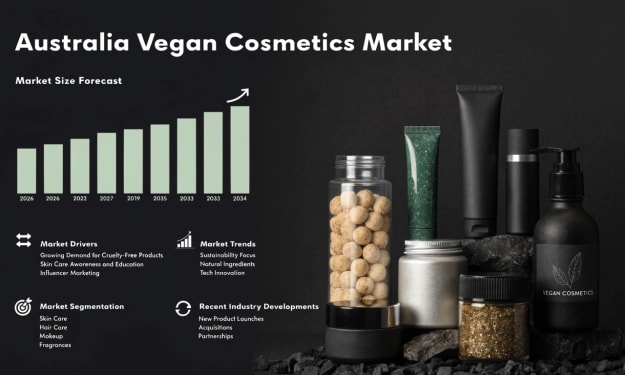
Australia Vegan Cosmetics Market: Ethical Consumerism, Product Innovation & Retail Growth
According to IMARC Group, the Australia vegan cosmetics market reached USD 552.7 Million in 2025 and is projected to grow to USD 1,073.0 Million by 2034, exhibiting a compound annual growth rate (CAGR) of 7.42% during 2026–2034. The market’s robust expansion reflects the rapid rise of ethical consumerism and clean beauty awareness across Australia. Increasing adoption of vegan lifestyles, heightened demand for ingredient transparency, and growing environmental consciousness are reshaping purchasing decisions. With innovation in plant-based formulations and strong digital retail growth, Australia vegan cosmetics market share continues to strengthen within the broader beauty and personal care industry.
By Shrestha Roy5 days ago in Futurism
SCADA Market Trends: Smart Manufacturing Shift, Edge Computing Integration & Forecast to 2034
Rising demand for industrial automation, the rapid integration of the Industrial Internet of Things (IIoT), and the increasing need for real-time data monitoring across critical infrastructure are driving the SCADA market growth. These systems are becoming essential for optimizing operations in the oil and gas, power generation, and water management sectors, where reducing downtime and increasing efficiency are top priorities. According to IMARC Group’s latest data, the global SCADA market size was valued at USD 22.8 Billion in 2025. Looking forward, IMARC Group estimates the market to reach USD 32.1 Billion by 2034, exhibiting a CAGR of 3.88% from 2026-2034.
By Andrew Sullivan5 days ago in Futurism



Comments
There are no comments for this story
Be the first to respond and start the conversation.