Latest Stories
Most recently published stories in Futurism.
Freeman Dyson's Vision of the Future
Professor Freeman J. Dyson has been discussing mind-boggling concepts in a calm, matter-of-fact, one-should-expect way since 1956. 'One should expect that within a few thousand years of its entering the stage of industrial development, any intelligent species should be found occupying an artificial biosphere which completely surrounds its parent star.' It is his hobby he says disarmingly, something that grew up alongside his career as one of the finest mathematical physicists of the last century. To his former colleagues at Princeton's Institute for Advanced Studies, Dyson was known for his understanding of what goes on in the core of a star or in the interaction of high-energy beams of subnuclear particles—contributions that earned him the American Institute of Physics' Heineman Prize and the Royal Society's Hughes Medal.
By George Gott9 years ago in Futurism
Is Technology Making Us Dumb?
It won’t be long before computers can think faster and better than humans. Artificial Intelligence exists, and it is getting smarter at an incredible rate. As so many focus on how well machines can think, alarmingly few people are concentrating on how well humans are thinking (or rather, how they aren’t thinking as well as they used to). A side effect of epic proportions has accompanied our ventures into superior technology. We have become inseparable from our computers and, as time goes on, we are relying on them for more and more of our daily cognitive functions. The brain needs exercise. When you don't use it often enough, your abilities deteriorate. The resources at our disposal are enabling us to perform more advanced tasks faster than ever before, but when it comes to plain old thinking, is technology making us dumb? The answer is two sided. On one hand, our ability to locate information is exponentially higher. On the other, we are retaining far less than we ever have.
By Chelsea Pullano9 years ago in Futurism
Carol Burnett's Captain Kirk Impersonation
American comedy can’t be neatly categorized into one absolute style, like the country from which it springs, it’s a big melting pot. From early, formative clowns such as The Marx Brothers, Milton Berle or Abbott & Costello, to the shock chuckles of Richard Pryor, Lenny Bruce, George Carlin and Chris Rock, American funny is a uniquely varied thing. However, it’s not only a boy’s club - one thing’s clear for awhile; we’ve been blessed with several of the funniest ladies history has ever known. There was lovable Lucille Ball, pioneer in the flexible art of the sitcom. Then came the outrageous Phyllis Diller, ground breaker in stand-up shtick. And then there's the comedy chameleon, Carol Burnett. Today’s funny ladies - Tina Fey, Kristen Wiig and Melissa McCarthy owe a lot to those original gals, but with Burnett, the modern sketch comedy we know today was basically shaped and fine tuned. If that wasn’t enough, Burnett has more than earned her ‘Geek Cred’, after she lampooned one of the most important sci-fi icons, none other than Captain Kirk. Carol Burnett's Captain Kirk impersonation is the original spoof on the iconic sci-fi figure portrayed by William Shatner.
By Will Stape9 years ago in Futurism
Chris Beckett's 'Dark Eden'
Chris Beckett’s Dark Eden highlights the evolution of narrative in a quiet coming-of-age story set on an alien planet with no sun. Often considered one of the best space colonization books, the novel spends much of its first half detailing the ways in which humans cope with life on a dark world. Light and warmth comes from “lantern trees,” which pump up hot liquid of some kind from the center of the planet. People hunt dark animals with green-grey meat. They measure time in “wombs” (the amount of time it takes for a baby to be born), as well as in “wakings” and “periods.” Words in Chris Beckett's Dark Eden universe have developed double meanings to make them emphatic, as language evolved from standard English. All five-hundred members of Family (as they are called) are descended from two humans who decided to stay on this strange planet, called Eden, and that the “Three Companions” made a risky attempt to return to Earth. Now, once a year (years are the Earth-time kept by the oldest members of Family), they gather to see the story of their origin acted out in drama, and to touch items from Earth.
By Futurism Staff9 years ago in Futurism
Star Wars Books for Kids
If you love Star Wars then chances are your children will or already do. So will their children, your grandchildren. These books are the perfect stories to read to kids after a long day of defending your individual galaxy. Star Wars has become so ubiquitous that it often gets on a kid’s radar long before they’re ready to actually see the movies or read the best Star Wars books. So, what’s a parent or grandparent to do when their 3-year-old wants to know everything there is to know about Darth Vader? Thankfully, the best Star Wars books for kids were created as kid-friendly stories that are sure to delight your little Jedi.
By George Gott9 years ago in Futurism
Scariest Sci-Fi Movies of the 90s
The US government reported that there were more alien invasions in the 1990's than any other decade. Of course, this was only in the movies. When it comes to scariest sci-fi movies of the 90s, fans enjoyed them because they were both frightening and satisfying. The combination of fear and science fiction proved to do well in the box office, but what did it do to our minds? Movies like Deep Blue Sea made our weariness of sharks even greater, while the 1990 film Hardware, made us second guess all of the ever-evolving technology that is all around us. Classic sci-fi horror films have a way of making us wonder, "Could this happen to us?" which is sometimes the most terrifying of all. And of course, as technology improves, so does the believability, which makes the sci-fi movies of the 90s even more terrifying than their predecessors.
By Lindsie Polhemus9 years ago in Futurism
Coolest Star Wars Aliens
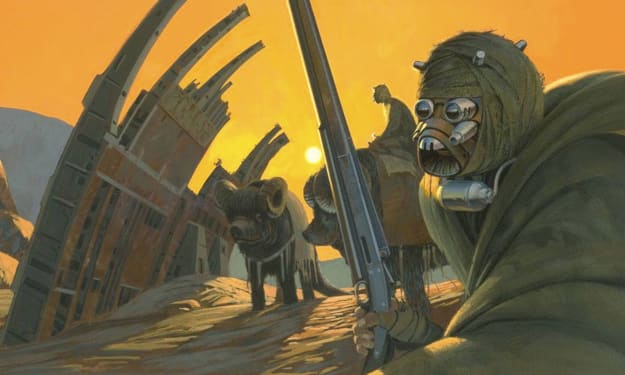
That galaxy far, far away wouldn’t be quite as special without the coolest Star Wars aliens we all know and love. Some of these aliens make a huge difference in Star Wars canon, affecting generations after them. Others on this list are just plain awesome and we enjoy seeing them in action. From the lovable and loyal Chewbacca to the unique crowd that gathers at the Cantina and even the Sith Emperor, the coolest Star Wars aliens are an important part of the Star Wars universe. Most of these Star Wars aliens are from the seven movies but a few of the lesser known ones come from Star Wars Legends, because every alien deserves a little recognition from time to time.
By Futurism Staff9 years ago in Futurism
The Five Holy Wounds of a Second Coming
9:00 am –– Thursday, April 14th 2033 There wasn't any room for the light. It could echo and bounce with no destination beyond entropic, move along little light. Presenter understood this, he felt most at home in the shadows, and their molesting reach dimming the flesh, dimming the speckled reminders. Pushing his sweat damaged linens off his gaunt frame, Presenter’s now upright body took aim at its beckoning stage. Joints cracked, or were they bones? Doesn't matter. He moved onwards, rising from the bed. The cracked and crusted eye sockets of his pale face were wiped and cleared, christened with the softness of the escaping sunlight. He wet his eyes with a yawn and unburdened himself with a throat clearing cough; reluctant to focus his sight, the parabolic flight of expulsion went unknown. Firmly composed, a blasé pace took Presenter over the refuse and across the threshold; entering the open concept kitchen, obeying his mandate.
By Joseph Somers9 years ago in Futurism
Octopus Facts
Researchers at the University of Chicago and a group at the Okinawa Institute of Science and Technology in Japan combined forces in the Octopus Genome Project. This huge undertaking maps out the entire DNA structure of this complex cephalopod. The Octopus facts, which were published in the science journal Nature, are simply incredible. Octopuses, not octopi, are so vastly different in their genetic makeup that they might as well be considered aliens from outer space. In uncovering the sequence, scientists found that octopuses have a significant expansion of a family of genes that play a role in neuronal development. A similar set of genes are found in humans, and until the Octopus facts were published, this gene expansion was believed to be a unique characteristic of vertebrates. Now, thanks to this research, we know that similar processes happened in octopuses.
By Stephanie Gladwell9 years ago in Futurism