Latest Stories
Most recently published stories in Futurism.
Finding Scorpius Constellation
Scorpius' claim to fame lies in its poisonous sting. The great hunter Orion boasted that he could wipe out all the creatures of the Earth. Gaia, the goddess of the Earth, realized how lonely our planet would be without the birds and beasts, so she sent a giant scorpion to attack the bragging hunter. In the terrible battle that followed, Orion killed the scorpion, but not before he was fatally stung.
By Futurism Staff10 years ago in Futurism
Most Terrifying Sci-Fi Books
Peanut butter and jelly. Hot rods and bikinis. Sci-fi and horror. Some things are meant to go together! Yet, while most of us are all too familiar with our two favorite genres mixing it up in motion pictures, it’s often under appreciated how well these types blend in book form. Together, we can correct that fault, by cherry-picking a few classics, blowing off the binary dust which has shamefully accumulated upon these wizened tomes, and gearing up to get our wits scared out of us!
By Matt Cates10 years ago in Futurism
Living in a Disconnected World
David Karp, a recent graduate from Cornell University, is part of the up-and-coming trend of initiative Millennials taking their careers by storm. In his visionary film Disconnected, Karp sees the world through a lens that we all find ourselves bound to: that of the screen. In a world where screen-time replaces human interaction, what does it mean to truly be alive?
By Natasha Sydor10 years ago in Futurism
Pioneers of Astronomy
Nicholas Copernicus once said “The massive bulk of the earth does indeed shrink to insignificance in comparison with the size of the heavens." While we may attribute our knowledge of the solar system and astronomy to modern day telescopes, space shuttles, and space probes, it is important to remember that the size of the heavens would not even be discovered without the pioneers of astronomy. From Nicholas Copernicus and Albert Einstein to astronauts and space organizations like NASA, the pioneers of astronomy have laid down an important foundation for which exploration of the stars today is firmly rooted.
By Futurism Staff10 years ago in Futurism
Jacques Vallee Interview
"When I was beginning my career in science," recalls Dr. Jacques Vallee, "the main argument against UFOs was that astronomers never saw them. I found that argument convincing." Then, in 1961, he and other satellite trackers at the Paris Observatory detected something odd overhead. Stranger still was what happened after that: The project director erased the data tape before an orbit for the unidentified object could be computed. "I thought, here we are at a renowned institution, seeing something we can't explain and destroying data for fear of ridicule. That, for me, reopened the entire question."
By Futurism Staff10 years ago in Futurism
Observatory Guide
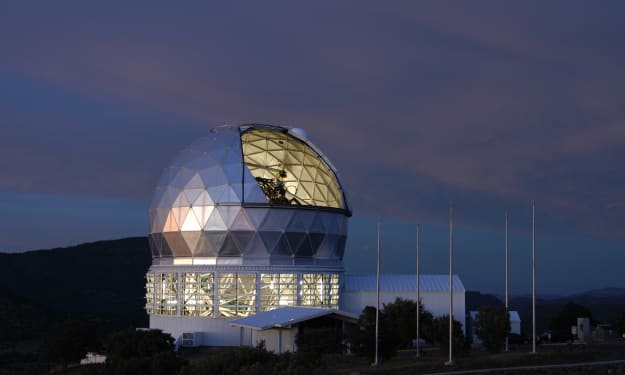
There are few pastimes more fascinating, more mysterious, or more peaceful than simply stargazing at a splendid night sky—wondering what it all means. Will we ever travel to any of those other suns? Are there other souls like us on a distant planet, looking up and wondering the same? A special breed of investigator is devoted to finding the answers to some of these questions, by studying everything in the universe from the movement of planets to the nature of such bizarre objects as quasars and black holes, which explode or go beep in the night. That investigator is the astronomer.
By Futurism Staff10 years ago in Futurism
Time's Role in Science Fiction
What is time? In our world, it represents a concept, unit, choice, and even a dimension. In the science fictional universe, it represents all of these concepts elevated into an all encompassing one. Time finds itself as a necessity in that nothing could exist without it––a statement that we cannot fathom because we have never experienced it. Writer Charles Yu claims in his novel, How To Live Safely in a Science Fictional Universe, that “time is an ocean of inertia.”
By Natasha Sydor10 years ago in Futurism
Voyager 2's Expedition
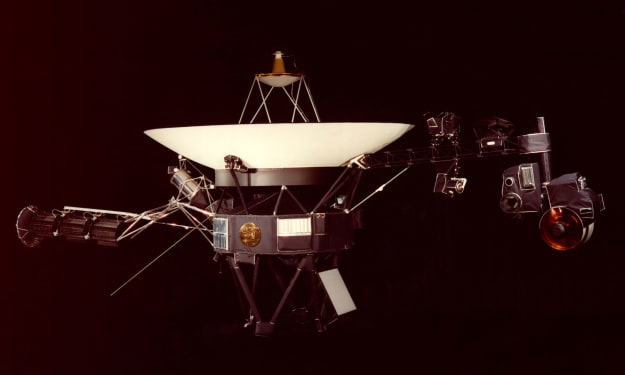
It weighs almost a ton and measures approximately four meters by four meters. Its two television cameras take tens of thousands of pictures of worlds in the outer solar system. A collision with a micrometeoroid could cause it to lose its orientation temporarily, but it wouldn't founder. It is made of millions of parts. If certain components fail, others will take over. We're talking about the fantastic Voyager 2, the semi-intelligent robot that, for nearly 40 years, has explored unknown worlds.
By Futurism Staff10 years ago in Futurism
Most Underrated Sci-Fi Movies. Top Story - June 2016.
Everyone’s been to the classic Hollywood summer blockbusters; We’ve munched popcorn through the whole Terminator series, slurped over-iced $10 sodas throughout the Men In Black movies, cringed and laughed during Aliens, E.T., and Back to the Future. We’ve stood (for longer than we should have) in those opening day lines for all the Star Wars and Star Trek films. We’ve checked out the new Planet of the Apes franchise, nodded approvingly (for the most part) at additions like Oblivion, Edge of Tomorrow, and Interstellar to our beloved genre. But many of the most creative sci-fi motion pictures flame out fast on very limited runs on a small number of screens. Must these glittering gems of imagination go unrecognized forever? Nope; Not in this day and age of online streaming!
By Matt Cates10 years ago in Futurism