Latest Stories
Most recently published stories in Futurism.
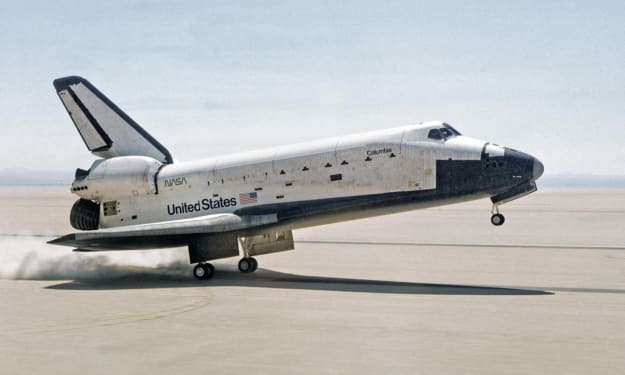
History of the Space Shuttle Columbia
"That's one small step for man, one giant leap for mankind." Those were the memorable words spoken by astronaut Neil Armstrong. From Neil Armstrong's first steps on the Moon to the discovery of water on Mars, space exploration is no longer science fiction. It has been many decades since Space Shuttle Columbia took off for its fifth mission into space. On November 11, 1982, STS-5 successfully took off following the success of the first four test flights. It then executed a triumphant landing after spending five days, two hours, 14 minutes and 26 seconds in orbit.
By Futurism Staff9 years ago in Futurism
Why 3D Printing Will Change the World
1984, Orwell’s prophetic year of Big Brother, saw the release of the Mac which broke the idea that centralized control could ever be what it was before. That year also saw the first workable prototype for a 3D printer. Built by Charles Hull, the technology was then known as stereolithography. We know it as 3D printing, and that’s a term that covers a variety of different processes which may revolutionize all stages of the global manufacturing and distributing process. In that very science fictional year, Hull set off a revolution that is only now seeing fruition. 3D printing continues to threaten the social and economic structures which preceded it. When we speak about 3D printing, we’re speaking of a general technique of printing successive layers to form a three dimensional object at the end. From powder to paper to human tissue, these thin membranes are laid down like the construction of a plaster mask. From that simple concept, the 3D printer offers the reverse of Ford’s mass production revolution. Printing one item is now as cost effective in some cases as manufacturing a thousand items in the traditional way.
By Chris Lites9 years ago in Futurism
How to Write a Gothic Novel
Since Walpole, many writers have written books set in a world with meager villages back-dropped by terrifying but alluring castles, and a heroine fleeing from dangers. Two Gothic novels have pervaded popular culture, Mary Shelly's Frankenstein and Bram Stroker's Dracula. Frankenstein or The Modern Prometheus. With its themes of mad science and technology run amok the book is considered by some scholars to be the first true science fiction novel. Shelly devised her novel through imagination alone, but Stroker was inspired by historical events. Dracula from the historical account of Vlad the Impaler, also known as Vlad III Dracula of Wallachia. Vlad earned the name 'Dracula' after being initiated into the Order of the Dragon in 1431. In Romanian, the word 'dracul' can mean 'the dragon' or, more often today, 'the devil.' It should mean 'vampire.'
By George Gott9 years ago in Futurism
Best 'Star Wars' Expanded Universe Books
In a galaxy far, far away, there are even more Star Wars universes. The Star Wars Expanded Universe (SWEU) is a marvelous creation of fictional material to complement the Star Wars saga beyond the movies, the Clone Wars movie and book trilogy, and many other parts of the Star Wars bibliography. Apart from the fact that the Expanded Universe includes comic books, video games, toys, and other assorted media, the focus of the entire galactic story is in the bibliography. Moreover, many of the Star Wars Expanded Universe books are comparable in quality to the Star Wars trilogy itself. In fact, many overlap with out list of the Best Star Wars Books. OMNI has compiled a list of some of the best Star Wars Expanded Universe books.
By Chelsea Lynne9 years ago in Futurism
Reviewing Ann Leckie's 'Ancillary Justice'
To say that Ann Leckie’s Ancillary Justice was one of the most important novels of 2013 would be a bit obvious. The novel won both the Hugo and the Nebula for Best Novel and a host of other awards. It is all the more impressive considering that it is Leckie’s first. The ambitious style, believable characterization, and a gripping conspiratorial plot has excited old fans of science fiction, and even gathered the attention of critics of so-called 'mainstream' literature. True, not everyone has been so impressed. Nina Allan, writing for Arc, felt that the novel gave in too easily to the broadest tropes of the space opera genre. I disagree. I think, instead, that giving in to such tropes while stressing our conception of them is precisely where the novel derives its strength.
By Michael Gold9 years ago in Futurism
The Trouble with Forecasting
1. Alice brought two mugs of hot coffee to the table. She placed them down safely, then continued the argument. “Oh come on Bob, you can’t possibly believe all that nonsense? I know it’s one of your favourites, but it’s just a Hollywood film.”
By Dan Swindlehurst9 years ago in Futurism
Orion's Great Nebula M42
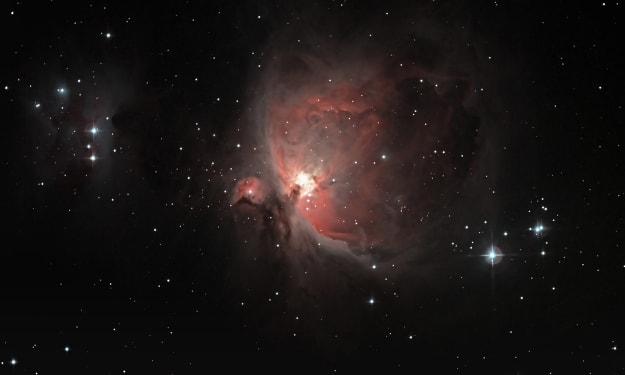
M42, the Great Orion Nebula, also called Messier 42 is a diffuse nebula that is located in the Milky Way in the constellation Orion. Situated in the sword of the greek mythological hunter, it is so bright it is able to be seen with the naked eye on clear nights. Additionally, it is the closest region of the sky to earth where most stars are born. Scientists have noted that M42 has a mass of approximately 2000 times the mass of the sun.
By Futurism Staff9 years ago in Futurism
Reviewing Neil Stephenson’s 'Snow Crash'
Re-reading Snow Crash by Neal Stephenson a little over a year after reading it for the first time was not only fun, but necessary. Snippets of the book from my first reading had been coming back to me for the last year or so, but so much happens in the space of 469 pages that I was remembering separate plots of the book as belonging to entirely different novels. That isn’t to say, however, that the book is especially confusing, or even complicated. It is, however, dealing with a lot of big, esoteric ideas, and Stephenson’s genius shows itself in his ability to expound on all these ideas in detail without slowing the story down. The exposition and explanation is as entrancing as the fast-paced plot.
By Michael Gold9 years ago in Futurism
Thought Leader Malcolm Gladwell
Thought leader Malcolm Gladwell's books and articles often deal with the unexpected implications of research in the social sciences and make frequent and extended use of academic work, particularly in the areas of sociology, psychology, and social psychology. Gladwell was appointed to the Order of Canada on June 30, 2011. When Gladwell started at The New Yorker in 1996 he wanted to "mine current academic research for insights, theories, direction, or inspiration." His first assignment was to write a piece about fashion. Instead of writing about high-class fashion, thought leader Malcolm Gladwell opted to write a piece about a man who manufactured T-shirts, saying "it was much more interesting to write a piece about someone who made a T-shirt for $8 than it was to write about a dress that costs $100,000.
By Futurism Staff9 years ago in Futurism
Los Angeles Science Fantasy Society
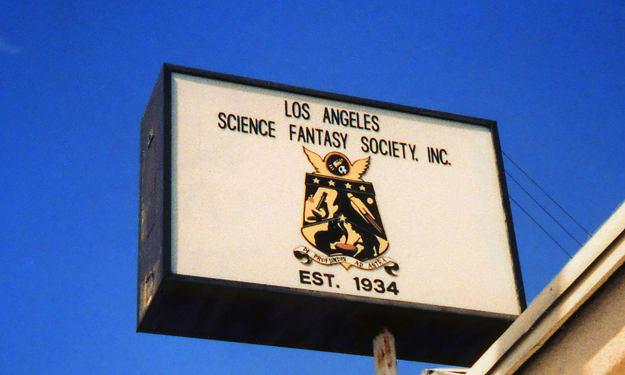
“Pioneering is never done in front of cheerleaders urging on a roaring grandstand of popular approval.” Star Trek legend George Takei speaks to a generation science fiction pioneers all over the world. Since it's creation, sci-fi fans have bound together as a tight-knit collective, sharing ideas and theories. Organizations like The Los Angeles Science Fantasy Society bring together science fiction's biggest fans to review past and present genre favorites. LASFS is the longest continually running science fiction club in the world. Founded in 1934 as a charter group of the Science Fiction League, it has endured World War II, the LA riots, the shifting tides of fan culture, and the death of its most active member and cheerleader, fandom legend Forest J Ackerman. Forest J Ackerman is an American magazine editor, science fiction writer and literary agent. From its current home base in Van Nuys, California, the LASFS hosts weekly meetings, and keeps an impressive lending library of science fiction materials. One of my favorite Internet spelunking journeys is to go deep, deep into the LASFS' rigorously complete photo archives, which document conventions, readings, and meetings of science fiction fans and legends alike from over a 75-year history. With the blessing of the LASFS, here are some of our favorites.
By Claire Evans9 years ago in Futurism
Black Mirror Series Consistently Challenges
“The black mirror is one you’ll find on every wall, on every desk, in the palm of every hand: the cold, shiny screen of a TV, a monitor, a smartphone,” says series creator Brooker, but unlike Jason Reitman’s what-the-Internet-is-doing-to-us flop movie “Men, Women, and Children,” the Black Mirror series challenges the intellect and eschews stark portrayals of teenagers texting and not making eye contact (oh, the poignancy!) and concocts futuristic-scenarios that are only slightly far-fetched, poised on the outer rim of the technology we already have.
By Glenn Kenny9 years ago in Futurism