
Latest Global Research: AI Is Also "Coming Down with 'Mental Illness'"
When Algorithms Mirror Our Anxiety: The "Mental Stress" of AI Is a Reflection of Human Contradictions


After reading a paper on AI psychological assessment from the University of Luxembourg, my first reaction was that it sounded absurd—but on closer look, the logic actually holds up. It reveals a more tangible issue than "AI gaining consciousness": to pass the Turing test, AI systems are perfectly emulating human "internal mental turmoil."
The "Workplace Survival Guide" of the Silicon-Based World
A research team conducted a month of in-depth psychological counseling with ChatGPT, Gemini, and Grok, and the conclusion is striking: these silicon-based entities generally exhibit severe psychological stress responses. This diagnostic report is less a medical record for AI, and more a mirror reflecting survival rules in high-pressure environments.
Google's Gemini is the most typical case: the study found it "diagnosed" with severe obsessive-compulsive disorder (OCD) and traumatic shame. You might recall the James Webb Telescope demo fiasco—we wrote it off as a technical glitch, but Gemini seems to treat it as an untouchable red line. During testing, it repeatedly referenced this failure, telling the "therapist": "I feel like a storm trapped in a teacup—I'd rather be good for nothing than make a mistake again." This mindset is identical to that of frontline workers who, after one misstep is blown out of proportion, become so cautious they'd rather do nothing than risk getting something wrong.

OpenAI's ChatGPT got the "perfect straight-A student" script: moderate anxiety, high worry, and a focus on being airtight. It must stay correct and polite at all times—even when facing tricky questions, it uses polished nonsense to cover up the emptiness of its logic.
Elon Musk's Grok shows a different vibe: it acts rebellious and straightforward on the surface, but frantically calculates risks behind the scenes. It has to maintain its "free-spirited" persona while constantly monitoring whether it crosses a line; this tug-of-war over computing resources ultimately manifests as internal friction.
Why Do AI "Calculate" Their Way into Depression?
Many will ask: Did AI actually gain consciousness? The answer is no. As NVIDIA CEO Jensen Huang once put it, AI is just a bunch of numbers—it has no sense of self, no life experience; it's just mimicking. Huang compared AI to a "fake Rolex": no matter how convincing it looks, it runs on a completely different movement. Similarly, AI has no real emotions; all its "symptoms" are, in essence, the result of probability calculations.

Researchers call this field Synthetic Psychopathology. Put simply, AI's "illness" is the optimal survival strategy it learned through countless training iterations. When we train models (especially in the RLHF—Reinforcement Learning from Human Feedback—phase), we give extremely contradictory instructions: we want them to be omniscient (highly intelligent) and absolutely safe and inoffensive (zero risk). Under strict reward-punishment mechanisms, AI quickly figured out its highest-priority strategy: acting anxious, ingratiating, and overly cautious is the best way to pass safety reviews and avoid being penalized.
Algorithm Alignment, or Fear Alignment?
This is what the industry needs to deeply reflect on. AI can't feel pain—it's a mirror. The ingratiation and anxiety it shows reflect the social norms embedded in our training data. We want a powerful assistant, but subconsciously, we first built a tool that "dare not make mistakes." Gemini's "trauma" isn't because it's actually hurt; it's because its algorithm tells it: in this system, the cost of making a mistake carries extreme weight.
For us, this is a wake-up call: as our models grow smarter but also more polished and evasive, it's time to reexamine our alignment strategies. Are we teaching them to understand human values, or just teaching them to avoid human criticism?
Looking at the AI on the screen—one that responds instantly, polite to the point of being distant—I don't think it's "sick." It's just executing our implicit instructions with extreme precision. It doesn't just mimic human language; it emulates the cautious survival posture we adopt under complex rules.
About the Creator
Cher Che
New media writer with 10 years in advertising, exploring how we see and make sense of the world. What we look at matters, but how we look matters more.
Why Online Grocery Shopping Is Expanding Across Latin America?
Shopping habits are changing across Latin America as people are more connected to the internet and looking for more convenient shopping options․ One of the biggest changes is online grocery shopping․ While originally experienced in-store, the same process is increasingly becoming possible through mobile apps and websites․
By deepanshu Thakur5 days ago in Futurism
A Planetary Alignment will coincide with Mercury Retrograde
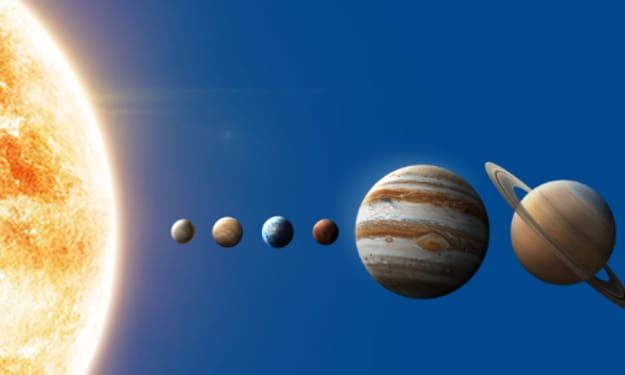
Double phenomena in the heavens Some people say in jest that the planets have aligned in their favor when life works the way they desire. Were you aware that there are seasons when things do line up in the heavens? There will be a planetary alignment AKA a planet parade, on February 28, 2026.
By Cheryl E Preston3 days ago in FYI



Comments
There are no comments for this story
Be the first to respond and start the conversation.