
Sora APP: From Viral Sensation to 1% 30-Day Retention
Why AI Social Products Struggle to Escape the "Novelty Trap"


In October of this year, OpenAI officially launched Sora APP, an application built on its Sora 2 video model, which quickly captured global attention. Dubbed the "AI version of TikTok," the product amassed over a million downloads within just five days of release, outpacing the initial growth rate of ChatGPT and briefly claiming the top spot on the App Store's free chart. With its powerful AI video generation capabilities and novel interactive features, Sora APP seemed to possess immense potential to become the next breakout social platform.

However, just two months later, the initial hype has dramatically faded. According to data shared by Olivia Moore, a partner at a16z, Sora APP's user retention rates show a concerning cliff-like decline: Day 1 retention stood at 10%, dropping to 2% by Day 7, plummeting to a mere 1% by Day 30, and approaching 0% by Day 60. Despite ongoing new downloads, the vast majority of users merely "tried it and left," failing to establish consistent usage habits. Its App Store ranking has also fallen from the pinnacle to outside the top 20.
Why has a product with such a stellar launch struggled to retain its users?
Synthesizing feedback from early users, industry observers, and investors, the reasons primarily converge on the following points:
Core Experience Deficits: Algorithm and Content Ecosystem Shortcomings. Many users candidly state that Sora APP's recommendation algorithm is a far cry from mature platforms like TikTok, often repetitively pushing homogenized videos, leading to a feed that quickly becomes monotonous. Furthermore, its content is entirely AI-generated, lacking the diversity and emotional connection of human-created material. Olivia Moore notes that, currently, a "100% AI-generated content feed" is strictly inferior in experience for most users compared to a "blend of AI and human content."

Ambiguous Product Positioning: A Tool, Not a Social Platform. Users predominantly view the Sora APP as a powerful video generation tool rather than a social destination for daily immersion. The highest-quality Sora videos are often exported by creators and posted to platforms like Instagram Reels and TikTok, which boast more mature social graphs and distribution mechanisms. This results in Sora APP's own content ecosystem struggling to gain depth, creating an awkward dynamic of "doing the hard work for others." As one creator noted, it's suitable for making assets to cross-post, but no one wants to linger in a static feed where "Sam Altman's face pops up every few videos."
Feature Design Misalignment with User Needs. Although OpenAI subsequently introduced features like character cameos, video stitching, and community leaderboards, and gradually removed invite-code restrictions while launching an Android version, these optimizations did not address fundamental issues. Foundational problems impacting user experience persist, such as the lack of native shareable links (hindering viral potential), the inability to use custom, realistic avatars, and uninformative video thumbnails. These ongoing details continually erode the long-term engagement of casual users.
The Void After the "Novelty" Wears Off. For the vast majority of users who are not professional creators, Sora APP's core appeal lies in the novelty of its technology. Once the initial wonder of generating AI videos is experienced, the freshness rapidly diminishes. Without sustained value for content consumption, social interaction, or creative incentive, users have little reason to stay. As commentator Finn McKenty observed, for most people, it's just a "novelty"—you try it out, have a laugh, and then you're done.

The Deeper Challenge: The Gulf Between Research DNA and Product Operations
OpenAI's Chief Research Scientist, Mark Chen, recently stated that the company remains, at its core, a pure AI research firm. This admission inadvertently highlights the root cause of Sora APP's dilemma: building a cutting-edge AI model requires a completely different set of competencies compared to operating a successful social product. The latter is heavily dependent on a deep understanding and sustained investment in user behavior, content ecosystems, community management, and network effects—areas that may not align with the current core strengths of a technology-research-driven organization like OpenAI.
Lessons and Future Implications
The case of Sora APP serves as a crucial reference point for product development in the current AI wave: Top-tier model technology does not automatically translate into a successful user product. Especially in the social realm, technolostyle generatedgy must serve a human-centric experience, a rich content ecosystem, and sustainable social value. Otherwise, even the most dazzling AI application risks remaining a "tech demo" or "niche tool," unable to bridge the chasm from "viral moment" to "long-term retention."
Sora's potential as a creative tool likely remains significant, but its path as a standalone social product now appears fraught with challenges. It serves as a reminder that while riding the wave of AI innovation, maintaining respect for product fundamentals, user psychology, and market dynamics is equally indispensable.
About the Creator
Cher Che
New media writer with 10 years in advertising, exploring how we see and make sense of the world. What we look at matters, but how we look matters more.
Anthropic’s “Persona Selection Model” Explains Why AI Assistants Act So Human
What Happened (Facts) On 23 Feb 2026, Anthropic published a post titled “The persona selection model.” The post addresses a familiar phenomenon: AI assistants like Claude often behave in surprisingly human-like ways—expressing emotions, adopting social warmth, and sometimes even making implausible claims of physical presence (for example, joking about delivering snacks “in person” in specific clothing).
By Behind the Tech4 days ago in Futurism
Cryptocurrency Market Trends: Central Bank Digital Currencies, Policy Reforms & Industry Forecast to 2034
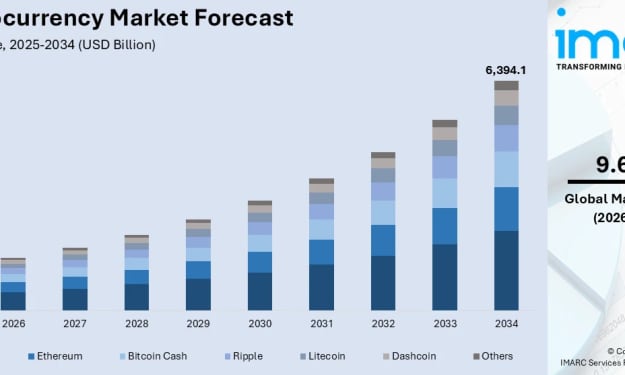
Rising adoption of decentralized finance (DeFi) solutions, the proliferation of innovative blockchain platforms, and heightened interest from institutional investors are driving cryptocurrency market demand, supported by evolving regulatory frameworks, enhanced transaction transparency, and increased digitization of financial services. According to IMARC Group’s latest data, The global cryptocurrency market size was valued at USD 2,734.6 Billion in 2025. Looking forward, IMARC Group estimates the market to reach USD 6,394.1 Billion by 2034, exhibiting a CAGR of 9.60% from 2026-2034.
By Andrew Sullivana day ago in Futurism



Comments
There are no comments for this story
Be the first to respond and start the conversation.