
Language Services Market Size and Forecast 2025–2033
How Globalization and AI Are Transforming the World’s Multilingual Communication Industry


Introduction: A Multilingual World Entering a New Era
The global Language Services Market, valued at US$ 78.12 billion in 2024, is undergoing one of the most significant transformations in its history. According to Renub Research, the sector is expected to grow to US$ 131.75 billion by 2033, registering a steady CAGR of 5.98% from 2025 to 2033. This rising demand is powered by globalization, digital expansion, international migration, and the rapid adoption of AI-driven translation and localization technologies.
As companies expand across borders and digital platforms reach new audiences, language is no longer simply a communication tool—it is a business asset. From healthcare to e-commerce, from government to entertainment, the need to communicate effectively across different cultures and languages has never been more urgent.
This article dives deep into the market overview, growth drivers, challenges, industry segments, regional insights, and competitive landscape shaping the future of this fast-evolving market.
Language Services Market Overview
Language services encompass a wide range of professional solutions designed to facilitate communication across linguistic and cultural barriers. Key components include:
Translation services
Interpretation services (onsite, remote, and telephonic)
Localization (websites, apps, video games, software)
Transcription
Content adaptation and editing
Language learning and training
In an interconnected world, the value of these services cannot be overstated. They support:
Global business expansion
Accurate medical communication
Legal and regulatory compliance
Seamless customer experience across languages
Cultural sensitivity in entertainment and advertising
Industries like IT, healthcare, legal, automotive, telecom, and e-commerce rely on language solutions not just for clarity but for safety, compliance, and effective global engagement.
Key Growth Drivers in the Language Services Market
1. Globalization and Cross-Border Trade
As commerce becomes increasingly global, language services have become essential infrastructure for international business. Companies expanding into new regions require:
Translated websites
Localized product manuals
Multilingual customer support
Region-specific marketing materials
Globalization has also diversified domestic populations. The U.S., for example, has seen the number of people speaking a language other than English at home rise to 67.3 million—double the number from 30 years ago. The U.S. Bureau of Labor Statistics projects a 19% growth in interpreter and translator employment by 2028, reinforcing the rising demand for multilingual solutions.
Industries most reliant on these services include:
E-commerce
Tourism
Banking and finance
Manufacturing
Supply chain and logistics
Cross-border trade is no longer feasible without accurate and culturally appropriate communication, making the language services sector indispensable.
2. Technological Advancements in AI and Machine Translation
The integration of AI, machine learning, and neural machine translation (NMT) has fundamentally changed the language industry landscape. Innovations like:
Real-time AI transcription
Automated subtitle generation
AI localization assistants
Hybrid machine-human translation workflows
Multimodal AI models (voice + text + image)
have increased both the speed and scale of multilingual content production.
In 2024, AI-powered translation startup DeepL raised US$ 300 million, reaching a $2 billion valuation, signaling strong investor confidence in AI-driven language solutions. More U.S. and European enterprises are adopting automated translation workflows to reduce costs and increase output.
This shift does not replace human experts—but enhances their efficiency—leading to a hybrid model that is reshaping the market's economics.
3. Rising Demand in the Healthcare and Legal Industries
Healthcare and legal systems rely heavily on precision. A mistranslated phrase or misunderstood term can lead to significant consequences.
In healthcare, interpreters and translators help bridge communication barriers between patients and providers, particularly in emergency care, immigration-heavy regions, and telehealth services. In November 2024, the ACGME introduced the Language Equity in Health Care Toolkit, in partnership with major medical associations, to promote improved language access in medical education and practice.
In the legal sector, accuracy is equally critical when translating:
Court documents
Immigration papers
Contracts
Compliance documentation
The complexity of these industries ensures that demand for highly specialized human linguists will remain robust despite technological advancements.
Market Challenges
1. High Cost of Specialized Services
Despite technological support, specialized translation—in medical, legal, and technical domains—remains expensive. The need for certified linguists, accuracy guarantees, and sector expertise increases operational costs.
Smaller businesses often struggle to afford these services, creating a gap in industry accessibility.
2. Cultural and Linguistic Complexities
Language is deeply tied to culture, emotion, and context. Even with AI advancements, nuances like tone, idioms, humor, and cultural references require human expertise.
Misinterpretation can lead to:
Brand reputation damage
Legal disputes
Miscommunication in healthcare
Cultural misunderstandings
The shortage of linguists with deep cultural knowledge remains a core challenge for the market.
Industry Breakdown: Key Segments
Language Translation Services Market
Translation remains the backbone of the industry. Demand is soaring for:
Website translation
Legal document translation
Technical manuals
Academic and scientific translation
Marketing localization
As machine translation grows more sophisticated, hybrid workflows (AI + human editing) are making translation faster and more affordable.
Language Interpretation Services Market
Interpretation—both real-time and scheduled—has expanded dramatically due to video conferencing and remote work. Key segments include:
Simultaneous Interpretation
Consecutive Interpretation
Video Remote Interpreting (VRI)
Over-the-Phone Interpretation (OPI)
VRI has become particularly popular, improving accessibility and reducing travel costs.
IT & Telecommunications Language Services Market
The tech and telecom sectors require continuous localization due to global product releases. Services include:
Software localization
Mobile app localization
IT support in multiple languages
Technical documentation translation
As technology integrates into everyday life, demand from this sector continues to rise rapidly.
Government Language Services Market
Government agencies use translation for:
Public service announcements
Diplomatic communication
Immigration documents
Citizen engagement
A major development in 2024 was the U.S. Department of Homeland Security announcing its first Indigenous Languages Plan, expanding language access for Latin American Indigenous populations.
Healthcare Language Services Market
Healthcare relies on accurate language services to ensure:
Equal treatment
Compliance with federal regulations
Improved patient outcomes
Global migration trends and telehealth expansion are accelerating growth in this segment.
Regional Insights
United States
The U.S. remains one of the largest markets globally, driven by:
High linguistic diversity
Strong healthcare and legal demand
Presence of global tech companies
Widespread adoption of AI translation tools
United Kingdom
With its strong financial, legal, and healthcare sectors, the U.K. commands a significant market presence. In December 2024, Espresso Translations launched a new digital platform to streamline translation queries and document uploads, reflecting rising demand for tech-enabled solutions.
India
India's rapid digitalization and multilingual population make it one of the fastest-growing markets. The government’s BharatGen initiative—an ambitious multimodal AI project for Indian languages—is expected to strengthen domestic AI language ecosystems and boost service demand across industries.
Saudi Arabia
Under Vision 2030, Saudi Arabia is transforming into a global trade and tourism hub. The Saudi LPTC's 2024 participation at the Guadalajara International Book Fair reflects its commitment to global cultural presence.
Market Segmentation
By Service:
Translation Services
Interpretation Services
Others
By Application:
IT & Telecommunications
Commercial
Government
Automotive
Healthcare
Others
Regions Covered:
North America, Europe, Asia-Pacific, Latin America, Middle East & Africa (detailed country list included in your original brief).
Competitive Landscape
The global language services market includes leading players such as:
Global Linguist Solutions, LLC
Hogarth Worldwide
Keywords Studios plc
LanguageLine Solutions (Teleperformance)
Lionbridge Technologies, Inc.
Mission Essential Personnel
SDI Media Group Inc.
Mitsubishi TransPerfect Solutions
These companies focus on AI integration, global expansion, strategic acquisitions, and advanced linguistic technologies.
Final Thoughts
The Language Services Market is not just growing—it’s evolving. As globalization intensifies and businesses chase new audiences, the demand for multilingual communication will only expand. AI will accelerate workflows, but human expertise will remain irreplaceable, especially in specialized domains.
From healthcare to entertainment, from diplomacy to e-commerce—the world increasingly depends on accurate and culturally sensitive language solutions. As the market moves toward US$ 131.75 billion by 2033, it stands at a unique intersection of technology, culture, and global opportunity.
About the Creator
Sushant. Renub Research
I’m Sushanta Halder, Digital Marketing Manager at Renub Research with 15+ years in SEO, content, PPC & lead generation. Passionate about data-driven growth strategies.
Keep reading
More stories from Sushant. Renub Research and writers in Futurism and other communities.
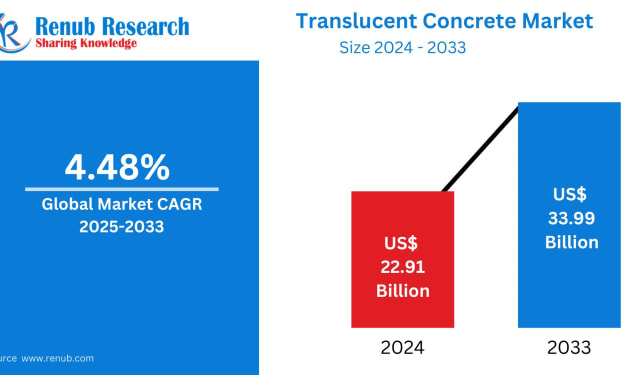
Translucent Concrete Market Forecast and Size (2025–2033)
Introduction The global construction sector is entering a new era—one where sustainability, energy efficiency, and visual innovation are no longer optional but essential. Among the materials leading this transformation is translucent concrete, a next-generation solution combining the robustness of concrete with the light-transmitting properties of embedded optical fibers and resin. Once considered experimental, translucent concrete is now emerging as a mainstream architectural asset shaping the future of modern buildings, interiors, and urban infrastructure.
By Sushant. Renub Research2 months ago in Futurism
About Binding Prometheus
I want to start actively advocating on behalf of my own work, and the most valuable part of my canon is, without a doubt, Binding Prometheus, the play I have been working on since 2019 and only finished in 2023 as part of my MA. The play itself is an amalgamation of a million different inspirations. On one end, it evokes the Ancient Greek myth-play, deriving its own title from the earliest extant work of Western drama we have, Aeschylus’s Prometheus Bound. On the other end, it borrows significantly from the sci-fi bulwarks from over the years, namely Mary Shelley’s Frankenstein and Karel Capek’s Rossum’s Universal Robots. The play could be an episode of Black Mirror, I fear. I don’t know. I’ve only ever seen one episode of Black Mirror.
By Steven Christopher McKnight14 days ago in Futurism
Power Cables Market: Transmission Efficiency, Cable Innovations & Regional Development Projects
According to IMARC Group's latest research publication, global power cables market size reached USD 186.5 Billion in 2025. Looking forward, IMARC Group expects the market to reach USD 289.9 Billion by 2034, exhibiting a growth rate (CAGR) of 4.98% during 2026-2034.
By sujeet. imarcgroup7 days ago in Futurism


Comments
There are no comments for this story
Be the first to respond and start the conversation.