
Japanese Scientist Wins Nobel Prize for cancer
Japanese Scientist Wins Nobel Prize for Discovering How the Body Eats Its Own Damaged Cells


In 2016, Japanese cell biologist Yoshinori Ohsumi was awarded the Nobel Prize in Physiology or Medicine for his groundbreaking discovery of how cells “eat” themselves to survive — a process known as autophagy. His work revolutionized the understanding of how living cells maintain their health by recycling their own components, shedding light on fundamental mechanisms that influence everything from aging and immunity to cancer and neurodegenerative diseases.
The Discovery of Autophagy
The word autophagy comes from the Greek words auto (self) and phagein (to eat), literally meaning “self-eating.” It describes the process by which cells break down and reuse their own damaged or unnecessary parts. This remarkable system allows cells to survive during times of stress, such as starvation, by recycling proteins and other cellular materials into energy.
Although scientists had observed the phenomenon of autophagy in the 1960s, its molecular mechanisms remained largely mysterious for decades. That changed in the 1990s when Yoshinori Ohsumi, then a researcher at the Tokyo Institute of Technology, turned his attention to the problem. Working with baker’s yeast (Saccharomyces cerevisiae) — a simple model organism — Ohsumi conducted ingenious experiments that made it possible to identify and study the genes involved in autophagy.
By genetically modifying yeast cells and observing how they responded under nutrient-starved conditions, Ohsumi pinpointed the key genes that control this recycling process. He demonstrated that autophagy is not merely a random act of destruction but a carefully regulated mechanism essential for maintaining cellular balance. His findings revealed the genetic and biochemical steps by which cells enclose damaged components in a double-membrane structure known as an autophagosome, which then fuses with a lysosome — the cell’s recycling center — where the waste is degraded and repurposed.
From Yeast to Humans
What made Ohsumi’s discovery truly revolutionary was that the same genes and processes he found in yeast are conserved across species, including humans. This meant that the simple yeast cell offered a powerful model for understanding human biology. His work provided the foundation for exploring how autophagy contributes to health and disease in more complex organisms.
In humans, autophagy plays a vital role in removing damaged organelles, misfolded proteins, and pathogens from cells. It helps maintain muscle mass during fasting, supports immune defense, and contributes to brain health by preventing the accumulation of toxic protein aggregates associated with disorders like Parkinson’s disease and Alzheimer’s disease.
Why Autophagy Matters
Autophagy can be thought of as the body’s internal recycling system — a natural detox mechanism that keeps cells healthy and efficient. During starvation, for instance, cells activate autophagy to break down their own material and generate nutrients for survival. In everyday life, autophagy prevents the buildup of damaged cell parts that could otherwise lead to inflammation or disease.
When autophagy fails or becomes dysregulated, the consequences can be serious. Scientists have linked defective autophagy to cancer, metabolic diseases like diabetes, and age-related degeneration. On the other hand, too much autophagy can also cause harm by leading to excessive breakdown of healthy tissues. Understanding this delicate balance has become one of the most active and promising areas in biomedical research today.
The Nobel Prize Recognition
The Nobel Assembly at the Karolinska Institute awarded Yoshinori Ohsumi the 2016 Nobel Prize “for his discoveries of mechanisms for autophagy.” His meticulous and creative experiments not only clarified a long-standing mystery in biology but also opened new doors for medicine.
In its official announcement, the Nobel Committee noted that Ohsumi’s discoveries “led to a new paradigm in our understanding of how the cell recycles its content.” His research continues to inspire scientists around the world who are exploring ways to manipulate autophagy to combat diseases such as cancer, infections, and neurodegeneration.
A Lifelong Passion for Science
Born in 1945 in Fukuoka, Japan, Yoshinori Ohsumi pursued a career in molecular biology out of a deep curiosity about life at its most basic level. After earning his Ph.D. from the University of Tokyo in 1974, he worked at Rockefeller University in New York before returning to Japan to establish his own laboratory. His persistence and creativity allowed him to overcome years of technical challenges that had discouraged many researchers before him.
When asked about his reaction to winning the Nobel Prize, Ohsumi humbly remarked that his work was driven by pure scientific curiosity, not the pursuit of recognition. “I never thought I would win a Nobel Prize,” he said. “I just wanted to understand what happens inside the cell.”
Lasting Impact
Today, Ohsumi’s discoveries continue to influence a wide range of research fields — from aging and immunology to cancer therapy and nutrition science. Understanding how autophagy is triggered, regulated, and disrupted has opened new pathways for developing treatments that can enhance cellular repair and extend healthy lifespan.
In essence, Yoshinori Ohsumi revealed one of nature’s most elegant survival mechanisms — the ability of life to recycle itself. His discovery showed that even in times of scarcity, the body’s cells possess an extraordinary power: the capacity to consume their damaged parts to renew and sustain themselves.
Through his work, humanity gained not only insight into a hidden process of life but also new hope for the fight against disease and aging. The story of autophagy stands as a reminder that within every cell lies a profound lesson in resilience — that renewal often begins from within.
About the Creator
About Binding Prometheus
I want to start actively advocating on behalf of my own work, and the most valuable part of my canon is, without a doubt, Binding Prometheus, the play I have been working on since 2019 and only finished in 2023 as part of my MA. The play itself is an amalgamation of a million different inspirations. On one end, it evokes the Ancient Greek myth-play, deriving its own title from the earliest extant work of Western drama we have, Aeschylus’s Prometheus Bound. On the other end, it borrows significantly from the sci-fi bulwarks from over the years, namely Mary Shelley’s Frankenstein and Karel Capek’s Rossum’s Universal Robots. The play could be an episode of Black Mirror, I fear. I don’t know. I’ve only ever seen one episode of Black Mirror.
By Steven Christopher McKnight18 days ago in Futurism
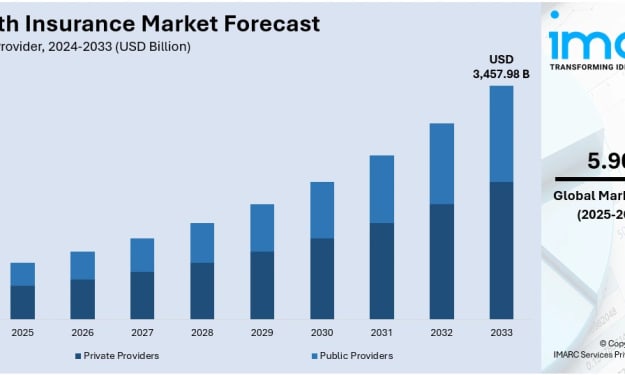
Health Insurance Market: Preventive Care Focus, Value-Based Models & Industry Trends
According to IMARC Group's latest research publication, global health insurance market size reached USD 1,949.84 Billion in 2024. Looking forward, IMARC Group expects the market to reach USD 3,457.98 Billion by 2033, exhibiting a growth rate (CAGR) of 5.90% during 2025-2033.
By Andrew Sullivan6 days ago in Futurism



Comments
There are no comments for this story
Be the first to respond and start the conversation.