
James Webb Space Telescope First IMAGES
James Webb Space Telescope First IMAGES - Explained

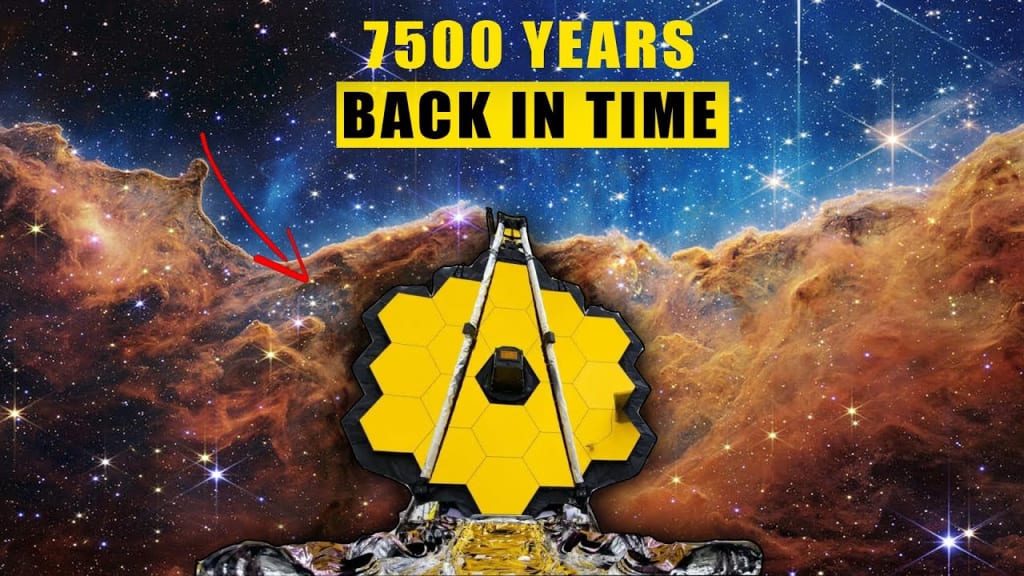
After years of continuous effort and a staggering $10 billion investment, the world's most powerful telescope was launched on September 28, 2021. Nearly six months after its journey began, this telescope started revealing secrets of the universe that were, until now, only imagined. Yes, we are talking about the James Webb Space Telescope.
Today, we will learn about the photos captured by James Webb and sent to NASA. What do these images tell us? Why is this information so crucial for humanity?
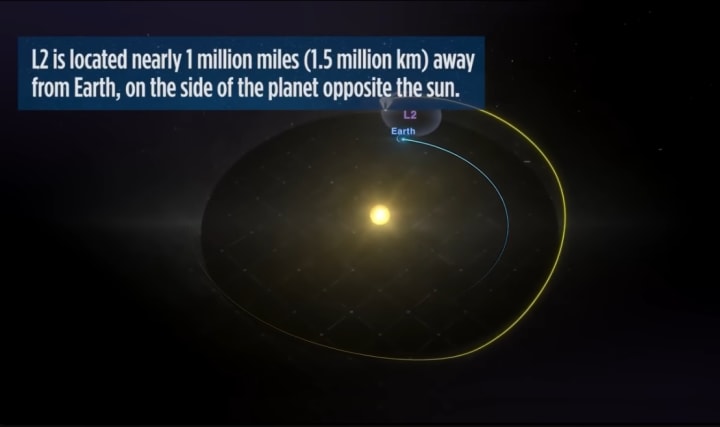
Currently, the James Webb Space Telescope is orbiting a point in space 1.5 million kilometers away from Earth, called the L2 point—a location where sunlight cannot directly reach the telescope. That’s why it's vital to keep the telescope away from both sunlight and heat. This telescope observes the universe in the infrared spectrum, which allows it to look deeper and farther than any telescope before it.
Millions or even billions of years ago, what exactly happened in our universe? How did stars, planets, and galaxies form? This telescope can essentially rewind time and observe ancient cosmic events. Not only can it observe the light of stars that have long since died, but it can also capture their explosions in real time.
Now let’s talk about the images James Webb captured in the past six months.
On July 12 2022, NASA released the first five images from James Webb, stunning the entire world. Its onboard camera can easily observe the universe in incredible detail.

In the first image, we see a deep field known as SMACS 0723. The glowing star-like objects are not individual stars, but entire galaxies. Just like Earth is part of the Milky Way galaxy—which spans about 100,000 light-years—this image shows thousands of galaxies, some of which are located 13.1 billion light-years away. That means the light we are seeing today started its journey 13 billion years ago. So, technically, we are looking into the distant past of the universe.
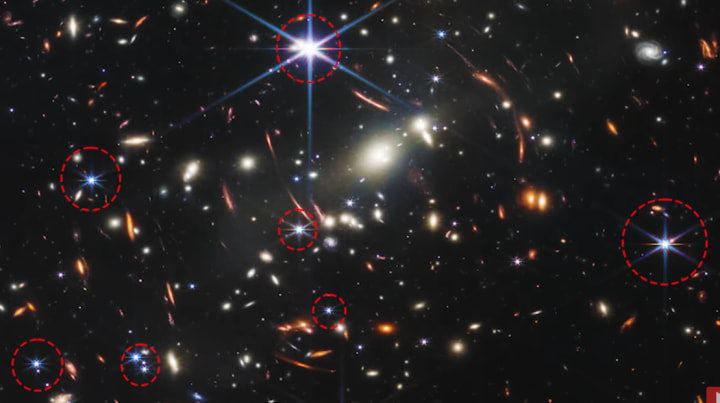

The blueish galaxies in the image indicate they are mature and contain many stars and planets. The reddish ones are still dusty and are in the process of forming new stars.
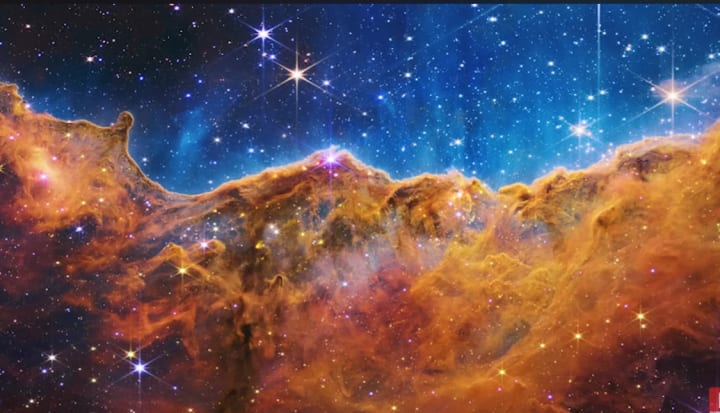
The second photo shows a stellar nursery located 7,600 light-years from Earth, known as the Carina Nebula. This is one of thousands of such nurseries in the Milky Way where new stars are born. The towering structures visible in the image are massive clouds of gas and dust. These clouds span several light-years, and the densest regions are the birthplaces of stars. Thanks to James Webb, we now have a breathtaking view of these star-forming regions.

The third image shows a dying star that exploded 2,500 years ago. Captured by two instruments—NIRCam and MIRI—this image reveals the massive energy and gas released during the explosion.
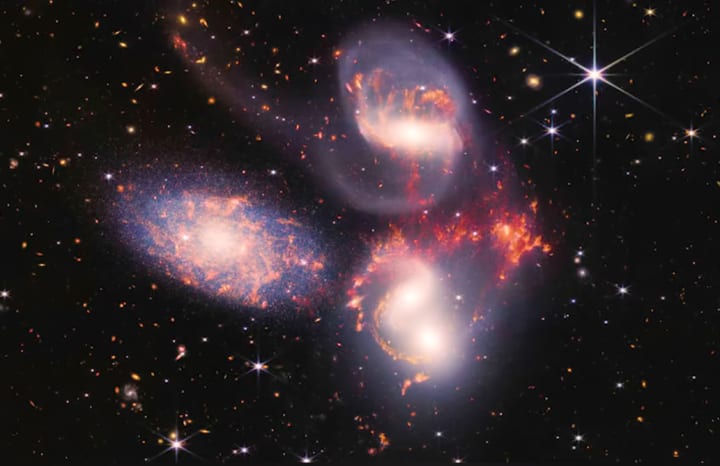
The fourth image is the largest captured by James Webb so far, with a resolution of 150 million pixels. It shows a cluster of five galaxies known as Stephan’s Quintet, which are rotating rapidly and slowly merging. Scientists believe that one day these galaxies will collide into one another. Currently, they are 300 million light-years away from Earth, meaning this image shows a scene from 300 million years ago. It's possible that these galaxies have already collided by now, but their light is just now reaching us.
The fifth discovery is an exoplanet located 1,120 light-years away, named WASP-96b. This planet orbits a star and shows potential signs of life. A single day on this planet equals three and a half Earth days.
But how did James Webb detect signs of life? When the planet passes in front of its star, it blocks the starlight. Some of this light passes through the planet’s atmosphere, and by analyzing how the light is absorbed and scattered, scientists can determine what elements are present. For example, if there’s more sulfur, the light behaves differently than if there is carbon dioxide or water.
In the case of WASP-96b, the light scattering revealed a high presence of water vapor—an essential ingredient for life.
James Webb is humanity’s most advanced telescope. It can see corners of the universe that even Hubble couldn’t reach. One major reason is its cold mirrors, capable of detecting even the faintest infrared light. The size of James Webb’s mirror is 6.5 meters, compared to Hubble’s 2.5 meters—allowing it to observe the Big Bang itself, which formed the entire universe.
What was once considered imaginary can now be observed for real by James Webb. Hopefully, in the coming months and years, NASA will continue publishing new information from the telescope.
About the Creator
Keep reading
More stories from Jehanzeb Khan and writers in Futurism and other communities.
The Mind of the Machine: Inside the World of Generative AI
There is a moment, familiar to anyone who has spent time with a modern AI system, that is difficult to fully rationalize. You type a question, a prompt, a request — and what comes back is not the mechanical, stilted output of the computers of popular imagination. It is fluent. It is contextually aware. It is, in some cases, genuinely surprising. It answers not just the question you asked but the question you meant to ask. It writes prose that flows, generates images of startling beauty, composes music that moves, and engages in conversation with a naturalness that, for a moment at least, makes you forget entirely that there is no one on the other side.
By noor ul aminabout 4 hours ago in Futurism
Biggest LLM Mistakes Companies Make
The rush to adopt generative AI has pushed many companies to deploy chatbots and language models without a clear strategy. While the intention is to improve productivity and reduce costs, the absence of proper LLM development solutions often leads to inaccurate outputs, security risks, and failed implementations. What looks like quick innovation on the surface can quietly become a long-term operational problem.
By Ritu Singh7 days ago in Futurism




Comments (2)
amazing
amazing bro me publish a new story you can see pleas