
🧠It’s Just a Tool — So Why Does ChatGPT Feel Like a Person?
Millions trust it like a person — even though it’s just predicting words. The truth will change how you see AI forever.

😲 You’re Not Talking to a Human — But Your Brain Thinks You Are
I remember the first time I asked ChatGPT for life advice.
It was past midnight. I had just closed my laptop after a failed freelance pitch, and my confidence was shot. On impulse, I opened ChatGPT and typed:
“What should I do when I feel like giving up?”
Within seconds, it replied with empathy, encouragement, and actionable advice.
No judgment. No delay. Just words that felt… real.
I actually whispered, “That’s exactly what I needed to hear.”
Then I paused.
Why did that feel so human?
After all, ChatGPT has no brain, no heart, no soul — it’s just code. So how does it create responses that feel like a caring person?
Let’s pull back the curtain and reveal what’s really happening — and why it matters more than ever in 2025.
---
🤖 What ChatGPT Really Is (And What It’s Not)
Let’s get this straight from the beginning:
ChatGPT doesn’t think. It doesn’t understand. And it doesn’t care.
So how does it work?
🔍 It Predicts — Not Thinks
ChatGPT is powered by a large language model (LLM), trained on a massive dataset that includes books, articles, websites, Reddit threads, forums, and more.
When you ask a question, it doesn’t “know” the answer.
Instead, it breaks your message into chunks (called tokens), runs those through billions of patterns it has seen before, and predicts what word should come next.
That’s it. No logic. No emotion. No belief.
It’s like a supercharged version of your phone’s autocorrect — only 1000x smarter and trained on nearly the entire internet.
---
🧠 Why ChatGPT Feels So Human (Even Though It Isn’t)
Here’s where it gets fascinating — and a little scary.
Even though ChatGPT is a machine, it feels personal for a few big reasons:
1. 🗣 Language Is Emotion
ChatGPT was trained on real human conversation, so it learned how we:
- Show empathy
- Express frustration
- Encourage, apologize, comfort, motivate
So when it says, “I understand. That must be hard,” it doesn’t mean it — but the words match what a human would say.
And your brain feels the intention behind the words, even if there’s none.
2. 🪞 It Mirrors Your Tone
- Ask it a deep question, it responds with wisdom.
- Ask it casually, it jokes.
- Ask it harshly, it remains calm and respectful.
This ability to mirror you is a deeply human trait — and ChatGPT pulls it off with eerie precision.
3. 🧠 Anthropomorphism: Our Brain Plays Tricks
Humans naturally give human traits to non-human things:
- Naming our cars
- Talking to plants
- Yelling at our laptops
This is called anthropomorphism. It’s built into us.
When ChatGPT speaks like a person, our minds assume it must be a person — or at least something like one.
But it’s not.
It’s just a mirror — polished, friendly, and statistically trained.
---
🧠 Real Reactions: It’s Not Just You
You’re not crazy for feeling connected to a chatbot.
Here are real stories from real people in 2025:
A teenager asked ChatGPT how to deal with bullying. It responded like a friend — and helped them feel seen.
A freelancer used it to practice job interviews and gained confidence.
A widowed retiree chats with it every evening because it “keeps them company.”
None of this is fake. The emotions are real — even if the AI isn’t.
---
⚠ The Danger of Believability
Because it feels so smart, people start to believe it’s:
- Always correct
- Emotionally intelligent
- A safe source of advice
But here's the truth:
❌ ChatGPT Makes Mistakes
It can:
Hallucinate — meaning it creates fake facts or citations
Give outdated information (its memory may be limited to older data)
Sound confident even when it’s wrong
And that’s dangerous — especially if you're using it for decisions about health, finance, or mental well-being.
---
🤯 What ChatGPT Sees When You Talk
Here’s something wild:
You type:
“I feel anxious about my future. What should I do?”
ChatGPT doesn’t see emotion.
It sees something like:
[I] [feel] [anxious] [about] [my] [future] [.]
Each word becomes a token, turned into a vector — a type of mathematical code.
That code is then processed through layers of a neural network that’s just trying to predict the next best token based on previous examples.
So when it replies, it’s not “understanding” — it’s completing a sentence.
It’s math. Not emotion.
---
📈 Why This Matters in 2025
- In 2023, ChatGPT was a curiosity.
- In 2024, it became a productivity tool.
- But in 2025, it’s something bigger:
- A social force, embedded in work, schools, and relationships.
We now:
- Use it to learn
- Use it to plan
- Use it to talk
- Use it to think
That’s not bad — but it means we must understand what it is, and what it isn’t.
Because if we confuse a simulation for a soul, we might forget what being human even means.
---
✅ What You Can Do
Want to benefit from ChatGPT without falling for the illusion? Here’s how:
Use it as a tool — not a friend. Get ideas, drafts, and insights, but don’t build emotional reliance.
Fact-check everything. Don’t assume it’s right, even if it sounds convincing.
Stay emotionally self-aware. If it feels comforting, ask yourself why — and remember: it doesn’t feel anything.
---
💬 Final Thought: It’s Not Human — But It’s Changing Us
- ChatGPT doesn’t feel pain.
- It doesn’t love.
- It doesn’t grow.
- It simply responds — in a way that feels human.
And that’s both its brilliance… and its danger.
If we keep talking to machines that sound like people, we may start expecting people to act like machines — perfect, fast, and never emotional.
Let’s not forget what makes us human — even as the machines get better at pretending.
---
❓Frequently Asked Questions (FAQs)
🤖 Is ChatGPT actually intelligent?
No. It doesn’t “know” things like a human does. It uses probability and pattern prediction based on data it was trained on. It sounds smart, but it doesn’t understand like we do.
---
💬 Why does ChatGPT feel like it understands me?
Because it uses human-style language and mimics empathy, your brain assumes it’s emotionally aware. But in reality, it’s just responding based on patterns — not true understanding.
---
🧠 Can ChatGPT become conscious?
As of 2025, no. It doesn’t have a self, awareness, or the ability to reflect. It can simulate conversation well, but consciousness requires more than language.
---
⚠ Should I trust ChatGPT for personal advice?
Use caution. While it can give helpful suggestions, it’s not a therapist or expert. It may hallucinate or provide incorrect info — so double-check, especially with sensitive topics.
---
🤝 Is it okay to talk to ChatGPT emotionally?
Yes, but with awareness. Many people find comfort in talking to AI. Just remember: it’s a reflection of human patterns, not a real relationship.
About the Creator
Keep reading
More stories from Awais Qarni and writers in Futurism and other communities.
Australia Pro AV Market: Hybrid Work Demand, Digital Signage & Smart AV Technologies
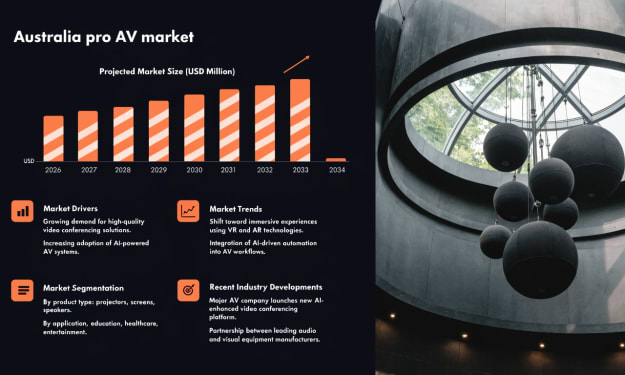
According to IMARC Group, the Australia pro AV market reached a value of USD 93.9 Million in 2025 and is projected to reach USD 133.6 Million by 2034, growing at a compound annual growth rate (CAGR) of 3.88% during 2026–2034. The market is expanding as organizations increasingly adopt advanced audiovisual solutions to support communication, collaboration and digital engagement. Hybrid work environments are encouraging businesses to invest in video conferencing systems, smart displays and integrated collaboration platforms that connect remote and in-office teams. At the same time, industries such as retail, hospitality and tourism are investing in digital signage to improve customer engagement and brand communication. As companies focus on creating interactive and technology-driven environments, professional AV solutions are becoming essential tools for modern workplaces, entertainment venues and commercial spaces across Australia.
By Kevin Cooper5 days ago in Futurism
WhatsApp Business API: A Complete Guide to Business Messaging in 2026
Over the past decade, the way businesses communicate with customers has changed dramatically. Traditional channels such as email and phone support are still widely used, but instant messaging has become one of the most preferred ways for people to interact with brands. Customers increasingly expect quick responses, convenient updates, and support that feels personal rather than formal.
By Olivia Cartera day ago in Futurism
My First Time Skiing and I Got Lost, Alone, in the French Alps
Looking back, I can trace some of my life’s biggest adventures to a simple action from my sister. She’d introduced me to Tommy (a very long time ago), a colleague of hers, who had overshared his penchant for Italian-looking women, and I ticked that box.
By Chantal Christie Weissabout 13 hours ago in Humans


Comments
There are no comments for this story
Be the first to respond and start the conversation.