


Time travel has always belonged to the realm of science fiction, but according to the latest research, it might not be as unreachable as once thought. Quantum physicists have long been working to unravel the mysteries of the universe, and it now seems that time travel is no longer just a fantastic dream.
But how could this work in reality?
Time travel forward in time is not only possible, but it has already happened. Through a process called time dilation, when an object is extremely dense or moving at high speeds, time literally slows down around it. This means that if someone were to travel near a super dense black hole and then return to Earth, less time would have passed for them than for those who remained behind.
The Tipler Cylinder: a theoretical time machine
The Tipler Cylinder is a theoretical device proposed by mathematician Frank Tipler. According to the theory, if a very long cylinder were spun at extremely high speeds, time would distort so much that anyone moving along the cylinder at near light speed would travel back into the past. While the realization of this concept would be incredibly complex and costly, it is theoretically not impossible.
Wormholes: gateways in the fabric of space-time
Wormholes, proposed by Stephen Hawking and Carl Sagan, offer a potential method for time travel that would allow us to jump to a different point in space-time. According to the concept, these "holes" in the fabric of space-time would provide a way to travel through time, but stabilizing them requires negative energy, and finding wormholes remains a significant challenge for scientists.
Obstacles
Although physicists suggest that time travel into the past is theoretically possible, there are additional theoretical obstacles that have yet to be overcome.
The most well-known of these is the "grandfather paradox." In short, it states that if I travel back in time and kill my grandfather, neither one of my parents nor I could have been born, meaning no one would be there to travel back in time to kill my grandfather, and so on.
Attempts have been made to resolve this issue, with the most famous being the theory of parallel universes, which proposes that such an action could only occur in a parallel universe.
A few years ago, a physics student developed a solution to make time travel viable without paradoxes.
Classical dynamics suggests that if we know the state of a system at a given point in time, it can tell us the system's entire history. However, Einstein's theory of general relativity predicts the existence of time loops or time travel, where an event can exist both in the past and the future, theoretically turning the study of dynamics on its head.
Calculations show that spacetime could potentially adapt to prevent paradoxes. For example, imagine a time traveler who goes back in time to stop the spread of a disease. If the mission were successful, the disease would no longer exist, which means there would be no reason for the time traveler to go back to stop it. Another hypothesis suggests that time travel is possible, but time travelers would be limited in their actions to avoid creating paradoxes.
While the mathematical model may work, the actual bending of space and time to enter the past remains physically unsolvable.
The time machines developed by scientists so far are technologically unfeasible for the foreseeable future, or they would require so much energy to realize that it is practically beyond our reach.
However, it’s possible that one day we may reach the world of time travel.
Stephen Hawking considered this possibility to be achievable.
About the Creator
Reader insights
Nice work
Very well written. Keep up the good work!
Top insights
Easy to read and follow
Well-structured & engaging content
Expert insights and opinions
Arguments were carefully researched and presented
Eye opening
Niche topic & fresh perspectives
Masterful proofreading
Zero grammar & spelling mistakes
On-point and relevant
Writing reflected the title & theme
Optical Coherence Tomography Market: Regulatory Approvals, Clinical Adoption Trends & Growth Outlook
According to IMARC Group's latest research publication, The global optical coherence tomography market size was valued at USD 2.6 Billion in 2025. Looking forward, IMARC Group estimates the market to reach USD 7.0 Billion by 2034, exhibiting a CAGR of 11.13% from 2026-2034.
By sujeet. imarcgroup4 days ago in Futurism
Indoor 5G Market Revenue to Boost Cross USD 87.9 Billion by 2034
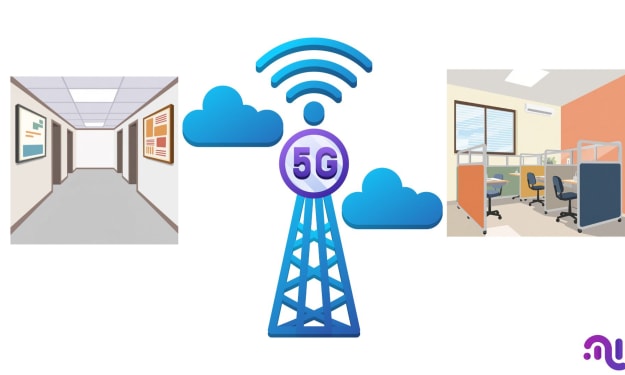
The Global Indoor 5G Market generated approximately USD 14.67 Billion in 2024 and is projected to reach around USD 87.9 Billion by 2034, expanding at a CAGR of 19.60% during the forecast period. The market growth is being supported by the increasing deployment of 5G infrastructure within buildings, enterprises, airports, hospitals, and commercial facilities where strong wireless connectivity is essential.
By Roberto Crum5 days ago in Futurism



Comments