
Is the future of solid-state batteries 3D-printed?
Battery of the future
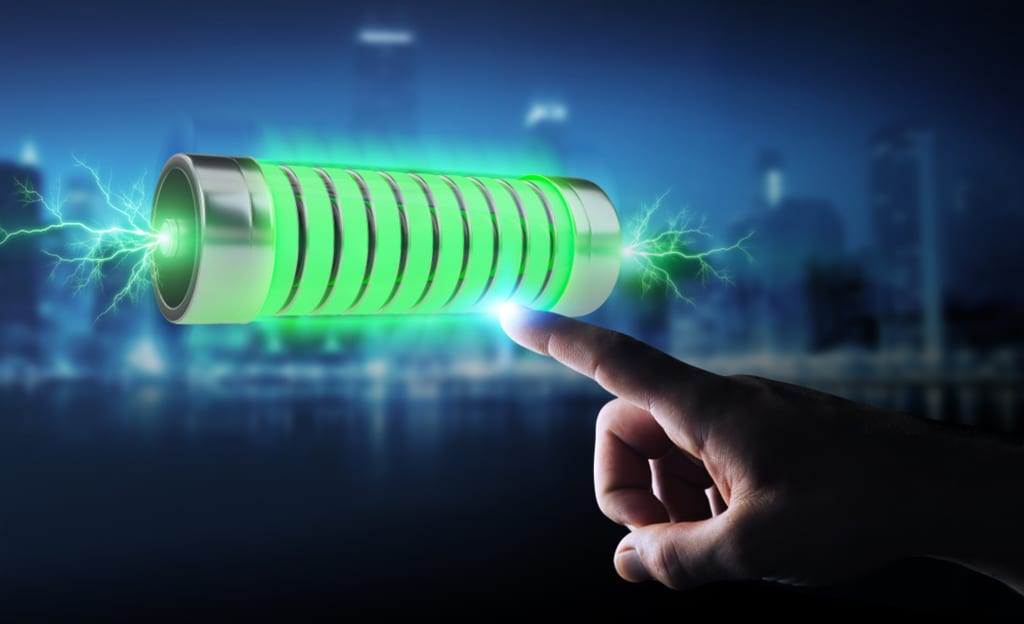
- [Lizzie] This could be the future
of rechargeable batteries.
It promises more power, better safety, faster charging,
and a longer lifespan.
And, in theory, could be any shape you want it to be.
Private companies and research labs are racing
to crack the code for a battery
that could someday replace these,
the ever-present lithium ion.
And one company is taking it a step further
and wants to change our idea
of what a battery can even look like by 3D printing them.
Let's take a step back and explain what a battery is.
A typical battery works
by converting chemical energy into electricity.
We need a positive end, or cathode.
In this case, a zinc-coated nail.
And a negative end, or anode,
which is our copper penny.
We also need something to connect these two
called the electrolyte.
That's where our potato comes in.
I'm just gonna do one in here. One in here.
Each end reacts chemically with the potato
and the anode actually releases electrons
which travel along this wire back to the cathode.
This flow of electrons is actually what's converting
that chemical reaction into electricity.
Now that didn't really do anything, as you can see.
But if we add a few more potatoes,
we'll probably get this light to work.
Thank you.
These clips are so hard.
And now... Lights, please.
Hey, that was pretty good.
So that's the foundation of any chemical battery.
Lithium ion batteries are some
of the most successful versions of this.
But there's room for improvement
and startups are adjusting two key elements of the design,
the electrolyte and the anode.
- Most batteries today,
pretty much every battery you will buy,
has a liquid electrolyte in it.
- We actually call them lithium ion batteries
because the electrolyte is full of lithium ions
moving the charge around.
Liquid electrolytes are great conductors.
But they're volatile, particularly when damaged
or at high temperatures.
And if you watch the news,
you've probably seen reports on incidents like this.
- [Announcer] Her phone caught fire.
- [News Anchor] Model S Plaid burst into flames
earlier this week.
- May have sparked a fire at a local recycling plant
is something that's plaguing those centers
across the country.
- We get it. There's a safety issue.
One solution is to use a more stable, non-flammable
solid material instead.
Right now, lots of companies
building these solid-state batteries are experimenting
with electrolytes made from all sorts of materials
like ceramics, glasses, and polymers.
The other big upgrade is finding a more powerful material
to use for your anode.
Your regular old lithium ion batteries use graphite
which already works pretty well.
But there is a more powerful candidate out there.
- The holy grail for battery anodes
has been lithium metal.
And that's not lost on people.
- So lithium metal has a higher capacity
than other anodes like silicon or graphite,
but it's hard to work with.
It tends to form these little microscopic structures
called dendrites that can short the battery.
That's been a big problem for liquid electrolytes.
But using a solid material could improve things.
- The way I think about dendrites is like the roots
of a tree system.
So the roots are growing.
You wanna stop the roots from, you know,
kind of coming into your house.
So what do you do?
You put a concrete wall or something really hard,
so mechanically stopping.
- So a good solid electrolyte can stand up
to those little dendrites
and still allow for the easy flow of ions back and forth.
(upbeat music)
Over the past few years,
there's been a lot of improvement in these new materials.
Today, leading startups are looking
to get their pilot batteries out of the lab
and into a factory.
And one California-based company, Sakuu,
is taking an even bigger swing.
They're designing solid-state batteries
with lithium metal anodes,
and they want to 3D print them.
- The only way to go into this direction
of having more sustainable, safer, superior batteries
is to, at some point in time,
challenge the manufacturing process.
- [Lizzie] So most batteries today are made
with a process called roll-to-roll manufacturing.
The materials are rolled out in long sheets
and then cut down for individual battery layers.
3D printing, on the other hand,
could let Sakuu cram more layers
into the same amount of space,
improving the overall capacity of the battery.
- [Arwed] So it's not like today
where you have them in a pouch
and the battery is just inside, the layers are inside,
it has to be sealed.
But in the printer with a Sakuu Kavian platform,
our printer platform, we can create these batteries
right in the printer and this is how they look like.
- [Lizzie] It's how Sakuu hopes to outcompete
other solid-state startups and lithium ion makers
who are sticking with roll-to-roll.
- So it really takes the combination
of the good battery design
and the superior manufacturing technology.
Staying with roll-to-roll
for sure would not enable us
to even have higher energy densities than anybody else.
- Okay, a big caveat to all of this.
Sakuu has 3D printed solid-state batteries in their lab,
but has not yet fully printed a battery
using their prototype.
In fact, we couldn't even film
the 3D printer prototype itself.
Sakuu says that's because there's just too much
proprietary stuff going on that they're not ready
to reveal to the public yet.
They actually have this prototype built,
they're doing tests,
and they're trying to figure out
how to make the best battery
using this manufacturing process.
What we're about to show you
is actually the 3D printed model of that 3D printer.
Meta, I know
- [Arwed] This platform can use several, too.
So it can print metals, it can print ceramics,
and it can print polymers.
And it's printing those layer by layer
and that's the key aspect to make it faster.
- [Lizzie] How fast? Well, we're not exactly sure yet.
Sakuu hopes that one day each machine would be able
to produce 40 megawatt hours of energy storage annually.
In normal terms, that's about the same
as 500 electric car batteries per year.
But this prototype works differently
than your conventional 3D printer.
Usually a printer deposits a layer of material,
waits for it to solidify, and then adds the next layer.
Here, each layer gets printed
and is quality controlled simultaneously.
Excess material can be recycled within the system.
The layers are stacked tightly together at the very end
and out pops a battery.
But the most surprising perk of this process isn't power
or safety or cost.
It's really about form factor.
Look at these batteries.
They're mostly rectangular or cylindrical.
That's because it's hard when using roll-to-roll
to actually make different shapes.
It would require new tools, more waste,
and probably a higher price tag.
3D printing could be much more flexible.
- Look at this in the future,
you will see batteries which actually become a part,
an integral part of a product.
For example, if you look at AR/VR glasses,
the temple arm of the glasses could be a printed battery.
Or you look at a a cell phone
where maybe the case of the cell phone
is actually a battery.
- [Lizzie] So the battery isn't just more powerful itself.
It can also fill in dead space,
maximizing its footprint in a product,
and boosting power that way too.
You wouldn't have to necessarily design a product
around a battery.
You could design the battery around your product.
And this is obviously not the real printer.
So what's the like footprint of one of these?
- [Arwed] For this first one,
the footprint is around 10 meters long.
This is now our first prototype, right?
- [Lizzie] Total reinvention is obviously risky.
The company claims that their process
could reduce manufacturing costs,
but they wouldn't share the actual price tag
of the printer with us.
On top of that,
you're introducing a new manufacturing process
to an established industry,
and that's always gonna be a challenge.
And they're not the only ones taking this approach.
Other companies like Blackstone Resources
and Photocentric are also working on 3D printed batteries.
While all this R&D has been happening,
lithium ion batteries are just getting cheaper
and more powerful.
That's really tough to compete with.
Sakuu is currently building out its first factory
and hopes to get sample batteries out to their clients
in 2023.
- So this facility will only host
our own battery manufacturing,
which is, of course, needed to prove the process
to show everybody that our technology works successfully.
- [Lizzie] While startups like Sakuu
are putting their first generation products to the test,
the need for more advanced batteries is only growing.
The goal isn't just to get a better battery into your phone,
it's increasing range for electric vehicles
and large scale storage for a decarbonized energy grid.
But to take on the world of lithium ion,
newcomers can't just be a little better.
- Which means that what we have to do
to get this material to be commercial
is we've got to make them perfect.
Because if it's not perfect,
they've become a significant challenge
when it comes to trying to make this into a battery
that'll stand the test of time
and power all the things we want to power.
- That one's there.
I think we should cut.
About the Creator
Keep reading
More stories from TBH Agencia Exclusiva Colsanitas and writers in Futurism and other communities.
About Binding Prometheus
I want to start actively advocating on behalf of my own work, and the most valuable part of my canon is, without a doubt, Binding Prometheus, the play I have been working on since 2019 and only finished in 2023 as part of my MA. The play itself is an amalgamation of a million different inspirations. On one end, it evokes the Ancient Greek myth-play, deriving its own title from the earliest extant work of Western drama we have, Aeschylus’s Prometheus Bound. On the other end, it borrows significantly from the sci-fi bulwarks from over the years, namely Mary Shelley’s Frankenstein and Karel Capek’s Rossum’s Universal Robots. The play could be an episode of Black Mirror, I fear. I don’t know. I’ve only ever seen one episode of Black Mirror.
By Steven Christopher McKnight18 days ago in Futurism
Saudi Arabia Dishwashing Detergent Market: Hygiene Awareness, Product Innovation & Growth Outlook
According to IMARC Group's latest research publication, GCC dishwashing detergent market reached USD 197.83 Million in 2024. The market is projected to reach USD 365.84 Million by 2033, exhibiting a growth rate of 7.07% during 2025-2033.
By Abhay Rajputabout an hour ago in Futurism




Comments
There are no comments for this story
Be the first to respond and start the conversation.