
Is Technology Evolving Faster Than We Can Keep Up?
Should we fear or embrace the new technology?

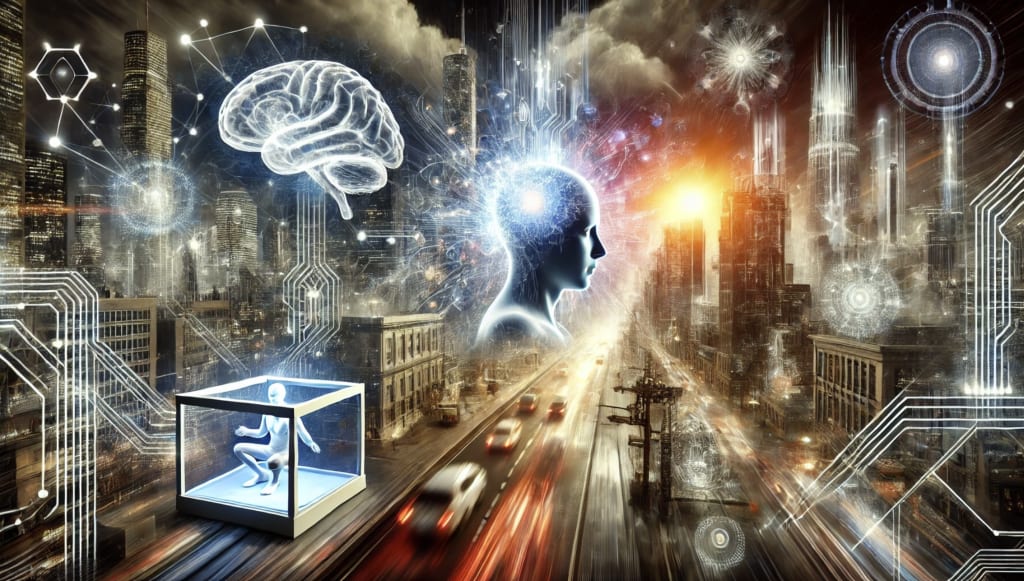
A World in Overdrive
Imagine waking up to a world that seems almost sentient in its design. Your AI assistant greets you with a rundown of your day, carefully curated based on your personal habits, preferences, and even your emotional state. The lights in your room gradually brighten, mimicking natural sunlight to ease you into consciousness. Your smart fridge orders groceries before you’ve realized you’re running low, and your car, programmed to know your exact schedule, waits in your driveway, ready to drive itself to your destination. This vision, once reserved for science fiction, is fast becoming our reality. On the surface, it feels like a utopia – a world where everything is tailored to make life easier. But underneath the seamless efficiency lies a growing tension: Are we still in control?
The speed of technological evolution has reached a point where it’s no longer just about progress; it’s about survival. Humans have always innovated – fire, the wheel, electricity – but those milestones took centuries or decades to spread and be adopted widely. Today, new breakthroughs emerge so rapidly that the average person barely has time to understand one innovation before another one renders it obsolete. Consider the smartphone: in just over a decade, it has gone from a novel luxury to an essential tool that dictates how billions of people work, socialize, and entertain themselves. But now, with artificial intelligence and quantum computing emerging, we are entering a realm of complexity that is leaving even experts scrambling to keep up. Like 3D printing technology, it's also evolving frightning fast. For instance you can now print wooden furniture, metal structures, or concrete house sections. What is next?
Artificial intelligence alone is rewriting the rules of human capability. Machines are now outperforming us in tasks we once considered uniquely human – recognizing faces, composing music, and even creating art. AI algorithms analyze data faster than any human brain could dream of, predicting outcomes and making decisions with precision we struggle to replicate. On one hand, this has brought tremendous benefits. Diseases are being detected earlier, fraud is being prevented before it happens, and industries are optimizing in ways that were previously unimaginable. On the other hand, the implications are staggering. As machines learn and adapt faster than we can, the balance of control begins to shift. Who decides how these systems are used? Who takes responsibility when they go wrong?
Then there’s quantum computing – a concept so advanced it almost feels like magic. While traditional computers process information in binary (zeros and ones), quantum computers use qubits that can exist in multiple states simultaneously. This allows them to perform calculations at speeds that dwarf anything humanity has ever known. Problems that would have taken centuries to solve can now be unraveled in seconds. For industries like healthcare, cybersecurity, and logistics, the potential is revolutionary. But for society at large, it raises unsettling questions. What happens when this immense power falls into the wrong hands? If encryption – the foundation of digital security – becomes obsolete overnight, how do we protect sensitive data, national security, or even personal privacy?
The workplace is another battleground in this accelerating technological arms race. Automation has already replaced millions of jobs in manufacturing, retail, and even white-collar industries like law and finance. Self-driving trucks could replace human drivers in a matter of years. Robots in warehouses move with a precision and tirelessness no human could match. While these advancements promise efficiency and reduced costs, they also threaten the livelihoods of countless workers. And it’s not just about losing jobs – it’s about losing a sense of purpose. For centuries, work has been a cornerstone of human identity. What happens when machines render large swaths of our labor obsolete?
At the same time, our ability to adapt to these changes is being tested like never before. Historically, humanity has relied on periods of adjustment to make sense of new technologies. Electricity, for example, took decades to be implemented on a global scale, allowing people to adapt gradually. Today, that buffer no longer exists. Social media platforms, which barely existed 20 years ago, now dominate how we communicate, consume information, and even think. Their impact on mental health, democracy, and interpersonal relationships is still not fully understood – yet we’re already moving on to the next wave of technological disruptions.
Perhaps the most unnerving aspect of all this is the loss of simplicity. In our rush to automate and optimize everything, we risk losing the very things that make us human: creativity, spontaneity, and connection. When every decision is guided by algorithms, every interaction mediated by screens, and every problem solved by machines, where does that leave us? Are we truly building a better world, or are we outsourcing our humanity to technology?
This is the paradox of our time. We are surrounded by tools that promise to make life easier, yet the pace of change leaves many feeling more disconnected and overwhelmed than ever. It’s no longer a question of whether technology can solve our problems – it’s a question of whether we can keep up with the solutions. Should we embrace new technology or be better to restrict some of it? I am no expert, but there are several things here which are already scaring me.
The Unrelenting Pace of Innovation
It’s often said that necessity is the mother of invention, but in this era, invention seems to fuel itself. The relentless pace at which technology advances has created a whirlwind effect, where innovation spawns more innovation. Breakthroughs that would have been considered once-in-a-generation achievements are now happening so quickly that they barely have time to be celebrated before being surpassed. This constant acceleration is not just reshaping industries – it’s reshaping how we live, think, and interact with the world around us.
Take the rise of artificial intelligence, for example. Once confined to research labs, AI now permeates every corner of our lives. It curates our social media feeds, drives targeted advertising, and even determines the outcome of job applications. Algorithms predict what we’ll buy, watch, or listen to before we’ve even thought about it. This is no longer just a tool – it’s an invisible force shaping our choices and behaviors in ways we don’t always recognize. Yet for all its convenience, AI comes with a cost: it erodes privacy, reinforces biases embedded in its programming, and introduces a level of automation that many people find unsettling. How do we balance the benefits of such transformative power with the risks it poses to our autonomy and individuality?
The same questions apply to another rapidly evolving field: biotechnology. CRISPR, a revolutionary gene-editing technology, has given scientists the ability to alter DNA with unprecedented precision. Diseases that were once incurable are now being tackled at their genetic roots, and the potential to eliminate hereditary conditions entirely is within reach. Yet this incredible power comes with profound ethical dilemmas. If we can edit genes to cure disease, what’s to stop us from using the same technology to enhance intelligence, athletic ability, or physical appearance? And if that happens, who decides who gets access to these enhancements? Biotechnology is not just rewriting the rules of medicine – it’s challenging the very definition of what it means to be human.
Meanwhile, in the realm of computing, quantum technology is pushing the boundaries of what’s possible. It’s a field so complex that even experts struggle to fully grasp its implications, yet its potential is clear. Quantum computers are capable of solving problems so intricate that they would stump traditional computers for centuries. They could revolutionize drug discovery, weather forecasting, and supply chain optimization. But quantum computing also poses existential threats, particularly in cybersecurity. Encryption methods that currently protect our most sensitive information could become obsolete overnight, leaving governments, corporations, and individuals vulnerable to unprecedented breaches. Are we ready for a world where no data is truly secure?
Perhaps the most visible sign of the relentless pace of technological advancement is automation. Across industries, robots and AI-driven systems are taking over tasks once performed by humans. Factories now operate with minimal human intervention, and self-checkout machines have become a standard feature in retail stores. On the surface, this seems like progress – greater efficiency, lower costs, and fewer errors. But automation is also displacing millions of workers, creating a growing divide between those who can adapt to new roles and those who cannot. It’s not just blue-collar jobs at risk; even professions like law, journalism, and medicine are seeing aspects of their work automated. How do we ensure that technological progress benefits everyone, rather than leaving large portions of society behind?
Amid all this rapid change, it’s easy to feel like we’re losing control. Technologies are being implemented faster than we can fully understand their consequences. Social norms, legal frameworks, and ethical guidelines struggle to keep pace with the speed of innovation. It’s as if we’re building a plane while flying it, hoping that everything holds together long enough to figure out where we’re headed.
And yet, the most troubling part might not be the technology itself, but our relationship with it. As we rush to adopt the latest innovations, are we pausing to consider what we’re giving up? Convenience often comes at the expense of privacy. Efficiency can erode jobs. Progress can widen inequalities. In our quest to push the boundaries of what’s possible, we risk losing sight of what’s truly important.
This is the paradox of technological advancement: it promises to solve the world’s greatest challenges, yet it often creates new ones in the process. The question isn’t whether we can keep up with the pace of change – it’s whether we’re prepared to deal with the world these changes are creating.
The Cost of Constant Acceleration
As the world rushes forward, powered by an unstoppable wave of technological advancements, it’s becoming increasingly clear that the pace itself may be our greatest challenge. The constant demand to innovate, adopt, and adapt is not only leaving individuals behind, but also exposing deeper cracks in the systems we rely on. For every breakthrough that promises a better future, there’s a hidden cost – whether it’s environmental, social, or psychological.
Take the issue of sustainability. Many of the technologies driving progress, from massive data centers to the mining of rare earth metals, come with significant environmental consequences. The energy required to power AI systems or maintain global networks isn’t just abstract – it contributes to rising emissions and resource depletion. While innovation often focuses on solving one problem, it frequently creates another. Can a world obsessed with speed afford to prioritize sustainability when the focus is always on what’s next?
There’s also the human toll. The pressure to keep up with constant change has created a culture of perpetual learning and adaptation, which can feel exhausting. Workers are expected to reskill continuously, while students are prepared for industries that might not even exist by the time they graduate. This relentless cycle breeds anxiety and burnout, as people struggle to find stability in a world defined by rapid transformation.
At its core, the question isn’t whether technology is evolving too quickly – it’s whether we are evolving quickly enough to handle it. Without meaningful reflection on the path we’re taking, we risk building a future that’s efficient but empty, connected but disconnected, advanced but devoid of the values that make life meaningful. The challenge isn’t just to keep up, but to ensure that progress remains rooted in purpose.
Are We Prepared for What’s Coming?
Technology has brought us to a point in history where the unimaginable has become routine. Artificial intelligence, quantum computing, biotechnology, and other innovations have transformed nearly every facet of our lives. But as these advancements race ahead, the question we’re left with is whether humanity is capable of keeping pace – not just in understanding these technologies, but in managing their consequences.
The rapid acceleration of innovation has created a world of possibilities, but also one of profound challenges. Automation threatens to displace millions of workers. AI systems make decisions we don’t fully understand. Quantum computing holds the promise of solving our greatest problems – and creating entirely new ones. Even as we embrace these tools, we’re increasingly aware of the price we might pay, from environmental costs to social inequalities and personal overwhelm.
The issue isn’t about halting progress, but about steering it in a direction that serves humanity as a whole. The future depends on our ability to balance speed with reflection, innovation with ethics, and progress with purpose. Without that balance, we risk building a world that’s technically brilliant but fundamentally unprepared for the human lives it’s meant to improve. It’s a challenge we can’t afford to ignore. I for one are already scared.
About the Creator
Peter Springer
Fitness trainer and gymnast. Been working for several years with Airtracks and trampolines. I was even training for the olympics but due to an injury I had to give up those plans. Now I just enjoy working with sport and fitness.
Keep reading
More stories from Peter Springer and writers in Futurism and other communities.
How to Get the Most Out of Your Trampoline as a Senior
Who says trampolines are just for kids? They’re actually a brilliant way for seniors to stay active and have a little fun at the same time. A trampoline workout—sometimes called rebounding—can do wonders for your balance, keep your joints happy, and even give your heart a nice little boost without feeling like you’re working too hard. Plus, let’s face it, bouncing around is just plain enjoyable, no matter what age you have.
By Peter Springerabout a year ago in 01
About Binding Prometheus
I want to start actively advocating on behalf of my own work, and the most valuable part of my canon is, without a doubt, Binding Prometheus, the play I have been working on since 2019 and only finished in 2023 as part of my MA. The play itself is an amalgamation of a million different inspirations. On one end, it evokes the Ancient Greek myth-play, deriving its own title from the earliest extant work of Western drama we have, Aeschylus’s Prometheus Bound. On the other end, it borrows significantly from the sci-fi bulwarks from over the years, namely Mary Shelley’s Frankenstein and Karel Capek’s Rossum’s Universal Robots. The play could be an episode of Black Mirror, I fear. I don’t know. I’ve only ever seen one episode of Black Mirror.
By Steven Christopher McKnight19 days ago in Futurism
Massage Equipment Market: Ergonomic Innovation, Wellness Demand & Market Momentum
According to IMARC Group's latest research publication, The global massage equipment market size reached USD 8.1 Billion in 2024. Looking forward, IMARC Group expects the market to reach USD 16.3 Billion by 2033, exhibiting a growth rate (CAGR) of 8.08% during 2025-2033.
By James Whitman7 days ago in Futurism
Wild Card Weekend Recap: What Happens Now?
I think I figured out why I love Wild Card Weekend so much. It's because it's the first playoff anything of the calendar year. The NFL season starts in the fall, and once upon a time, the champion was crowned either on or slightly before New Year's. The evolution of the NFL schedule has resulted in the playoffs starting just into the New Year, and currently, the final week of the season falls on the first weekend of the New Year, with Wild Card Weekend coming a week after that. So yes, chronologically, the NFL's Wild Card Weekend serves as the first playoff anything of the calendar year.
By Clyde E. Dawkins7 days ago in Unbalanced




Comments