
Is Singularity an Illusion? The True Nature of Black Holes
Challenging the myth of infinite density, this article explores a more grounded explanation for what lies at the heart of black holes.

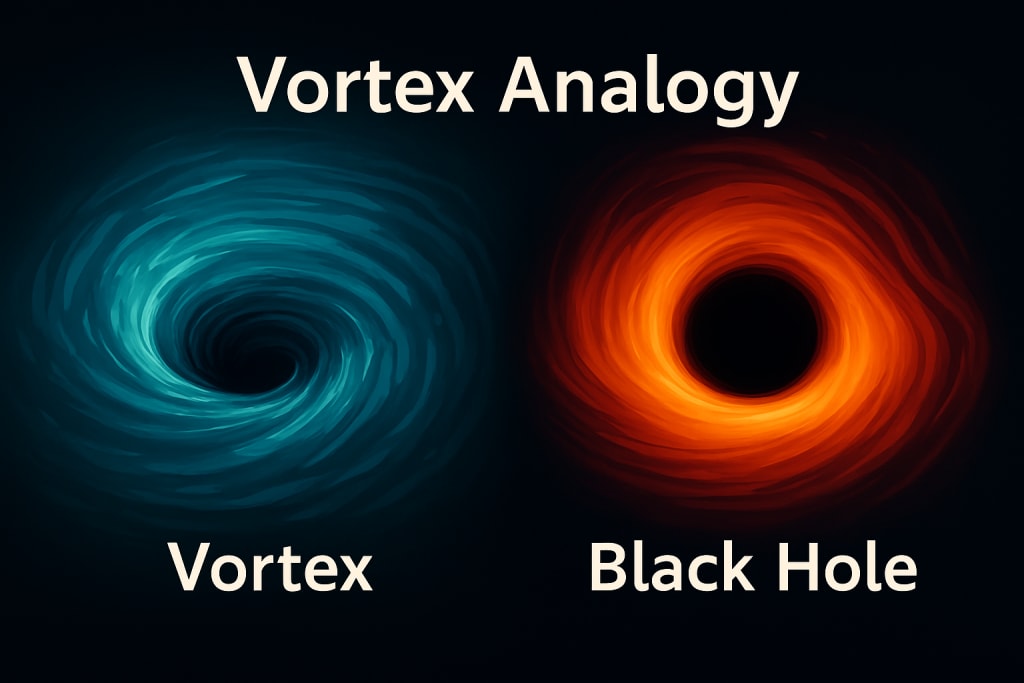
Black holes have long fascinated both scientists and enthusiasts alike. In most popular descriptions, they are said to contain a “singularity” at their center a point of infinite density and zero volume. Yet “infinity” is not an observable feature of nature; rather, it signals the limits of our current theories.
But what if black holes are not “infinities” at all, but instead the lasting imprints of stars in spacetime? If so, what lies at their center may not be emptiness, but something far more familiar: an extremely small, extremely dense, yet still law-abiding accumulation of matter and energy.
From Star to Black Hole: The Natural Course of a Whirlpool
Classical astrophysics describes black holes as the result of massive stars exhausting their fuel and collapsing under their own gravity. This explanation is often portrayed as a dramatic “collapse” ending in a mysterious singularity.
Yet it may be more natural to think of black holes like whirlpools on the surface of water. A star, throughout its existence, bends spacetime with its mass. When it disappears, this curvature does not simply vanish. On the contrary, it persists, stabilizing into a permanent whirlpool.
Every piece of matter that falls into a black hole feeds this whirlpool, strengthening its presence. But if a black hole fails to attract new matter for long enough, it is destined to calm down, much like a whirlpool that loses its energy. The scale is vastly greater spanning billions of years but the principle remains the same: a black hole is not nothingness, but the natural trace of existence, sustained by the flow of matter.
The Whirlpool Analogy: Continuity, Not Annihilation
Imagine placing an oval-shaped, rotating object with suction power into water. It pulls the water inward, creating a spiral motion around it. Now remove the object: a whirlpool remains, sustained for a while by the momentum of the water. The whirlpool is not the absence of the object but the continuation of the effect it left behind.
Black holes can be understood the same way. The initial effect of the star defines the black hole’s birth. From then on, every new particle of matter that falls in feeds the whirlpool and prolongs its existence. If left unfed, the black hole, like a whirlpool, must eventually quiet down. Because of the immense scale, this process unfolds over billions of years, yet the underlying logic is the same.
Is Singularity an Illusion?
For decades, black holes have been described as harboring a “singularity” an infinitely dense, dimensionless point. This result emerges from mathematical equations, not from physical observation. Infinity in such equations is less a real object than a sign that our methods have reached their limits.
Throughout history, humanity has been drawn to the impossible. Mathematics, too, has been used to reach for it: sometimes producing results that exist only in abstraction, not in nature. Singularity is one such case. Equations may yield infinity, but the universe does not. Nature itself has never produced infinities; it produces finite, measurable structures.
The appeal of singularity lies not in evidence, but in our fascination with the impossible. In reality, what exists at the core of a black hole is not infinite density but an extremely dense, compact accumulation of matter and energy still bound by the laws of physics. The star’s original imprint gives rise to this structure, and every new influx of matter sustains and intensifies it.
This perspective reframes black holes not as places of annihilation, but as the ultimate expressions of continuity in the cosmos.
Conclusion: Continuity, Not Nothingness
Rather than viewing black holes as points of destruction, enigmatic singularities, or poetic mysteries, it makes more sense to see them as natural processes of continuity. A star’s mass and rotation already bend spacetime; its disappearance solidifies this effect into a lasting whirlpool.
As matter continues to fall in, the black hole is fed and strengthened. When matter runs out, the whirlpool must settle into stillness. Though this process stretches across cosmic timescales, the principle remains: a black hole is not emptiness, but the transformed state of existence itself.
This view suggests that singularity is an illusion. At the heart of a black hole lies not a supernatural void, but an extremely dense yet finite accumulation of matter and energy. Black holes, then, are not symbols of nothingness, but the most extreme examples of continuity in the universe.
📌 Note: This essay presents an original and potentially verifiable interpretation of black holes, offering a different perspective on their true nature.
About the Creator
Keep reading
More stories from writers in Futurism and other communities.
About Binding Prometheus
I want to start actively advocating on behalf of my own work, and the most valuable part of my canon is, without a doubt, Binding Prometheus, the play I have been working on since 2019 and only finished in 2023 as part of my MA. The play itself is an amalgamation of a million different inspirations. On one end, it evokes the Ancient Greek myth-play, deriving its own title from the earliest extant work of Western drama we have, Aeschylus’s Prometheus Bound. On the other end, it borrows significantly from the sci-fi bulwarks from over the years, namely Mary Shelley’s Frankenstein and Karel Capek’s Rossum’s Universal Robots. The play could be an episode of Black Mirror, I fear. I don’t know. I’ve only ever seen one episode of Black Mirror.
By Steven Christopher McKnight18 days ago in Futurism
Gelatin Market: Clean Label Demand, Functional Ingredients & Food Industry Expansion
According to IMARC Group's latest research publication, global gelatin market size reached 4,70,970 Tons in 2024. Looking forward, IMARC Group expects the market to reach 5,36,020 Tons by 2033, exhibiting a growth rate of 1.3% during 2025-2033.
By sujeet. imarcgroup4 days ago in Futurism
The Devil's Cut
“Comrade, finally you’re awake.” The voice was smooth, sensual. A flickering incandescent bar was all that lit the white, sterile room. All Vladimir remembered was everything going black. He tried to move his arms and found them strapped to the gurney.
By Matthew J. Fromm5 days ago in Fiction




Comments
There are no comments for this story
Be the first to respond and start the conversation.