

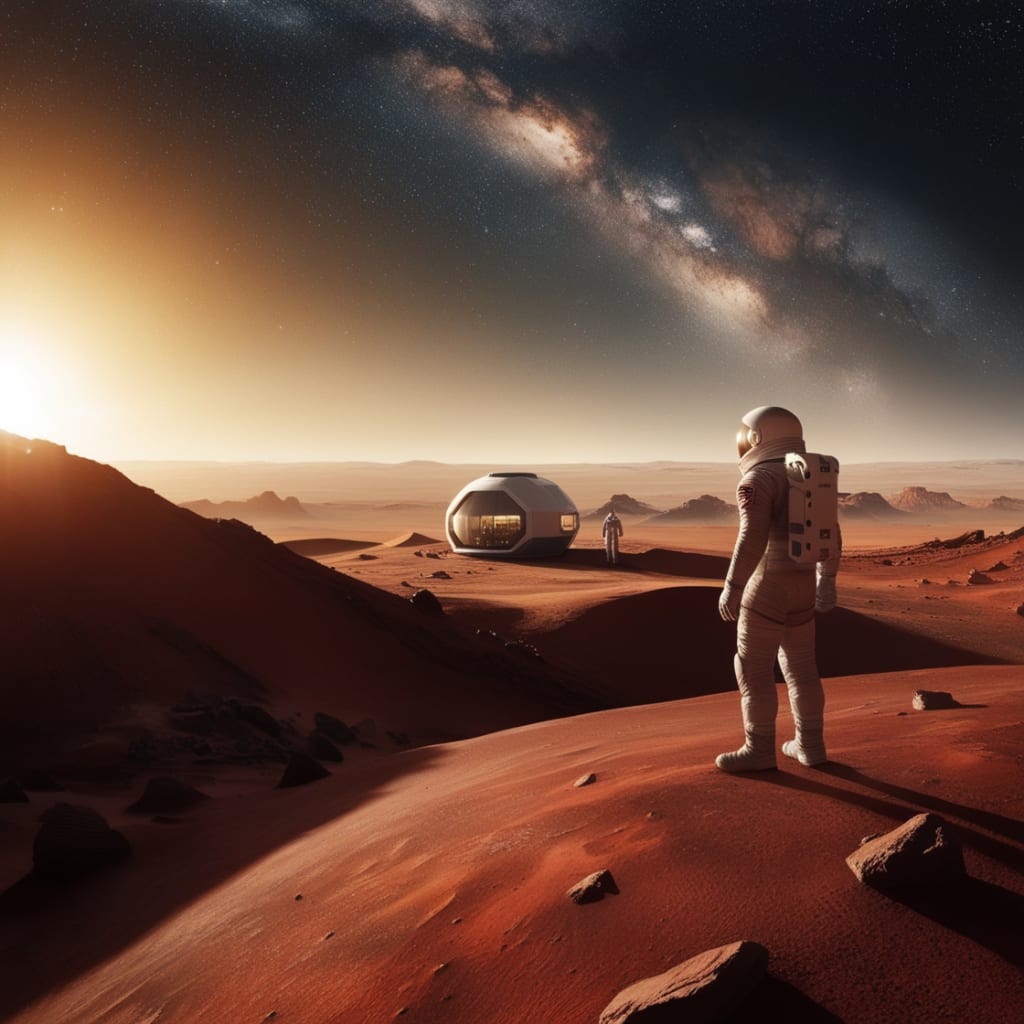
Humanity’s dream of reaching Mars has fascinated generations, from early science fiction to today’s cutting-edge space exploration programs. For some, Mars is more than just a distant, rusty planet—it represents hope for the future, a potential backup plan should Earth become uninhabitable. But is colonizing Mars truly a feasible contingency for humankind’s survival, or is it simply a captivating dream that reflects our desire to explore and conquer the unknown? This question is both practical and philosophical, demanding an honest look at the scientific challenges, the technological advancements, the ethical considerations, and the human spirit driving the endeavor.
From a scientific perspective, Mars presents an incredibly harsh environment. It is about half the size of Earth, with a thin atmosphere composed mostly of carbon dioxide, and surface temperatures that swing wildly—from bone-chilling lows near minus 125 degrees Celsius at the poles to highs around 20 degrees Celsius at the equator during summer. The planet’s lack of a protective magnetic field exposes its surface to intense cosmic and solar radiation, a danger for any human explorers or settlers. In addition, the gravity on Mars is only about 38% of Earth’s, which poses unknown risks to human health over extended periods. Unlike Earth, where liquid water is abundant, Mars’ surface water is mostly frozen beneath the soil or trapped at its poles, making access to water a significant logistical challenge.
Despite these seemingly insurmountable obstacles, advances in space technology have brought Mars colonization from science fiction into the realm of possibility. NASA has outlined plans for manned missions to Mars, potentially within the next two decades, aiming to first land astronauts and establish bases to study the planet more thoroughly. Meanwhile, private companies such as SpaceX have set ambitious goals to not only send humans to Mars but also build a self-sustaining city. Elon Musk’s vision involves launching thousands of rockets to ferry people and cargo, growing food using hydroponics and synthetic biology, and creating habitats shielded from radiation. This vision sparks excitement and hope that Mars might one day support human life independently from Earth.
However, the challenges of creating a livable environment on Mars are not just scientific but deeply human and ethical. The psychological effects of long-duration space travel, isolation millions of miles from home, and living in confined habitats present unknown risks to mental health. Social dynamics within a small, isolated Martian community could be strained, requiring careful planning and support. There is also the ethical question of whether humanity should colonize another planet, potentially disrupting any existing ecosystems or future discoveries of microbial life. Furthermore, the massive cost and resource investment required for Mars colonization has led some critics to argue that these funds should instead be directed toward solving urgent environmental and social crises on Earth, such as climate change, poverty, and biodiversity loss.
Balancing these concerns is the argument that Mars exploration drives technological and scientific innovations with broad applications back on Earth. Technologies developed for life support, renewable energy, water purification, and sustainable agriculture in space often translate into advances in clean energy, medicine, and environmental conservation. The aspiration to reach Mars inspires STEM education and international cooperation, uniting people around a common goal of exploration and discovery. It reminds humanity of our potential to adapt, innovate, and thrive even in the face of great adversity.
Philosophically, Mars symbolizes both a backup plan and a profound dream. As a backup plan, it offers a chance to preserve human civilization if Earth’s environment were to become too hostile due to nuclear war, asteroid impact, or catastrophic climate change. The Red Planet could act as a “plan B” to ensure the survival of our species. Yet the reality is that Mars colonization is not near enough to serve as an immediate lifeboat. Establishing a self-sufficient colony would take decades, if not centuries, and early settlers would be heavily dependent on Earth for supplies and support. It is, therefore, a long-term investment in the survival of humanity rather than an emergency evacuation route.
More profoundly, Mars represents humanity’s innate desire to explore and push beyond limits. It embodies the hope to write new chapters in human history, to transcend boundaries, and to test the resilience of our species. It’s a dream fueled by curiosity, courage, and creativity—qualities that have driven human progress throughout the ages. Even if Mars never becomes a thriving colony, the quest itself enriches our understanding of the universe and ourselves.
Some experts caution that the fascination with Mars might detract from addressing Earth’s immediate problems. They warn against the “space escape” mentality, where people imagine that if we just move to another planet, we can avoid fixing the damage done here. However, many advocates argue that investing in space exploration and caring for Earth are not mutually exclusive. The challenges of making Mars habitable demand innovations in sustainability, efficient resource use, and life support that could help us live better on our home planet as well. The environmental stewardship needed to support Mars settlers may also inspire renewed commitment to protecting Earth’s fragile ecosystems.
In conclusion, Mars stands at the intersection of reality and dream—a planet of daunting scientific challenges, yet boundless possibilities. It is neither a quick fix for humanity’s problems nor a guaranteed future home, but it is an inspiring vision that compels us to think bigger and reach further. Mars may not be our immediate backup plan, but it symbolizes human resilience and the pursuit of knowledge beyond earthly limits. Whether that dream turns into a thriving colony or remains a beacon of exploration, it reminds us that our future is shaped by the risks we take and the hopes we dare to chase.
About the Creator
Muhammad Asim
Welcome to my space. I share engaging stories across topics like lifestyle, science, tech, and motivation—content that informs, inspires, and connects people from around the world. Let’s explore together!
Keep reading
More stories from Muhammad Asim and writers in Futurism and other communities.
How Space Tourism Will Change the World
Space tourism is quickly moving from science fiction to a tangible reality, promising to reshape not only travel but also society at large. As private companies invest billions in developing commercial spaceflights, the idea of ordinary people journeying beyond Earth’s atmosphere is becoming more attainable. But how exactly will space tourism change the world? Beyond the obvious thrill of venturing into orbit, this emerging industry carries profound implications for science, economy, culture, and the environment.
By Muhammad Asim8 months ago in Futurism
Launch and Scientific Impact of NASA’s Nancy Grace Roman Space Telescope (2026)
In 2026, NASA is preparing to launch one of the most ambitious space observatories of the decade: the Nancy Grace Roman Space Telescope. Designed to survey the universe at an unprecedented scale in near-infrared light, Roman is expected to reshape modern astrophysics by combining high resolution with an extraordinarily wide field of view. If the Hubble Space Telescope revealed the fine details of the cosmos, Roman will provide the panoramic context.
By Holianyk Ihor7 days ago in Futurism
Australia Cold Chain Logistics Market: Temperature-Controlled Capacity, Food & Pharma Demand & Technology Integration
According to IMARC Group, the Australia cold chain logistics market was valued at USD 5.2 Billion in 2025 and is projected to reach USD 7.3 Billion by 2034, exhibiting a compound annual growth rate (CAGR) of 3.80% during 2026–2034. The market’s steady expansion reflects the growing importance of temperature-controlled supply chains across Australia. Rising investments in refrigerated transportation fleets, advanced cold storage warehouses and smart inventory systems are strengthening logistics infrastructure nationwide. As food safety standards tighten and pharmaceutical distribution becomes increasingly complex, cold chain logistics is emerging as a strategic pillar of supply chain resilience.
By Shrestha Roy5 days ago in Futurism



Comments
There are no comments for this story
Be the first to respond and start the conversation.