
Is Google's Flutter the End of Native App Development?
A Strategic Guide for C-Suite Leaders Navigating the Future of Mobile Development

No. Flutter app development is not the end of native app development.
Recent years have shown us that there has been a significant rise in mobile applications, both in terms of usage and market growth (demand and supply). The number of smartphone users has surpassed 6.3 billion globally, with over 90% of mobile time spent on mobile applications.
Google grabbed this opportunity. It launched Flutter, a UI toolkit allowing developers to build cross-platform mobile applications using a single codebase. This catered to the rising demand and gradually, Flutter app development emerged as a contender that challenged the dominance of native app development.
However, with the rise of hybrid solutions comes skepticism. Does Flutter app perform as good as native applications? How does Flutter vs Swift compare when the stakes are high for UX and security? Is the trend sustainable, or is Flutter dead in the wake of industry changes and Google Flutter layoffs?
In this article, you will explore the rise of Flutter and also understand how it is different from native app development, and why it is not going to end native app development.
The Rise of Flutter: What You Need to Know
Since its public release in 2017, Flutter app development has become a critical mobile framework used by tech giants and startups alike. Built on the Dart programming language, Flutter allows developers to create a single codebase that compiles into high-performance apps for Android, iOS, web, and desktop. For organizations striving to scale efficiently, this capability alone sets Flutter app development apart in the mobile landscape.
Unlike traditional native app development, which relies on platform-specific technologies like Swift for iOS and Kotlin or Java for Android, Flutter app development simplifies the process dramatically. The rise of Flutter vs Swift as a common decision point reflects how Flutter is encroaching on what was once a purely native domain.
The framework is adopted by companies like BMW, eBay, Google Ads, and Alibaba, and this signals that it’s not just a trend. Yet recent questions like “Is Flutter dead?” have surfaced amid news of Google Flutter layoffs, prompting concern among business leaders.
But the ecosystem remains vibrant. Google continues to back Flutter through major updates and tooling investments, and many believe the innovation cycle is far from over. For businesses exploring alternatives to siloed native mobile app development, Flutter represents a high-speed, high-efficiency bridge to digital scale.
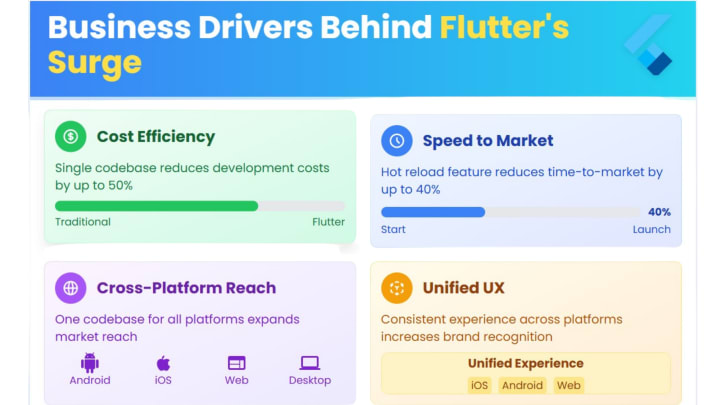
The Business Drivers Behind Flutter’s Surge
Business leaders anchor their decisions related to technology in business value, and that’s precisely where Flutter app development shines. It’s not just another framework for tech-focused leaders; this is a strategic asset that can streamline delivery, reduce engineering overhead, and rapidly scale digital experiences.
1. Lower Total Cost of Ownership (TCO)
Traditional native app development requires separate teams for Android and iOS, often doubling engineering and QA costs. In contrast, Flutter app development enables a single team to write once and deploy across platforms. This efficiency directly lowers development costs, ongoing maintenance expenses, and even hiring complexity.
2. Accelerated Time-to-Market
Speed is non-negotiable. Businesses can prototype, iterate, and launch much faster with Flutter app development than through traditional native mobile app development. This speed offers a crucial first-mover advantage, especially for product-driven companies.
3. Consistent UI/UX Across Platforms
Unlike Flutter vs Swift, where native iOS development typically offers tight UI control, Flutter's widget-based architecture delivers uniform experiences across devices, critical for maintaining brand integrity at scale.
4. Future-Proofing Through Platform Expansion
Flutter isn’t just for phones. Flutter app development helps businesses extend their products beyond mobile without restarting from scratch. This ecosystem consolidation means a faster path to omnichannel readiness.
Despite doubts raised by searches like “is Flutter dead”, especially in the wake of Google Flutter layoffs, the business case for Flutter remains compelling. Executives must ask themselves: if one team can deliver for five platforms in half the time, how long will siloed native app development remain viable?
Flutter vs. Native: A Strategic Comparison
The choice between Flutter app development and native app development is no longer a purely technical decision; it's a strategic one that affects your budget, hiring roadmap, user experience, and long-term scalability.
To help leaders make an informed call, here’s a direct comparison of Flutter vs Swift (iOS native) and Flutter vs Kotlin/Java (Android native) across key business-impact metrics:
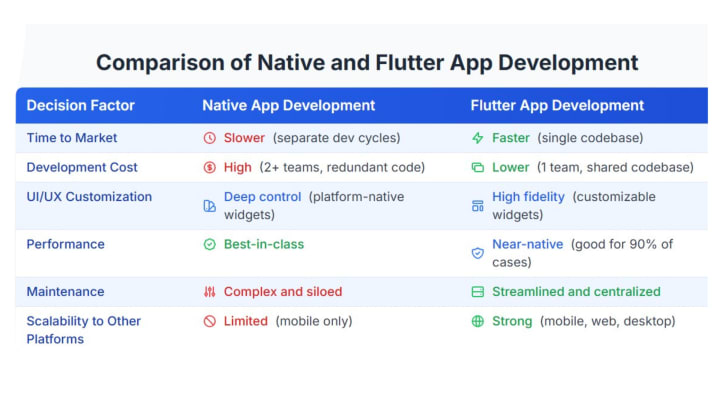
Executives often ask: “Does Flutter app perform as good as native applications?” The answer is: for the vast majority of business apps, yes. Unless you're building ultra-high-performance, hardware-intensive applications (e.g., 3D games, camera-heavy utilities), Flutter app development delivers performance that’s virtually indistinguishable from native.
This is especially relevant for product leaders facing rising development costs and elongated release cycles. By aligning with Flutter app development, organizations not only cut time and budget but also set themselves up for faster adaptation as user expectations evolve.
As for comparisons like Flutter vs Swift, it’s important to note: the real choice isn’t about superiority; it’s about strategic alignment. Native has its place, but Flutter is clearly engineered for scale, speed, and cross-platform cohesion.
The Innovation Factor: Flutter’s Ecosystem and Roadmap
Beyond cost and speed, Flutter app development is winning favor with forward-looking organizations because of its innovation potential. The framework isn’t just keeping pace with modern demands—it’s shaping the future of mobile and cross-platform application development.
Omnichannel Expansion
Flutter’s ability to extend beyond mobile to web and desktop is a game-changer. With Flutter 3 and newer releases, developers can build apps for macOS, Windows, and Linux—expanding your product’s reach with minimal overhead. This breaks the conventional boundaries of native mobile app development, where each platform demands a unique tech stack.
Tooling and Low-Code Evolution
Google’s launch of FlutterFlow, a low-code visual builder, signals a new wave of developer productivity. This innovation empowers product teams to rapidly iterate MVPs or internal tools, slashing both costs and development timelines. For executives balancing delivery speed with engineering headcount, this is a clear competitive lever.
Ecosystem Backing and Community Growth
Despite concerns raised by the Google Flutter layoffs, the ecosystem is expanding. A vibrant open-source community, thousands of plugins, and an aggressive release cadence prove that Flutter app development remains a priority for Google’s product strategy. The question “Is Flutter dead?” is best answered by the thriving developer adoption curve and continued corporate investment.
As more companies confront the limitations of traditional native app development, Flutter’s maturing ecosystem offers a resilient, forward-compatible path to innovation.
Risks & Limitations Executives Should Know
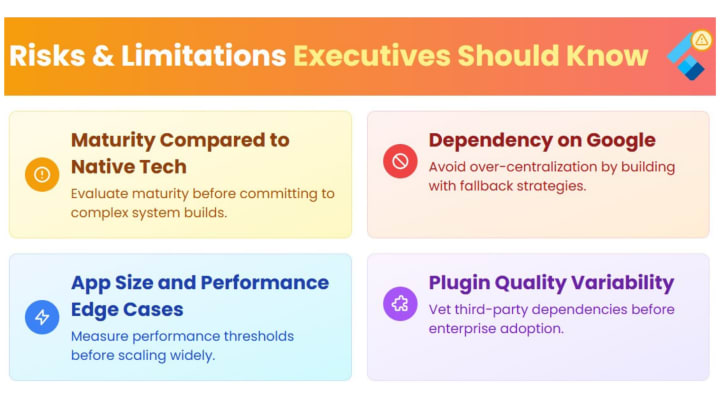
While Flutter app development offers powerful strategic advantages, no technology is without tradeoffs. For C-suite leaders evaluating digital infrastructure choices, understanding the potential risks is essential to making a balanced decision.
Maturity Compared to Native Tech
Despite rapid evolution, Flutter app development is still younger than native app development stacks like Swift or Kotlin. For apps that demand deep integration with native APIs or hardware, such as AR/VR tools, Bluetooth-dependent systems, or platform-specific animations, native mobile app development may retain a slight edge.
Dependency on Google
The question “Is Flutter dead?” occasionally surfaces due to changes within Google, including the highly publicized Google Flutter layoffs. While Flutter’s open-source nature ensures continuity, major roadmap decisions still rest with Google. For risk-averse enterprises, this level of vendor dependency might raise eyebrows.
App Size and Performance Edge Cases
Although most executives ask, “Does Flutter app perform as good as native applications?”—and for most business apps, it does, there are edge cases. Flutter apps can be larger in binary size and slightly less optimized for ultra-lightweight experiences (e.g., on low-end Android devices).
Plugin Quality Variability
Flutter’s strength is its rich plugin ecosystem. However, not all plugins are equally maintained or production-ready. This adds a level of engineering scrutiny during development that could offset time gains for highly specialized features.
In conclusion, these limitations are rarely deal-breakers, but they must be acknowledged. As with any strategic shift, due diligence matters.
Is This the End of Native App Development?
So, is Flutter app development the final nail in the coffin for native app development?
Not quite, but it’s undeniably a turning point.
In most business scenarios, Flutter now delivers near-native performance, faster time-to-market, and reduced costs. Unless you’re building extremely resource-intensive apps—like AAA gaming titles, advanced 3D rendering tools, or platform-dependent features—Flutter can meet the needs of nearly every product strategy.
When you evaluate Flutter vs Swift or Kotlin, the real question becomes: Do we still need to build everything twice to achieve excellence? The answer for most C-suite leaders is increasingly no.
The reality is that native mobile app development won’t disappear—it will be reserved for edge cases where device-specific functionality is mission-critical. But for enterprise applications, customer portals, B2C platforms, and MVPs, Flutter app development is fast becoming the preferred standard.
And the growing momentum behind Flutter, despite the wild spreading news like “Is Flutter dead?” or news of Google Flutter layoffs, proves it’s evolving, not fading.
In other words, Flutter app development isn’t killing native. It’s redefining when and why we choose native in the first place.
Strategic Recommendations for C-Suite Leaders
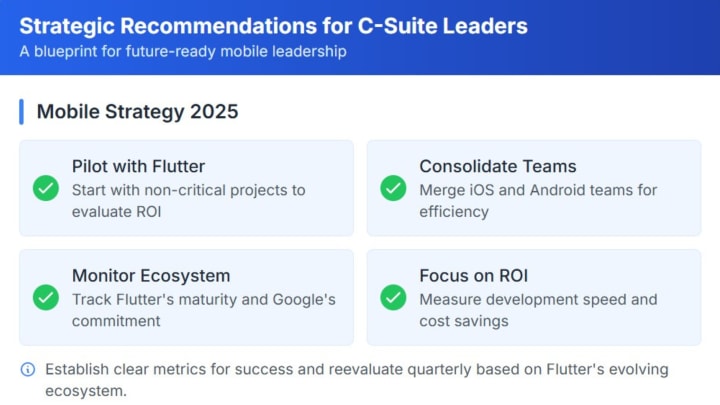
For executives evaluating mobile strategy through the lens of growth, cost-efficiency, and innovation, Flutter app development should be more than a technical experiment—it should be a core consideration.
1. Pilot with Purpose
Instead of revamping all digital products at once, begin with a pilot project using Flutter app development—perhaps a customer-facing mobile portal, internal dashboard, or MVP. Evaluate performance, development speed, and stakeholder feedback compared to prior native app development initiatives.
Learn how product discovery improves strategic alignment in mobile app projects.
2. Rethink Talent Allocation
Reduce dependence on separate iOS and Android teams. Invest in cross-platform talent or partner with a Flutter development company to optimize hiring costs and delivery timelines. This is especially useful if you’ve historically managed siloed native mobile app development operations.
3. Focus on ROI-Driven Tech Stack
Ask your teams not just how an app is built, but why. If performance trade-offs are negligible and costs are halved, Flutter app development becomes a logical path forward. Tools like FlutterFlow also provide low-code options for rapid prototyping and internal apps.
4. Monitor the Ecosystem (Not the Noise)
While headlines about Google Flutter layoffs and “is Flutter dead” may appear, the framework’s momentum and community are thriving. Focus on Flutter’s roadmap and developer community—not clickbait speculation.
Ultimately, a hybrid-first strategy that leverages Flutter app development for efficiency, while reserving native where necessary, gives your organization both flexibility and future-readiness.
Conclusion
The conversation isn’t about choosing Flutter app development instead of native; it’s about choosing the right tool for the right job, with strategy at the center.
For most enterprise use cases, Flutter app development delivers performance, efficiency, and speed that rival traditional native app development, all while simplifying operations and reducing cost. As mobile ecosystems grow more complex, solutions that unify platforms under a single codebase will win executive mindshare and budget.
There are many Flutter app development companies offering great development services that are cost-effective. These companies act as a safe start for businesses that are trying to avail these services with minimal resources and are not willing to compromise on quality.
Despite ongoing debates around Flutter vs Swift, and periodic concerns like “is Flutter dead” or the implications of Google Flutter layoffs, the market reality is clear: Flutter is not a fringe tool—it’s becoming foundational to modern development.
As a C-suite leader, your mobile strategy must reflect where the future is heading, not just where it’s been. Embracing Flutter app development—strategically, selectively, and intelligently—could be the inflection point your organization needs to lead in the digital age.
Explore the differences between native, hybrid, and cross-platform development here -> https://www.resourcifi.com/blog/native-vs-hybrid-vs-cross-platform/
About the Creator
Sarah Kamal
Sharing expert insights on next-gen tech services to help businesses innovate and grow!
Keep reading
More stories from Sarah Kamal and writers in Futurism and other communities.
Top React JS Features That Make it Ideal for Web Apps
React JS is the most commonly used library for frontend web development. It offers speed and flexibility, which makes scaling easy. It is one of the top choices for building high-performing web applications. As a founder or even as someone who is looking to scale their enterprise platform, it is best to understand the core features of React JS. It will guide you to build smarter and faster.
By Sarah Kamal8 months ago in Futurism
About Binding Prometheus
I want to start actively advocating on behalf of my own work, and the most valuable part of my canon is, without a doubt, Binding Prometheus, the play I have been working on since 2019 and only finished in 2023 as part of my MA. The play itself is an amalgamation of a million different inspirations. On one end, it evokes the Ancient Greek myth-play, deriving its own title from the earliest extant work of Western drama we have, Aeschylus’s Prometheus Bound. On the other end, it borrows significantly from the sci-fi bulwarks from over the years, namely Mary Shelley’s Frankenstein and Karel Capek’s Rossum’s Universal Robots. The play could be an episode of Black Mirror, I fear. I don’t know. I’ve only ever seen one episode of Black Mirror.
By Steven Christopher McKnight24 days ago in Futurism
Global Skateboard Market Size and Forecast 2025–2033
Global Skateboard Market Outlook The global skateboard market is undergoing a steady yet culturally significant transformation. According to Renub Research, the skateboard market is expected to reach US$ 4.53 billion by 2033, up from US$ 3.41 billion in 2024, growing at a CAGR of 3.20% from 2025 to 2033.
By Sushant. Renub Researcha day ago in Futurism




Comments
There are no comments for this story
Be the first to respond and start the conversation.