


The idea of being able to control one’s environment using thoughts was merely a dream of the realm of science fiction, until recently. Introducing the field of Brain-Computer Interface, a technology that enables the electric signals, generated upon brain activity, to be used to interact, manipulate, or control the environment.
Brain-Computer Interface is a system that gauges the activity of the Central Nervous System (CNS) and translates it into an artificial output that manipulates, enhances, or simplifies natural CNS output. Such a technological interaction has been found to have plenty of implications.
Research in the field of BCI began around the 1960s where trials were conducted on monkeys and the findings suggested that neural signals could be used to control a meter needle. However, systematic studies with human subjects began only in the 1970s. Initially, the progress in the research was slow due to the limitations of computer capabilities and our knowledge of brain psychology.
According to one of the latest scientific report, Invasive BCI focuses to improve the life of one suffering from quadriplegia, by using a decoded movement machine to let him interact with artificial robotic limbs. 3 Major factors like decoding error, alignment error and missing somatosensory feedback to analyse the performance of end effector with BCI (Brain computer interface). Using virtual reality model of a Brain computer interface decoder, with healthy participants, it was found that notable loss of performance assigned only to the alignment error. It was also found that 90° rotation of the robot arm performs worst relative to the participant leads, while no difference found in 45° and 0° robot arm.
Over a period of over 4 decades, progress accentuated, and the latest studies show that an individual is capable of controlling gadgets, such as television, sound systems, computers, etc., using BCI technology.
Currently, the electrophysiologic brain computer interface (BCI) systems are of two types: Invasive, and Non-Invasive.
A non-Invasive EEG-based BCI system is the safest and most convenient way to conduct studies and recruit participants. The applications of such a system are mostly limited to low-degree-of-freedom continuous movements and discrete selection. Due to the ease of its applications, observations have been made on spelling devices, conventional assistive devices, prosthetic devices, etc.
In an invasive EEG-based BCI system, the signals are captured from the cortical surface and thus require implantation of a subdural or epidural electrode array. EEG records signals of higher amplitude as compared to EEG. It has been used to decode finger and arm movements.
The applications of BCI range across a wide array of industries. This cutting-edge technology will add immense value, especially to the medical industry. Giving an opportunity to people challenged physically, verbally, or mentally, to be able to operate assistive devices using just the thoughts. This will, to an extent, free them from any kind of external aid required from another individual.
Moreover, applications of BCI have been observed in the gaming industry as well, wherein individuals are required to use a VR-headset. Using the BCI headset, an individual can perform the same controls using the brain, as he can using the conventional controller.
BCI technology, as it progresses, opens doors for a plethora of opportunities across different industries. It could help enhance the technological landscape manifolds. In addition, it could completely change the way we interact with our environment.
The possibility of being able to control the environment using the power of the brain generates tremendous excitement among scientists, researchers, doctors, and the regular public. This technology could be used to replace the conventional means of controlling our surroundings. What was once just a part of science fiction, is now turning into a reality that may very well serve as a feasible communication solution to our conventional problems.
About the Creator
Roshni Raturi
I am a content writer in Home Improvement niche with more than 5 years of experience. I have worked with many national and internation brands.
Keep reading
More stories from Roshni Raturi and writers in Futurism and other communities.
Trunk Injections: Everything You Need To Know About
While tree care depends on the time of year, trunk injections can be started at any time, whether it is summer or winter. Trunk injections infuse fertilizers and insecticides directly into a tree’s xylem – a tissue includes several specialized water-conducting cells known as treachery elements – using capsules. Trunk injections mean your tree will get 100% nutrients – they need for grow healthy – without leakage.
By Roshni Raturi6 years ago in Lifehack
Australia Energy Storage Market: Renewable Integration, Grid Resilience & Technology Advancements
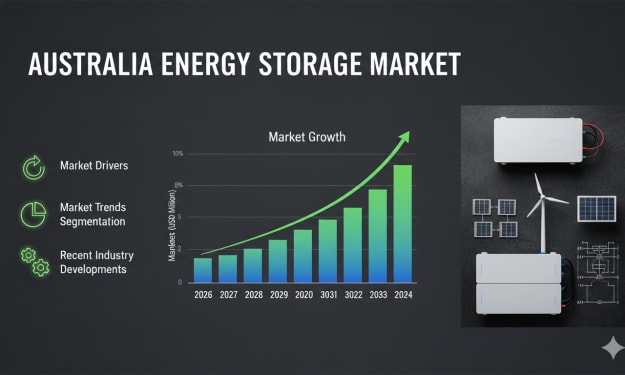
According to IMARC Group, the Australia energy storage market reached 4.72 GW in 2025 and is projected to expand significantly to 19.81 GW by 2034, exhibiting a robust compound annual growth rate (CAGR) of 17.28% during 2026–2034. This rapid expansion highlights the critical role energy storage plays in transforming the electricity ecosystem across Australia. As renewable energy capacity accelerates and coal-fired plants retire, storage systems are becoming essential for maintaining grid stability, ensuring reliability and supporting long-term decarbonization goals. From large-scale battery installations to residential storage units, energy storage is emerging as a cornerstone of Australia’s clean energy transition.
By Shrestha Roy6 days ago in Futurism
Cooking Oil Market: AI-Driven Innovation Transforming Global Edible Oil Demand
AI Overview of the Cooking Oil Market The cooking oil market includes a wide range of edible oils derived from plant and seed sources such as soybean, palm, sunflower, olive, coconut, and canola. These oils are essential ingredients in households, restaurants, food processing industries, and the HoReCa (Hotel, Restaurant, and Catering) sector.
By James Smithabout 8 hours ago in Futurism



Comments
There are no comments for this story
Be the first to respond and start the conversation.