
INTO THE BELLY OF THE BEAST
What if Human Went To Saturn?
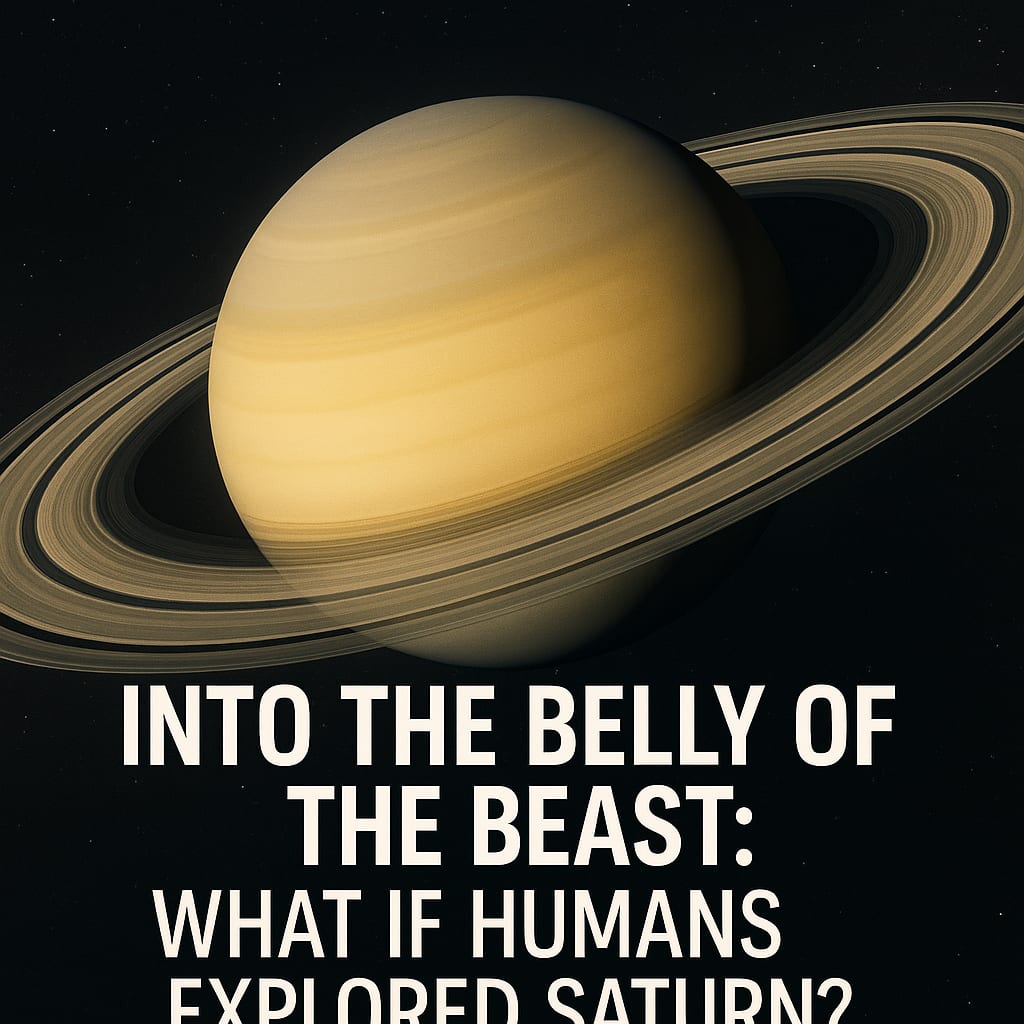
In 2017, NASA's Cassini probe gave us our most intimate look at Saturn, diving headfirst into the gas giant’s turbulent atmosphere. The images were breathtaking—but what if we, humans, made that daring journey ourselves?
First, the voyage. Saturn lies a staggering 1.2 billion kilometers from Earth. Even with today’s most advanced spacecraft, you’re in for a grueling eight-year ride. But finally, you arrive. And there it is—Saturn, in all its glory.
This planet is colossal—the second largest in the solar system. Over 760 Earths could fit inside. But we’re not just here for the size. We’re here for the rings—those dazzling, iconic halos that set Saturn apart from every other planet.
From afar, they seem like vast, flat discs—perfect for landing. But don't be fooled. The rings are no solid ground. They’re a chaotic ballet of ice and rock, from dust-sized specks to boulder-sized chunks. If you dared to hike around Saturn’s largest ring, you’d have to walk 12 million kilometers—about 15 round trips from Earth to the Moon. Along the way, you’d spot floating moons and ethereal spokes of dust, seemingly levitating in the cosmic void.
You might also notice icy particles raining down onto Saturn itself. That’s ring rain—a silent countdown. Saturn’s magnetic field is slowly stealing its own rings. Every 30 minutes, enough water to fill an Olympic pool vanishes. In 300 million years, those famous rings will be gone. Lucky us—we made it just in time.
Now, back to our ship. Destination: Saturn’s surface—except, there isn’t one. Saturn is a gas giant, made mostly of hydrogen and helium. At 4,000 kilometers up, we touch its upper atmosphere, diving through the north pole, where we’re treated to a glowing aurora, much like Earth’s but far more powerful.
But beware—Saturn’s auroras are charged with enough energy to scramble electronics, so this show might cost you your navigation systems.
Next comes the troposphere, where weather happens. Prepare for winds blowing at 400 meters per second—over three times the speed of Earth’s strongest hurricanes. Around you, thick yellow clouds swirl, heavy with ammonia crystals. Tempted to take a sniff? Don’t. Ammonia is toxic, and at -250°C, this place is colder than Antarctica's coldest night.
Dive deeper—300 kilometers down, things warm up. You hit a layer of liquid water at 0°C. But as pressure builds, water turns to solid ice, mixing with gases and pelting you in a storm of hail.
Make it through, and you’ll plunge into a sea of liquid hydrogen—not ideal for swimming. 1,000 kilometers in, the pressure alone would crush any Earth-made submarine like a soda can. But say you survive—there’s more.
Next stop: liquid metallic hydrogen—a strange substance that conducts electricity like metal. If your systems weren’t fried earlier, they probably are now.
And finally, the core. Scientists believe Saturn hides a dense heart made of iron and nickel, but whether it's liquid or solid remains a mystery. Reaching it means braving temperatures over 83,000°C—hotter than the surface of the Sun.
And that, dear explorer, is where your journey ends—your ship melted, your systems destroyed, and your bravery immortalized in the annals of space history.
Maybe… just maybe… we should leave Saturn to the probes.
About the Creator
Keep reading
More stories from Kreative William 254 and writers in Futurism and other communities.
Our Potential New Homes in the Universe
In the vast expanse of space, astronomers have been on a relentless quest to find planets beyond our solar system that could support life. Among the thousands of exoplanets discovered, a special group known as “super Earths” stands out. These are rocky planets with masses up to ten times that of Earth, and they could potentially become future homes for humanity. Let’s take a closer look at some of the most intriguing ones.
By Kreative William 25410 months ago in Futurism
GCC Generic Injectables Market Outlook: Growth Drivers, Competitive Landscape & Emerging Trends
According to IMARC Group's latest research publication, "GCC Generic Injectables Market: Industry Trends, Share, Size, Growth, Opportunity and Forecast 2025-2033", The GCC generic injectables market size reached USD 761.0 Million in 2024. Looking forward, IMARC Group estimates the market to reach USD 1,893.0 Million by 2033, exhibiting a growth rate of 10.7% during 2025-2033.
By Abhay Rajputabout 3 hours ago in Futurism
Australia Non-Dairy Coffee Creamers Market: Plant-Based Demand, Coffee Culture & E-commerce Growth
According to IMARC Group, the Australia non-dairy coffee creamers market reached a value of USD 78.5 Million in 2025 and is projected to reach USD 154.9 Million by 2034, growing at a compound annual growth rate (CAGR) of 7.85% during 2026–2034. The market is expanding as consumers increasingly shift toward plant-based alternatives due to lactose intolerance, dietary preferences and growing health awareness. Many consumers experience digestive discomfort when consuming dairy products, encouraging the adoption of non-dairy creamers made from ingredients such as almond, soy, coconut and oat. Australia’s strong café culture and rising coffee consumption are further supporting demand for plant-based creamers across households and foodservice outlets. At the same time, expanding e-commerce platforms and online grocery services are improving product accessibility and enabling consumers to explore a wider range of dairy-free coffee creamer options.
By Shrestha Roy3 days ago in Futurism



Comments
There are no comments for this story
Be the first to respond and start the conversation.