
Interactive Whiteboard Market Size and Forecast 2025–2033
How Smart Classrooms, Corporate Collaboration, and Digital Transformation Are Powering a USD 9.37 Billion Market

Introduction
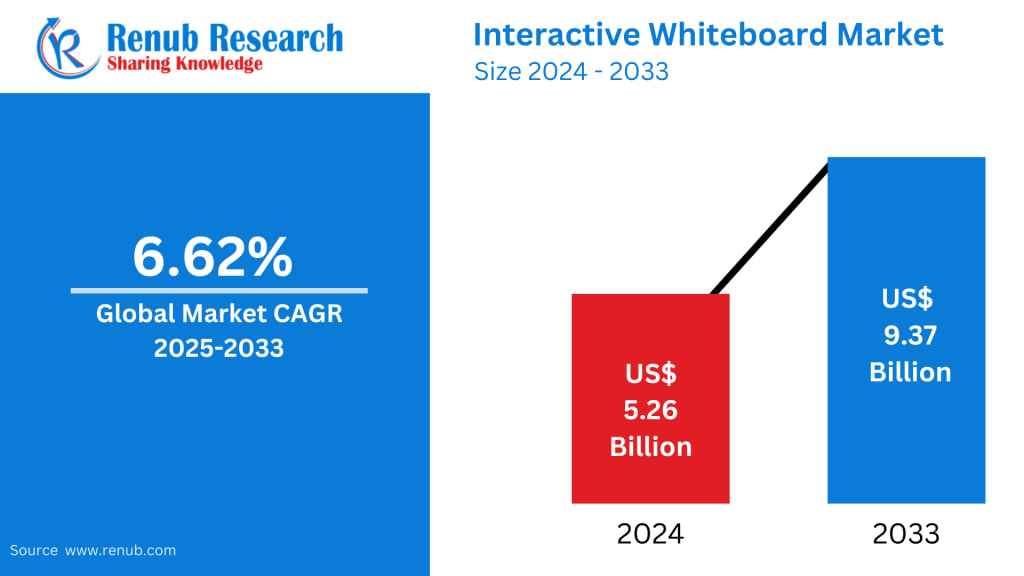
The global interactive whiteboard (IWB) market is entering a transformative decade, driven by rapid digitalization across education, corporate, and government sectors. According to Renub Research, the market is expected to grow from USD 5.26 billion in 2024 to USD 9.37 billion by 2033, registering a CAGR of 6.63% during the forecast period. Rising adoption of smart classrooms, hybrid work environments, and interactive collaboration tools continues to fuel demand.
In an era where communication and engagement depend increasingly on digital interfaces, interactive whiteboards have evolved from niche presentation tools into essential devices powering modern learning and business ecosystems. With advanced touch capabilities, AI-driven collaboration features, seamless device integration, and cloud connectivity, IWBs are reshaping the way people teach, learn, brainstorm, and innovate.
Renub Research’s comprehensive report, Interactive Whiteboard Market & Forecast 2025–2033, analyzes key segments—including Type, Technology, Screen Size, Application, and Country—while also examining leading global players. Below is an in-depth editorial-style breakdown of the market's current state, its evolution, and future opportunities.
Interactive Whiteboard Market Overview
Interactive whiteboards, also known as IWBs, are large touch-enabled displays connected to a computer or projector. They allow users to control content through touch, stylus input, gestures, or digital writing. Their versatility has made them indispensable in:
Education: boosting student engagement with dynamic multimedia lessons.
Corporate environments: enhancing meetings, virtual collaboration, and real-time brainstorming.
Government & institutions: supporting training, presentations, and decision-making.
IWBs can integrate video conferencing, annotation tools, content sharing, cloud storage, and real-time collaboration. As hybrid models become mainstream globally, the need for interactive, connected, and user-friendly presentation devices continues to rise.
Advantages of Interactive Whiteboards
The interactive whiteboard market is growing rapidly because it solves several modern challenges in communication and collaboration:
1. Enhanced Learning & Engagement
Touch-enabled screens allow teachers and trainers to deliver interactive lessons with videos, diagrams, quizzes, and simulations. Students participate actively, improving attention spans and retention levels.
2. Support for Remote & Hybrid Models
IWBs integrate with Zoom, Microsoft Teams, Google Workspace, and other platforms—making them ideal for hybrid classrooms and remote business environments.
3. Real-Time Collaboration
Multiple users can write, draw, and interact simultaneously—making IWBs efficient tools for brainstorming, design sessions, and problem-solving.
4. Replacement for Legacy Tools
IWBs reduce dependence on projectors, whiteboards, and flipcharts, providing all-in-one digital collaboration systems.
5. High Productivity & Creativity
The inclusion of cloud integration, interactive apps, and multimedia tools enables more engaging presentations and creative communication.
These advantages are accelerating global adoption, especially in education and corporate sectors undergoing digital modernization.
Future Outlook: Where the Market Is Heading
The future of interactive whiteboards is shaped by innovation in:
AI-driven collaboration
Cloud-integrated smart classrooms
Hybrid meeting ecosystems
Gesture-based and multi-touch technologies
4K/8K ultra-HD displays
Wireless device connectivity
As investments rise in digital education and smart workplaces, interactive whiteboards are expected to become a standard communication tool worldwide. The push toward personalization, immersive learning, and automation will further propel market expansion.
Key Market Growth Drivers
1. Increasing Adoption in Educational Institutions
Education is the largest application segment in the IWB market. Schools and universities are integrating interactive boards to modernize teaching methods and enhance learning outcomes.
Government-led digital education initiatives across India, China, Saudi Arabia, the UAE, Europe, and the U.S. are significantly boosting adoption.
Example:
Vedantu's W.A.V.E 2.0 platform (2022) uses AI and machine learning to improve teaching efficiency and student engagement.
Samsung and STS Education (2023) collaborated to deploy interactive whiteboards in smart classrooms.
2. Growing Demand for Remote Collaboration & Hybrid Work
Corporate work environments have evolved deeper into hybrid models. IWBs are now highly valued for enabling virtual meetings, real-time document editing, and cross-team collaboration.
Example:
Cisco Board Pro G2 (2024) was launched to deliver secure, intelligent, and integrated collaboration for global teams.
3. Technological Innovations & Smart Integrations
The market has seen rapid advancements such as:
AI-driven writing tools
High-precision infrared touch frames
Palm rejection technology
Anti-microbial display glass
Gesture-based commands
Multi-device connectivity
Example:
Boxlight’s MimioPro G (2024) includes Google EDLA certification, two-step authentication, encrypted data, and advanced IR touch accuracy.
These innovations make IWBs more efficient, secure, and scalable across industries.
Market Challenges
1. High Initial Investment & Maintenance Costs
Interactive whiteboards cost significantly more than traditional teaching and meeting tools. Installation, periodic upgradation, and software licensing pose financial constraints, especially in developing markets.
2. Lack of Technical Training
Without proper training, educators and professionals may underutilize IWB features. Poor integration or limited digital skills reduces adoption efficiency.
3. Compatibility Issues
Ensuring smooth integration with existing digital infrastructure can be challenging for institutions with outdated systems.
Segment Insights
Type
Fixed Projection
Portable Projection — increasingly popular due to mobility and affordability.
Portable IWBs are gaining traction among mobile trainers, field teams, and institutions with shared resources.
Technology
Infrared (IR) – most widely used; reliable, cost-efficient, supports multi-touch.
Resistive
Capacitive
Electromagnetic
Others
Infrared technology remains dominant due to durability and low maintenance.
Screen Size
Greater than 90 inches
71–90 inches (fastest-growing size segment)
50–70 inches
Less than 50 inches
Boards between 71 and 90 inches are preferred for classrooms and conference rooms because they offer optimal visibility and interaction space.
Application
Education (largest market share)
Corporate
Commercial
Others
Education remains the strongest demand generator, but corporate adoption is accelerating with hybrid meeting ecosystems.
Regional Market Analysis
United States
The U.S. leads the global market due to:
High EdTech adoption
Strong digital infrastructure
Corporate demand for collaboration tools
In January 2024, Newline Interactive partnered with Merlyn Mind to integrate AI-driven learning and meeting features into interactive panels.
United Kingdom
UK classrooms are rapidly transitioning toward digital-first environments. Public and private institutions are investing heavily in smart education tools.
A London-based school (2024) launched the first AI-driven classroom equipped with IWBs, VR, and personalized learning systems.
India
Driven by smart classroom initiatives and government digital literacy programs, India is one of the fastest-growing markets.
SMART Technologies introduced the MX and GX series in 2024, boosting availability and affordability.
China
China’s market is expanding due to extensive investments in smart city and smart classroom development. Both urban and rural schools are integrating interactive boards for improved teaching efficiency.
Brazil
Brazil is gradually adopting IWBs as part of digital transformation efforts in education. Corporate sectors are also increasing usage for remote collaboration.
UAE & Saudi Arabia
Both nations have strong government-led digital learning strategies:
UAE’s smart city goals
Saudi Arabia’s Vision 2030
These policy-driven investments make the Gulf region one of the fastest-growing markets for IWBs.
Recent Product Launches
SMART Technologies (2024) – MX Series® & GX Series® in India
CG Brand (2024) – Launched IWBs for education, corporate, and hospital use
SHARP India (2024) – Introduced new IWBs (PN-LC752, PN-LC862)
Ricoh (2022) – Released Android-based A-Series interactive boards
Google Workspace (2023) – Expanded integrations for collaborative IWB experiences
These developments highlight increasing innovation and global expansion.
Top Companies Covered
Renub Research analyzes leading companies across five viewpoints: Overview, Key Persons, Strategies, Portfolio, and Financial Insights. Major players include:
Hitachi Ltd
Panasonic Corporation
LG Display
Samsung Electronics
Cisco Systems
Alphabet (Google)
Microsoft Corporation
These companies continue to invest in touch technologies, cloud connectivity, and AI-driven systems to maintain competitive advantage.
Final Thoughts
The interactive whiteboard market is evolving rapidly, driven by the need for smarter, more engaging, and highly collaborative communication tools. With a projected value of USD 9.37 billion by 2033, IWBs are transitioning from optional teaching aids to essential digital infrastructure across the globe.
As schools adopt smart education models and corporations embrace hybrid work cultures, interactive whiteboards will serve as the central hub connecting people, ideas, and innovation. Continuous advancements in AI, display resolution, cloud integration, and security will further solidify their place in future classrooms and boardrooms.
The next decade is poised to be a landmark period for IWB technology—and the world is just beginning to unlock its full potential.
About the Creator
Janine Root
Janine Root is a skilled content writer with a passion for creating engaging, informative, and SEO-optimized content. She excels in crafting compelling narratives that resonate with audiences and drive results.
Keep reading
More stories from Janine Root and writers in Futurism and other communities.
Building Automation Systems Market Size and Forecast 2025–2033
The global Building Automation Systems (BAS) market, valued at USD 97.05 billion in 2024, is projected to reach USD 225.11 billion by 2033, expanding at a robust CAGR of 9.80% between 2025 and 2033. According to Renub Research, this growth is fueled by rising demand for energy-efficient infrastructure, the rapid penetration of IoT technologies, and the increasing emphasis on comfort, safety, and sustainability across modern buildings.
By Janine Root about a month ago in Futurism
About Binding Prometheus
I want to start actively advocating on behalf of my own work, and the most valuable part of my canon is, without a doubt, Binding Prometheus, the play I have been working on since 2019 and only finished in 2023 as part of my MA. The play itself is an amalgamation of a million different inspirations. On one end, it evokes the Ancient Greek myth-play, deriving its own title from the earliest extant work of Western drama we have, Aeschylus’s Prometheus Bound. On the other end, it borrows significantly from the sci-fi bulwarks from over the years, namely Mary Shelley’s Frankenstein and Karel Capek’s Rossum’s Universal Robots. The play could be an episode of Black Mirror, I fear. I don’t know. I’ve only ever seen one episode of Black Mirror.
By Steven Christopher McKnight14 days ago in Futurism
Saudi Arabia E-Commerce Market: Rising Online Adoption, Digital Payments & Demand Growth
According to IMARC Group's latest research publication, Saudi Arabia e-commerce market size reached USD 222.9 Billion in 2024. The market is projected to reach USD 708.7 Billion by 2033, exhibiting a growth rate (CAGR) of 12.8% during 2025-2033.
By Suhaira Yusuf3 days ago in Futurism


Comments
There are no comments for this story
Be the first to respond and start the conversation.