
Inside the Rise of AI-Generated Music: Will Your Favorite Artists Be Replaced?
The future of sound might not be human—should you be worried or wowed?
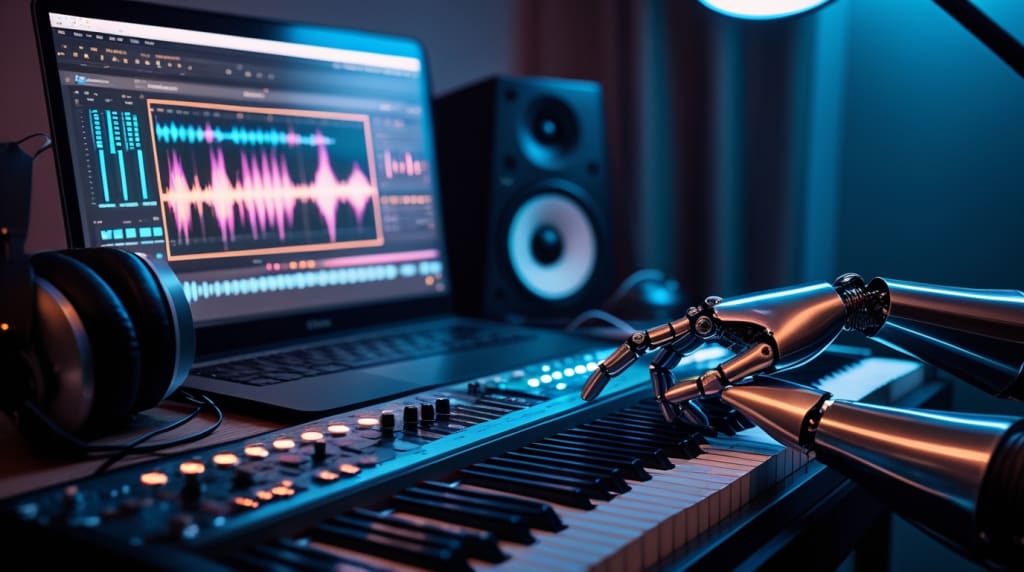
One day at random, you are on Spotify listening to a soothing, low-fi song. You search for the artist because it intrigues you. In the biography, there is only one word that would shock you: AI.
Wait, what?
Welcome to 2025, when artificial intelligence may create hit pop songs, replicate the voices of famous musicians, and compose whole symphonies instead of being constrained to creating emails and suggesting films. Music's future has arrived. Moreover, there could not be anyone in it.
Should we greet this change with pleasure or should we be concerned about the nature of music?
🎵 What Is AI-Generated Music, Anyway?
AI-generated music refers to music that is either completely composed, partially created, or heavily assisted by artificial intelligence. It’s built using algorithms trained on massive data sets—everything from Bach’s sonatas to Billie Eilish’s hits.
Using tools like Amper Music, AIVA, Jukebox (from OpenAI), Suno, and even Google’s MusicLM, AI can now:
Compose melodies and harmonies
Generate realistic vocals
Mimic famous voices or styles
Autocomplete a song based on a single prompt
Think of it like ChatGPT—but instead of spitting out essays, it’s spinning up beats.
🎤 Can AI Really Replace Human Artists?
Let’s get real: humans bring emotion, lived experience, and cultural context to their work. That’s not easy to fake. But AI is evolving faster than most of us are ready for.
Already, we’ve seen:
Fake Drake & The Weeknd tracks go viral on TikTok
AI-written jingles and background scores appearing in YouTube videos
Entire albums generated by AI—with zero human touch
And sometimes, listeners can’t tell the difference.
What’s more? Some artists are embracing it. Grimes famously said she’d split royalties 50/50 with anyone using her AI-generated voice. Others, like David Guetta, have dropped AI snippets in live sets. The line between artist and algorithm is blurring—and quickly.
🧠 Why Are People Actually Using AI for Music?
Simple: speed, affordability, and access.
AI allows:
Indie creators to have orchestral backgrounds without hiring musicians
Content creators to license royalty-free music at scale
Small businesses to get custom jingles or hold music in minutes
Everyday users to turn ideas into songs—without knowing a single chord
It’s democratizing music. You no longer need a record label or a studio. Just an internet connection and a few prompts.
🎧 But… Does It Sound Good?
Surprisingly, yes. In fact, some AI-generated music is indistinguishable from human-made tracks, especially in instrumental genres like:
Ambient
Classical
Lo-fi hip hop
Cinematic background music
But when it comes to lyrics and vocals, things get trickier. AI can replicate structure and rhyme, but not always meaning or authentic emotional depth. There’s still something missing in an AI's breakup song—it hasn’t had its heart broken.
Yet.
🤖 Artists Are Torn: Tool or Threat?
Here’s where things get complicated. Many musicians see AI as a powerful tool—not an enemy. It’s the digital equivalent of a synthesizer or an auto-tune plugin. You can:
Generate ideas or chords to beat writer’s block
Use AI vocals as a demo before hiring real singers
Remix your own tracks with AI-powered mastering
But others worry AI could:
Devalue original work
Flood streaming platforms with low-quality, algorithmic songs
Replace session musicians, composers, and even vocalists
It’s not just about “can AI make music?”—it’s should it replace the humans behind it?
🧑⚖️ What About Copyright and Ethics?
We’re in legal limbo.
Is it legal to release an AI song in Drake’s voice?
Who owns a melody created entirely by code?
Can AI "steal" from real songs it's trained on?
Laws are struggling to catch up. As of now:
Some platforms (like YouTube and Spotify) are beginning to flag or remove unauthorized AI impersonations
Music labels are pushing back hard against unlicensed AI mimicry
Artists are calling for ethical boundaries and consent-based AI models
We're entering an era where identity, voice, and originality are up for debate—and the law hasn't finished the chorus yet.
🌍 What Does It Mean for Music Lovers Like Us?
Here’s the truth: music is evolving—and it always has.
From vinyl to streaming, acoustic to electronic, the heart of music has always been about emotion and connection. If AI can enhance that, maybe there’s room for it. If it starts to replace human voices entirely, we have to ask ourselves: are we still listening to music, or just a reflection of ourselves through data?
You don’t have to fear AI in music. But you do have to stay aware. Ask:
Is this music authentic?
Is it honest?
Does it move me?
Whether it's made by a person or a program, the real magic of music still lives in what it makes us feel.
Final Thoughts
AI-generated music isn’t the end of artistry—it’s the start of a new chapter. One where human creativity meets machine learning. One where a 16-year-old in their bedroom can make symphonies, and a robot can write hooks that go viral.
Your favorite artist won’t be replaced—not yet. But they might soon be collaborating with something that doesn’t eat, sleep, or miss a beat.
And who knows? The next song that gives you chills might have been written by someone with zero heartbeat—and a whole lot of code.
About the Creator
Keep reading
More stories from Shahjahan Kabir Khan and writers in Futurism and other communities.
Tech Loyalty Tested: Why Even Apple Fans Are Considering the Pi Switch
For many years, Apple has had among the most passionate fan base in the technology industry. People would queue for blocks whenever a new iPhone debuted. Every table at the coffee shop was embellished with Mac stickers. AirPods also evolved to represent contemporary fashion. But a surprising rival—the Tesla Pi Tablet—is starting to eat away at that loyalty in 2025; soon it is said there will be a Pi Phone as well.
By Shahjahan Kabir Khan7 months ago in Futurism
About Binding Prometheus
I want to start actively advocating on behalf of my own work, and the most valuable part of my canon is, without a doubt, Binding Prometheus, the play I have been working on since 2019 and only finished in 2023 as part of my MA. The play itself is an amalgamation of a million different inspirations. On one end, it evokes the Ancient Greek myth-play, deriving its own title from the earliest extant work of Western drama we have, Aeschylus’s Prometheus Bound. On the other end, it borrows significantly from the sci-fi bulwarks from over the years, namely Mary Shelley’s Frankenstein and Karel Capek’s Rossum’s Universal Robots. The play could be an episode of Black Mirror, I fear. I don’t know. I’ve only ever seen one episode of Black Mirror.
By Steven Christopher McKnight18 days ago in Futurism
Saudi Arabia Boiler Market: Clean Energy Transition, Vision 2030, Emission Control & Modern Heating Systems
Saudi Arabia's boiler market grows through Vision 2030-driven industrialization, with rising demand in petrochemicals and power plants. Innovations like energy-efficient and biomass-fired models support sustainability goals, while Aramco expansions boost adoption of advanced systems amid rapid infrastructure projects. According to IMARC Group's latest research publication, Saudi Arabia boiler market size reached USD 902.70 Million in 2024. The market is projected to reach USD 1,631.91 Million by 2033, exhibiting a growth rate (CAGR) of 6.10% during 2025-2033.
By Jeffrey Wilson6 days ago in Futurism




Comments
There are no comments for this story
Be the first to respond and start the conversation.