
Industrial Internet of Things (IIoT) Market in Asia Pacific is expected to expand at a rapid CAGR
Industrial Internet of Things (IIoT) Market | Exclusive Report on the Latest Trends and Opportunities in the Future

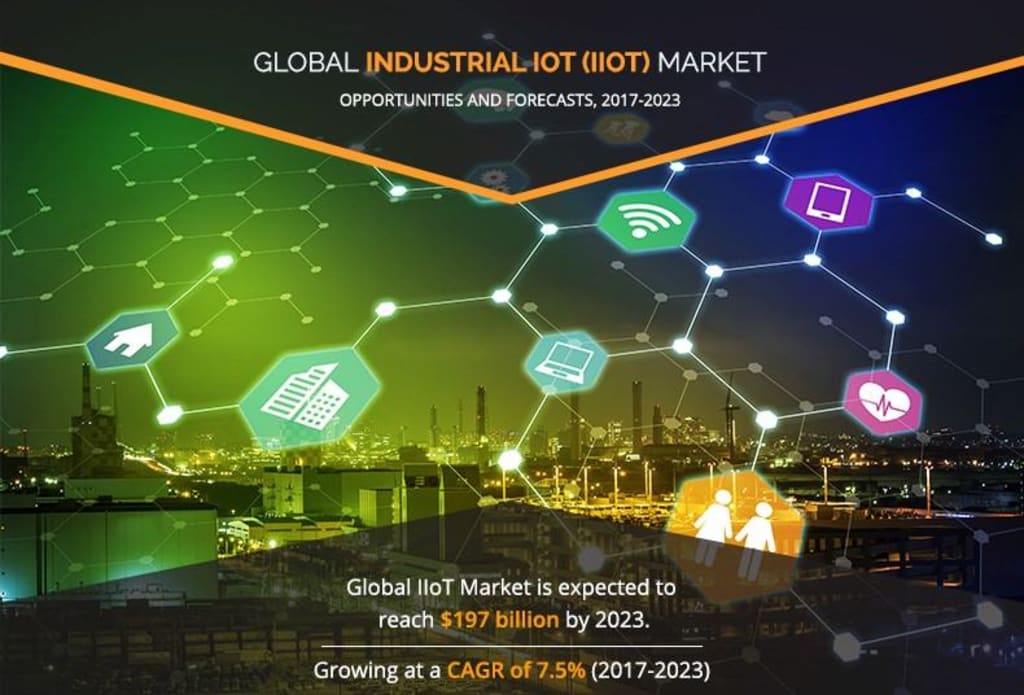
Allied Market Research, titled, Global Industrial Internet of Things (IIoT) Market by Component and Application: Opportunity Analysis and Industry Forecast, 2017-2023, the IIoT market size was valued at $115 billion in 2016, and is projected to reach at $197 billion by 2023, growing at a CAGR of 7.5% from 2017 to 2023.
IIoT is a network of multiple devices connected through communications technologies. The sub-systems are able to collect, monitor, analyze, and deliver insights for driving business decisions for the industrial companies. IIoT is an integration of advanced technologies such as Machine-to-Machine (M2M) communication
In 2016, the hardware components dominated the IIoT market in terms of revenue. Further, based on application, the manufacturing application led the market with 35% share in 2016.
Key Findings of the Industrial Internet of Things (IIoT) Market:
- Hardware components are projected to continue to maintain their leading position during the forecast period.
- Manufacturing application is projected to continue to maintain its leading position till 2023.
- Asia-Pacific is expected to exhibit promising growth rate during the forecast period.
- IIoT industry participants is anticipated to focus on introducing new products with innovations and partnerships to improve their market share.
The key players profiled in the report include Cisco Systems, Inc., General Electric, Intel Corporation, Rockwell Automation, Inc., ABB, Texas Instruments Inc., Dassault Systmes, Honeywell International Inc., Huawei Technology Co., Ltd., and International Business Machines Corporation (IBM). These market players focus on the development of new technology, launch of novel products with innovative variations, and adoption of partnership and collaboration as key strategies to establish their position in the market.
Low operational cost
Smart and connected products are critical components in the connected supply chain and smart manufacturing processes. Further, the advent of low cost connected devices has enabled manufacturers to adopt IoT technologies to lower resource consumption and increase the overall productivity. Moreover, due to low operational cost, several manufacturers prefer to implement IoT applications in machines to maximize the efficiency with reduced cost.
Growth in adoption of cloud-based deployment model
Demand of low-cost data storage, backup, and data protection are major opportunities for small & medium enterprises (SMEs). Implementation of cloud helps enterprises to provide better IoT services to various industry verticals.
Growth in adoption of Industrial Internet of Things
Advancement in technologies has helped key players to offer enhanced IIoT offerings to their end users. Integration of smart sensors into industrial machines has encouraged the manufacturers to reduce the operational cost by 50%, and this is expected to decrease further during the forecast period. Further, virtual and augmented reality offers end users a 360-degree of an object before manufacturing it in real.
Increase in technological advancements
Advancement in technologies has helped key players to offer enhanced IIoT offerings to their end users. Integration of smart sensors into industrial machines has encouraged the manufacturers to reduce the operational cost by 50%, and this is expected to decrease further during the forecast period. Further, virtual and augmented reality offers end users a 360-degree of an object before manufacturing it in real.
Inadequate IT infrastructure
Poor internet architecture and lack of skilled labors majorly limit the growth of the IoT in manufacturing market. Many of the developing countries lack basic IT infrastructure, which is pre-requisite for reliable connectivity. Further, power supply systems have to be stable and reliable to ensure high quality exchange of data between sensors and control systems. Therefore, poor internet connectivity in countries such as Africa, Malaysia, Chile, and Brazil is expected to hinder the industrial internet of things market growth in the coming years.
Surge in predictive maintenance
Predictive maintenance techniques are designed to determine the condition of in-service equipment to predict when maintenance is required. The application of predictive maintenance is based on actual condition of the equipment rather than time or age factors. Rise in adoption of predictive maintenance has encouraged key players to install such techniques into their existing machines.
About the Creator
Keep reading
More stories from Shubham Jamdade and writers in Futurism and other communities.
Wearable Sensors Market in Asia Pacific is expected to expand at a rapid CAGR | Allied Market Research
Allied Market Research, titled, " Wearable Sensor Market by Product Type and Application: Global Opportunity Analysis and Industry Forecast, 2014 - 2022",the global wearable sensor market was valued at $123 million in 2015, and is projected to reach $2,258 million by 2022, growing at a CAGR of 52.9% from 2016 to 2022. The wrist wear segment accounted for more than 45% share of the global market in 2015.
By Shubham Jamdadeabout a year ago in Futurism
Why Flutter and Firebase Are the Best Tech Stack for Startup App Development
Building a startup app today is very different from what it was even five years ago. Speed matters. Budget matters. Scalability matters even more. Most startups cannot afford a year-long development cycle or separate teams for Android, iOS, backend, and web. They need a tech stack that delivers a working product fast and scales when the business grows.
By Emily Carter5 days ago in Futurism
iOS & Core ML: Best Practices for Deploying ML Models in iOS App Development
Let’s face it, users expect their apps to be smart. They want apps that anticipate their needs, recommend content, and feel intuitive. That’s where machine learning in iOS comes in. From photo tagging to predictive text, ML is transforming how apps interact with users.
By Emily Carter7 days ago in Futurism




Comments
There are no comments for this story
Be the first to respond and start the conversation.