
India Biometrics Market Size and Forecast 2025–2033: Digital Identity Driving a Secure Future
India’s Biometrics Industry Poised for Strong Double-Digit Growth as Security, Digital Payments, and E-Governance Accelerate

India Biometrics Market Outlook
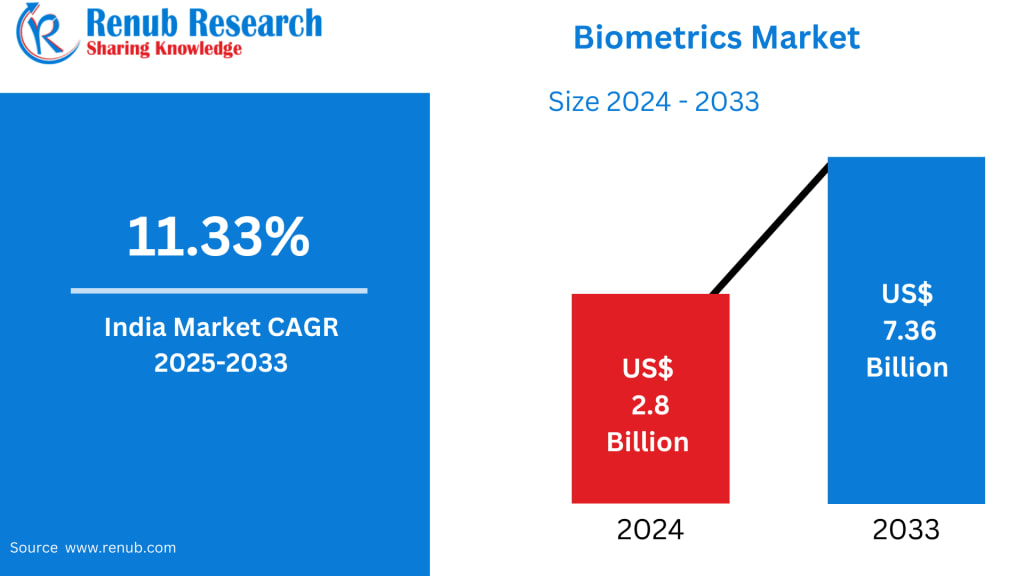
The India Biometrics Market is entering a high-growth phase as the country strengthens its digital infrastructure, expands e-governance, and enhances national security systems. According to Renub Research, the market is expected to grow from US$ 2.8 billion in 2024 to US$ 7.36 billion by 2033, registering a strong CAGR of 11.33% from 2025 to 2033.
This expansion is being driven by rising security threats, data theft concerns, and the government’s continuous push toward digitization and identity-based service delivery. From Aadhaar-enabled services and biometric banking authentication to smartphone security and border control, biometrics has become a cornerstone of India’s digital transformation journey.
As identity verification becomes increasingly essential in both physical and digital environments, biometric technology is evolving from a security tool into a fundamental enabler of India’s digital economy.
India Biometrics Industry Overview
The Indian biometrics industry has witnessed rapid adoption across sectors such as government, banking, defense, healthcare, transportation, and consumer electronics. At the heart of this growth is India’s large population, increasing digital inclusion, and the widespread implementation of Aadhaar, the world’s largest biometric ID program.
Government-led initiatives have created a nationwide biometric ecosystem that enables citizens to access welfare schemes, banking services, SIM card registration, and healthcare benefits securely and efficiently. Biometric authentication is now deeply integrated into daily life, particularly in urban and semi-urban areas.
Additionally, the rapid growth of digital payments, mobile banking, and e-commerce has fueled demand for secure authentication systems. Biometrics offers a unique advantage by eliminating passwords, reducing fraud, and ensuring seamless user experiences.
With advancements in AI-driven facial recognition, iris scanning, and voice recognition, biometric solutions are becoming more accurate, faster, and easier to deploy, paving the way for sustained long-term growth.
Rising Adoption in Consumer Electronics
The expansion of biometric applications in consumer electronics has significantly boosted market demand. Smartphones, laptops, and wearable devices increasingly rely on biometric authentication for unlocking devices, authorizing payments, and accessing sensitive applications.
For example, fingerprint sensors and face recognition systems have become standard features in smartphones across all price segments in India. Popular apps such as WhatsApp, banking apps, and digital wallets now allow biometric authentication, enhancing both convenience and security for users.
This mass adoption has normalized biometric usage, creating trust among consumers and encouraging further expansion into sectors such as healthcare, education, and enterprise security systems.
Rise of Multimodal Biometric Systems
In recent years, multimodal biometric systems have emerged as a key trend in India. These systems use multiple identifiers such as fingerprints, facial recognition, iris scans, and voice patterns to authenticate users.
Multimodal systems are particularly valuable in large-scale applications such as national ID programs, border control, defense, and financial services, where accuracy and reliability are critical. By combining multiple biometric traits, these systems reduce false positives and false negatives, ensuring stronger security and better user experience.
As security requirements become more complex, the demand for hybrid biometric systems is expected to grow rapidly across both public and private sectors.
Key Factors Driving the India Biometrics Market Growth
1. Rising Technological Advancements
Rapid improvements in biometric technologies are significantly enhancing system accuracy, speed, and reliability. Advanced machine learning algorithms, AI-powered facial recognition, and improved sensors have reduced error rates and increased adoption across industries.
Modern biometric systems can now operate effectively even in challenging conditions such as low lighting, aging fingerprints, or partial facial visibility. These technological breakthroughs are making biometric solutions more affordable and scalable, allowing even small organizations to implement secure authentication systems.
The integration of cloud computing, edge AI, and mobile biometrics is further transforming the industry, enabling real-time authentication and remote identity verification.
2. Growing Security and Fraud Concerns
India has witnessed a sharp increase in cyberattacks, identity theft, data breaches, and financial fraud in recent years. Traditional authentication methods like passwords and PINs are increasingly vulnerable to hacking, phishing, and misuse.
Biometric authentication provides a powerful solution by using unique biological traits that are difficult to replicate. As a result, banks, financial institutions, government departments, and enterprises are rapidly adopting biometrics to protect sensitive systems and data.
With rising digital transactions and online service delivery, biometric security has become essential to maintaining trust in India’s digital ecosystem.
3. Increasing Smartphone Penetration
India is one of the world’s largest smartphone markets, with hundreds of millions of active users. The widespread availability of biometric-enabled smartphones has significantly accelerated the adoption of biometric technology in everyday life.
Consumers now routinely use fingerprint or face recognition for unlocking phones, accessing apps, and authorizing payments. This familiarity is driving acceptance of biometrics in other domains such as healthcare, education, workplace access, and public services.
As smartphone penetration continues to grow in rural and semi-urban regions, biometric authentication will play a key role in expanding digital inclusion.
4. Government Initiatives and Digital India Programs
Government-led digitization initiatives are a major catalyst for market growth. Programs such as Aadhaar, Digital India, Jan Dhan Yojana, and Direct Benefit Transfer (DBT) rely heavily on biometric authentication to ensure accurate identification and eliminate fraud.
Biometric attendance systems in government offices, biometric verification at ration shops, and biometric authentication for banking services have become standard practices. These initiatives have created a strong foundation for sustained biometric market growth over the next decade.
Challenges in the India Biometrics Market
Privacy and Data Security Concerns
Despite strong growth, privacy and data protection remain critical challenges. Biometric data is highly sensitive, and any breach can lead to serious consequences such as identity theft or surveillance misuse.
Public concerns over data storage, consent, and misuse have increased, especially with large-scale biometric databases. India’s evolving data protection framework will play a crucial role in shaping public trust and future adoption.
To address these concerns, companies are investing in data encryption, decentralized storage, and privacy-by-design systems that protect user information while maintaining authentication efficiency.
Accuracy and Reliability Issues
While biometric technology has improved significantly, accuracy remains a concern in certain scenarios. Environmental conditions, physical changes, or sensor limitations can affect the reliability of fingerprint, face, or iris recognition systems.
For example, worn fingerprints, poor lighting, or facial obstructions can lead to authentication failures. These issues can cause inconvenience, especially in high-volume applications like banking or public services.
Continuous innovation, multimodal systems, and AI-driven improvements are essential to overcoming these challenges and ensuring consistent performance.
India Biometrics Market Segmentation
By Technology
Face Recognition
Fingerprint Recognition
Voice Recognition
Hand Geometry
Iris Recognition
Others
By Functionality
Non-Contact
Contact
Combined
By Component
Hardware
Software
By End Use
Government
Defense Services
Banking and Finance
Consumer Electronics
Healthcare
Commercial Safety and Security
Transport / Visa / Logistics
Others
Competitive Landscape: Key Companies in the India Biometrics Market
The Indian biometrics market is moderately fragmented, with both global leaders and domestic players competing across different segments. Companies are focusing on innovation, strategic partnerships, and large-scale government projects to strengthen their market positions.
Major Companies Covered
IDEMIA
SecuGen India Pvt. Ltd.
NEC Technologies India Pvt. Ltd.
4G Identity Solutions Pvt. Ltd.
HID Corporation
eSSL Security
3M India Ltd.
Honeywell International Inc.
These players are investing in AI-powered biometric systems, cloud-based authentication, and multimodal security solutions to meet evolving market needs.
Future Outlook: What Lies Ahead for India’s Biometrics Industry?
The future of the Indian biometrics market looks highly promising. As digital services expand and security requirements intensify, biometric authentication will become a standard feature across all industries.
Emerging technologies such as behavioral biometrics, AI-driven facial analysis, and blockchain-enabled identity systems will further reshape the market. Additionally, the integration of biometrics with IoT devices, smart cities, and connected infrastructure will create new growth opportunities.
By 2033, biometrics will not only secure identities but also power India’s vision of a seamless, inclusive, and trusted digital society.
Final Thoughts
The India Biometrics Market is undergoing a transformative phase, driven by technological innovation, government initiatives, and the growing need for secure digital authentication. With the market expected to reach US$ 7.36 billion by 2033, biometrics will remain at the center of India’s digital evolution.
As privacy frameworks strengthen and technology continues to mature, biometrics will play a pivotal role in enabling safe, efficient, and inclusive digital services across the nation.
About the Creator
Keep reading
More stories from Aaina Oberoi and writers in Futurism and other communities.
Laptop Market Size and Forecast 2025–2033: Global Industry Outlook, Growth Drivers, and Future Trends
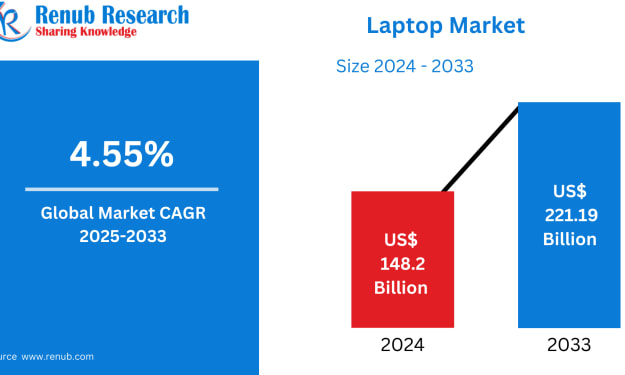
Global Laptop Market Outlook 2025–2033 The Global Laptop Market is entering a new phase of sustained growth, driven by evolving work cultures, rapid digital transformation, and rising demand for portable computing solutions. According to Renub Research, the global laptop market was valued at US$ 148.2 billion in 2024 and is expected to reach US$ 221.19 billion by 2033, growing at a CAGR of 4.55% from 2025 to 2033.
By Aaina Oberoi2 days ago in Futurism
About Binding Prometheus
I want to start actively advocating on behalf of my own work, and the most valuable part of my canon is, without a doubt, Binding Prometheus, the play I have been working on since 2019 and only finished in 2023 as part of my MA. The play itself is an amalgamation of a million different inspirations. On one end, it evokes the Ancient Greek myth-play, deriving its own title from the earliest extant work of Western drama we have, Aeschylus’s Prometheus Bound. On the other end, it borrows significantly from the sci-fi bulwarks from over the years, namely Mary Shelley’s Frankenstein and Karel Capek’s Rossum’s Universal Robots. The play could be an episode of Black Mirror, I fear. I don’t know. I’ve only ever seen one episode of Black Mirror.
By Steven Christopher McKnight24 days ago in Futurism
3D Cell Culture Market: Tissue Engineering Demand, Cancer Research Focus & Market Forecast
Rising demand for physiologically relevant in-vitro models is accelerating adoption of 3D cell culture across drug discovery, toxicology, and regenerative medicine. According to IMARC Group's latest research publication, global 3D cell culture market size reached USD 2,643.1 Million in 2024. LAccording to IMARC Group's latest research publication, global 3D cell culture market size reached USD 2,643.1 Million in 2024. Looking forward, IMARC Group expects the market to reach USD 7,819.7 Million by 2033, exhibiting a growth rate (CAGR) of 12.69% during 2025-2033.
By sujeet. imarcgroup4 days ago in Futurism
🅼🅸🅳🅽🅸🅶🅷🆃 🆂🅽🅰🅲🅺🆂
"It's 10 in Tuscon! We all know what that means... It's Time for Midnight Snacks with your man, Gerald Gee! Ready to spend the night together? Me too! I'm full of snacks and can't wait to regurgitate them all back into your hungry ears. Crack a brew! Pop some corn! Anything to get ready for one hell of a show where the talk maybe cheap but the words cut deep...
By Lamar Wiggins3 days ago in Fiction


Comments
There are no comments for this story
Be the first to respond and start the conversation.