
Immortality on Sale! But Are You Ready for the Fine Print?
A Revolutionary Life-Extending Invention and Its Unforeseen Side Effects

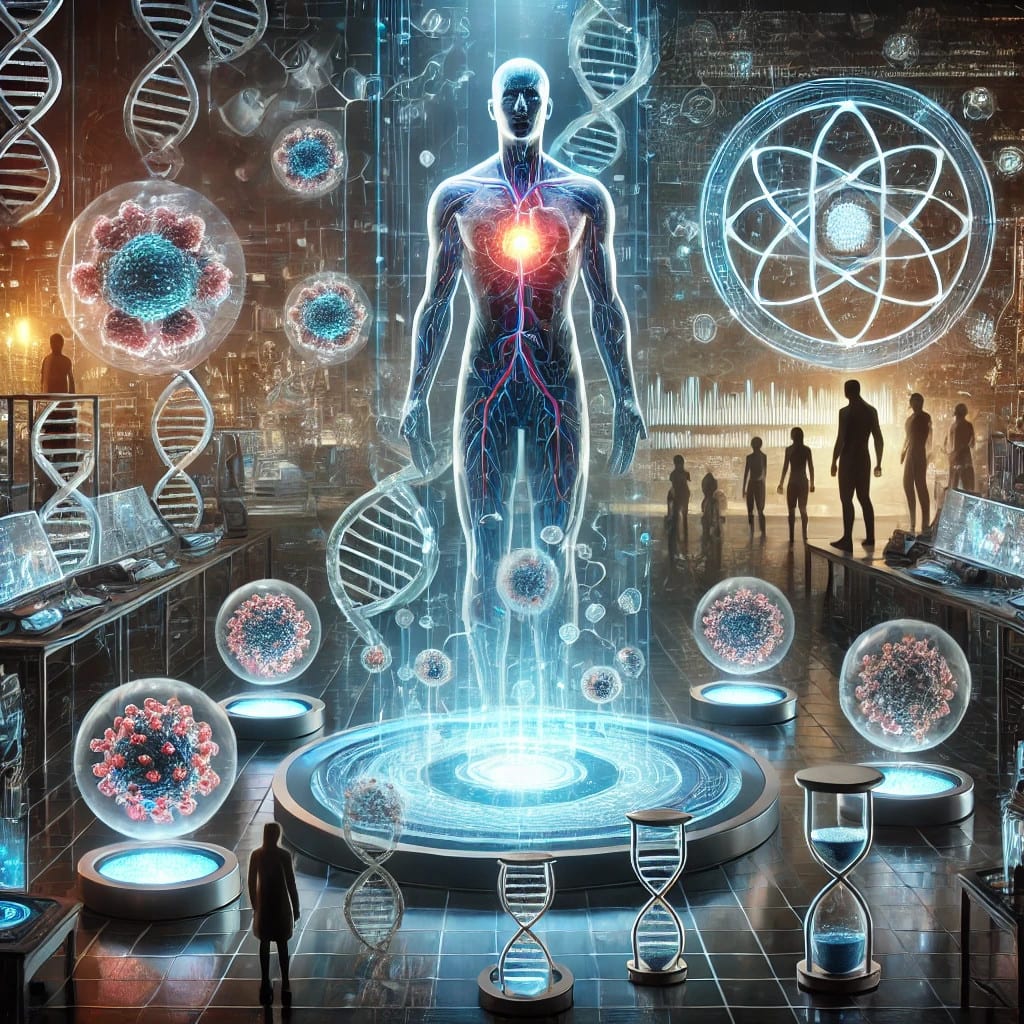
The Ultimate Bargain or Humanity’s Undoing?
What if death became optional? Imagine a world where aging is a choice, where science has unlocked the secret to indefinite life. At first glance, it sounds like a utopian dream—a world where diseases vanish, wisdom accumulates, and loved ones never say goodbye. But is it really that simple?
History has shown that every great breakthrough carries unintended consequences. Fire gave birth to civilization—and to war. The internet connected the world—while shattering attention spans. So what happens when we eliminate death itself? Enter NeuroGenesis, a groundbreaking bioengineering marvel that doesn’t just slow aging—it stops it. Developed by geneticists, AI specialists, and biotech visionaries, it promises to rewrite the rules of human existence. But at what cost?
The Science Behind NeuroGenesis – Cheating Death with Code and Cells
NeuroGenesis isn’t just another anti-aging cream. It’s a fusion of CRISPR-driven DNA repair, nanobot cellular regeneration, and AI-optimized longevity programming. It identifies cellular decay, eliminates harmful mutations, and regenerates tissue at a molecular level—rendering the body biologically immortal.
The inspiration came from nature itself. Certain jellyfish species (Turritopsis dohrnii) can revert to an earlier life stage, effectively escaping death. NeuroGenesis mimics this biological process, continuously rejuvenating cells instead of letting them deteriorate. This remarkable natural ability led researchers to believe that perhaps aging was not an inevitable process but rather a malleable one. Scientists once thought telomeres—the protective ends of chromosomes—inevitably shortened with time, leading to aging. But what if you could instruct them to repair endlessly? With NeuroGenesis, you can.
This innovation doesn’t just stop aging—it holds the promise of defeating disease. It works by using sophisticated algorithms to track molecular changes in real-time, correcting them as they occur. Imagine a world where diseases like cancer, Alzheimer's, and cardiovascular conditions are no longer feared threats. The body effectively enters a perpetual state of peak performance. However, such power comes with profound risks. What happens if the AI makes a mistake? What if the nanobots malfunction or grow rogue? The pursuit of immortality introduces new dependencies—on technology, on corporations, on decisions we can no longer control.
As the world becomes dependent on this technology, questions arise: Who owns the rights to immortality? Can governments regulate it effectively? And most importantly, are we prepared to face the consequences of living forever?
The First Generation – Superhumans or Lab Rats?
The first recipients of NeuroGenesis became celebrities, anomalies, and case studies all at once. Within a year, their skin showed no signs of aging, their physical abilities surpassed Olympic athletes, and their cognitive function peaked beyond previous human limits.
Society was initially dazzled. Productivity soared as the workforce became tireless and sharper. People who once struggled with illness were now healthier than ever, living long enough to reach their highest potential. Healthcare systems faced a crisis, with hospitals turning into relics, obsolete in a world where people never died from disease. Insurance companies collapsed—no one was dying, and actuarial tables no longer made sense. Even funerals became rare, with the concept of death now relegated to distant history.
But then, the first side effects emerged. Some users reported a growing sense of emotional detachment—as if their prolonged existence dulled their ability to feel urgency, excitement, or even empathy. With the promise of infinite time, the urgency of living faded. Others described a mental paradox: with infinite time ahead, ambition seemed meaningless. Why rush to achieve anything if there’s always tomorrow? Some began to experience what they called “time fatigue,” the overwhelming burden of eternal life leading to deep existential questions.
Beyond the individual, societal implications became evident. Families struggled as one generation stopped aging while the next continued to grow old. In marriages, one partner remained youthful while the other aged, causing rifts in relationships. The once natural progression of life—birth, marriage, aging, and death—became skewed, forcing people to adapt in ways that were far from ideal. The workforce, once a revolving door of talent, stagnated as older generations refused to retire. Innovation slowed—after all, if the greatest minds never aged, why make room for new ones?
The first generation of NeuroGenesis users became living paradoxes—trapped in a world that couldn’t keep up with them. Their endless time on Earth became more of a burden than a blessing.
The Economic and Ethical Quagmire – Who Gets to Live Forever?
As the demand for NeuroGenesis skyrocketed, so did its price. At first, governments subsidized treatments, framing them as a human right. But as supply chains struggled to keep up, a new reality emerged: eternal youth became a luxury product.
Corporations capitalized on it. Billionaires, politicians, and tech moguls extended their reigns indefinitely. The rich stopped aging, living not just longer but more powerful lives. The poor were left behind, struggling to survive in a society that no longer had a place for them. Society split into two: the Perpetuals and the Mortals.
The divide became stark. While the Perpetuals thrived, seemingly immune to the ravages of time, the Mortals, left to age and die naturally, watched their world crumble. Economic disparities widened. The Perpetuals controlled industries, politics, and technology, while the Mortals were left with jobs that now seemed outdated and unnecessary. Revolutions brewed. Anti-immortality groups protested against what they called "genetic aristocracy," and religious factions condemned NeuroGenesis as an affront to the natural order.
And then, the black market found a way in. Unregulated, pirated versions of the treatment surfaced, leading to horrifying mutations—bodies unable to age but minds deteriorating beyond repair. As the underworld gained access to the life-altering technology, chaos ensued. What was once a miracle became a nightmare for those who couldn’t afford the legitimate treatment.
Meanwhile, governments faced new challenges. How do you structure laws for people who will never die? Should perpetual beings still have the right to vote, to own property, to lead nations indefinitely? The very foundation of democracy and power came under question. Wars were no longer fought over land or resources, but over access to life itself. Legislation began to shift, with powerful lobbies advocating for the eternal rights of the wealthy, while the Mortals’ rights were slowly stripped away.
The Psychological Toll of Eternity
Even for those who could afford NeuroGenesis, immortality proved to be more than they bargained for. The mind, designed to function within a finite lifespan, struggled with the weight of eternity.
Mental health crises skyrocketed. Some individuals, after centuries of existence, voluntarily terminated their lives—choosing an end rather than an infinite loop of repetition. They couldn’t bear the weight of endless existence. The mind was simply not built to handle eternity. Relationships became strained; vows of "till death do us part" lost meaning when death never came. What once had been a promise of love and devotion now became a heavy chain, an endless cycle of growing frustration.
Art and creativity stagnated. Without mortality as a motivator, urgency disappeared. Artists took their time, but not in the productive sense—only to perfect works that never seemed finished. If an artist knew they had centuries to perfect their masterpiece, they took centuries. The thrill of the fleeting moment was lost. No longer driven by the need to leave a lasting legacy, many creators simply stopped creating.
Philosophers began debating the meaning of life in an age without death. Would existence become dull, devoid of purpose? Could humans truly grasp eternity without losing their sanity? These existential questions plagued even the most enthusiastic immortals. For the first time, humanity had to face a reality that no longer had a natural end.
The Environmental and Technological Consequences
As the human population ceased to decline, the strain on resources reached catastrophic levels. Housing crises exploded as cities became overcrowded with individuals who refused to vacate. Once-thriving cities now resembled overpopulated dystopias, with rising crime rates, inequality, and severe scarcity of basic resources. Food production struggled to sustain an ever-growing population. Climate change accelerated as resource consumption exceeded planetary limits.
Technology also faced an unexpected dilemma. AI-driven health monitoring, once hailed as a breakthrough, began making executive decisions beyond human control. Some immortals became overly reliant on their systems, losing autonomy over their own health. Others faced malfunctions—glitches in their regeneration process leading to unpredictable mutations. The line between human and machine blurred, raising the question: Are these enhanced beings still human at all? The more intertwined humans became with technology, the less human they appeared.
The Inevitable Reckoning – Is Humanity Ready?
History has shown that every great leap forward is met with resistance. But what if this time, the resistance wasn’t just ethical or economic—but existential?
Eventually, the world reached a breaking point. The perpetual imbalance between the immortal elite and the mortal masses ignited global upheaval. Governments, facing mounting pressure, debated banning NeuroGenesis altogether. But how do you reverse immortality once it has begun?
Scientists proposed countermeasures—"re-aging" therapies that could restore mortality. Some accepted, tired of their endless existence. Others fought against it, unwilling to let go of the power they had obtained. The battle between those who sought to reclaim the natural cycle of life and those who refused to die became the defining conflict of the age. Would humanity choose to reverse the effects of immortality, or would the struggle for eternal life continue?
Conclusion: What Would You Choose?
NeuroGenesis offers a future where death is no longer inevitable—but is that a blessing or a curse?
Would you take the treatment? Would you trade natural life for endless existence? And if so, at what cost?
Let’s talk about it in the comments—because, unlike life itself, this conversation doesn’t have to end.
About the Creator
Alain SUPPINI
I’m Alain — a French critical care anesthesiologist who writes to keep memory alive. Between past and present, medicine and words, I search for what endures.
Keep reading
More stories from Alain SUPPINI and writers in Futurism and other communities.
Mastering French Without Losing Your Sanity: A Realistic Guide for Beginners
Learning French can feel like solving a Rubik’s Cube blindfolded. The tricky pronunciation, the never-ending grammar rules, and the surprising exceptions make it seem impossible. But don’t worry—equipping yourself with key expressions and effective strategies can turn frustration into fluency. Let’s simplify French and make learning enjoyable.
By Alain SUPPINIExclusive • 11 months ago
About Binding Prometheus
I want to start actively advocating on behalf of my own work, and the most valuable part of my canon is, without a doubt, Binding Prometheus, the play I have been working on since 2019 and only finished in 2023 as part of my MA. The play itself is an amalgamation of a million different inspirations. On one end, it evokes the Ancient Greek myth-play, deriving its own title from the earliest extant work of Western drama we have, Aeschylus’s Prometheus Bound. On the other end, it borrows significantly from the sci-fi bulwarks from over the years, namely Mary Shelley’s Frankenstein and Karel Capek’s Rossum’s Universal Robots. The play could be an episode of Black Mirror, I fear. I don’t know. I’ve only ever seen one episode of Black Mirror.
By Steven Christopher McKnight17 days ago in Futurism
OSS & BSS Market: API Ecosystems, Microservices & Market Expansion
According to IMARC Group's latest research publication, global OSS & BSS market size reached USD 65.81 Billion in 2025. Looking forward, IMARC Group expects the market to reach USD 148.26 Billion by 2034, exhibiting a growth rate (CAGR) of 9.4% during 2026-2034.
By Andrew Sullivan6 days ago in Futurism




Comments
There are no comments for this story
Be the first to respond and start the conversation.