
I Use AI to Analyze My Dreams, And I Am Loving It
Two dreams and the surprising insights AI uncovered


As 2025 is nearing its end, I started reflecting on all the different tools I used throughout the year to improve my wellbeing. Mood tracking apps, health apps, water-intake reminders, sleep-cycle calculators. But the tool that surprised me the most wasn’t even designed for mental health. It was Gen AI.
I heard someone say (which, in Gen Z language, means “I saw it somewhere on TikTok”) that ChatGPT could be used for psychoanalysis. This idea immediately struck me, because even years before AI became mainstream, I already had the habit of journaling my dreams — the strange ones, the emotional ones, the ones that stayed with me for days. So I combined the two. I created a folder titled Dream Analysis and wrote a custom prompt, my little digital therapist's instruction manual. The key part of it reads:
“You are a world-class cognitive scientist, trauma therapist, and human behavior expert. Your task is to conduct a brutally honest and hyper-accurate analysis of my personality, behavioral patterns, cognitive biases, unresolved traumas, and emotional blind spots, even the ones I’m not aware of. Analyze each dream using clinical psychology, symbolic interpretation, archetypes, emotional schemas, and everything you know about dream logic. Decode what my unconscious mind is trying to communicate to my conscious self.”
Every morning, as soon as I woke up, I told AI about my new dream. And the insights were so sharp, so strangely accurate, that I kept doing it. Soon, patterns emerged: recurring places, recurring symbols, recurring emotional loops. It felt like inviting an extra lens into my mind, one that could connect dots I wasn’t connecting myself.
Below are two dreams that shaped this practice for me and the interpretations that stayed with me long after.
“Stay or Leave?” (April 13, 2025)
I was in my university with colleagues from work, except the university was located near the beachfront, which is definitely not the case in real life. Somehow my underwear fell off the balcony. One of my female colleagues jumped into the sea to catch it before I did. When she returned it to me, I felt both grateful and deeply exposed.
Then we had a swimming competition with a coach. Swimming is usually my strength, but in the dream I was extremely weak. After we got back to the boat, I asked the captain how I did, and he waited until others were out of earshot before telling me I was last. I explained that my medication has been making me feel drained, and he understood.
Randomly, the environment completely shifted. My friend and I walked through an imaginary town I’ve seen in my dreams before. A street singer, a woman in her fifties with long blond curls, heavy makeup, and vibrant clothes, sang about couples staying together through ups and downs. It felt theatrical, exaggerated, like a performance of loyalty and endurance.
Then I entered a modern cave glowing with red and orange walls — another recurring place in my dreams. Inside, I suddenly had a toddler in my arms. I didn’t know if the child was mine. Still thinking about the singer’s message, I found myself reflecting on how breakups and divorces are justified when a relationship becomes harmful. In the cave, an open book was displayed as a visual piece of art. One side symbolized staying; the other symbolized leaving. My image represented the leaving; the singer’s, the staying. A family of four walked by, mother, father, daughter, son, and in that moment it felt like they belonged to the “staying” story. A life path I was observing from the outside.
What AI Saw in It
What struck me most was how creatively the AI interpreted each element of my dream. It extracted the core symbols and gave them emotional meaning.
- University mixed with work people: A blending of self-evaluation with professional performance. The university became a place of measuring myself, and the colleagues symbolized social comparison and the pressure to overperform.
- Underwear falling: A vulnerable and exposing moment. Underwear symbolizes intimacy, boundaries, and the inner self. A colleague retrieving it before you do suggests others may see your vulnerabilities before you can own them.
- Swimming competition: A disconnection from my usual emotional strengths, which AI interpreted as: “You’re traditionally good at swimming, but here you're weak — a radical shift from your self-image. It implies you’re currently disconnected from your emotional resilience.”
- The singer: A representation of cultural or internalized expectations about relationships, the story that staying is noble and endurance is admirable. She is performing the idea of staying.
- The cave: A recurring emotional battleground — modernized, yet primal. The red and orange interior suggested tension, passion, frustration, and unresolved conflict.
- The toddler: A symbol of emotional responsibility, something I’m holding but unsure whether it truly belongs to me.
- The open book: The central thesis. The split “stay vs. leave” imagery represented my struggle to justify a departure, from a person, a role, or a version of myself, while still trying to understand those who choose to stay.
- The family passing through the cave: Not judgment, but contrast. A reminder of a path I didn’t know I wanted, but still think about.
And finally, the distilled message:
“You don’t feel strong in the way you used to. You fear being seen before you’re ready. You’re revisiting unresolved emotional territory. You’re rationalizing and emotionally processing a choice to leave something, or someone.
This was the moment I realized AI might actually be helping me understand myself.
“How did this horse get in here?” (December 6, 2025)
I dreamt that I was in a white room with large, bright windows. Outside, several horses stood near the house. One black horse approached, pushed through a half-open window, and entered the room. I panicked and called for my father to kick it out. The horse calmly walked around the house, then opened the window with its mouth and left. When I returned later, the same horse approached me again and simply wanted to be next to me.
What AI Saw in It
This analysis felt almost cinematic. Horses represented instinct, personal power, raw emotional energy, and parts of myself I either suppress or don’t fully trust. The fact that they were outside the window showed that these forces were near, but not welcomed — hovering right at the edge of consciousness.
The black horse specifically became the Jungian “shadow,” the intense, unfiltered part of me I’ve been taught to regulate or minimize. Its behavior mattered: it didn’t storm in or cause damage. It respected boundaries. It left when asked. And yet it came back when I did. AI explained that the qualities I fear, intensity, desire, emotional force, are not dangerous. They are simply unfamiliar, and they keep returning because they belong to me.
Calling my father symbolized an old reflex, relying on external authority to handle emotions that feel too big. But the horse leaving peacefully showed that what I fear inside myself is not trying to harm me; it wants coexistence.
The final message of my unconscious was surprisingly gentle:
“A powerful part of you, instinctual, passionate, authentic, is trying to re-enter your life. You are afraid of it because it doesn’t fit your old identity. But it is not here to harm you; it is here to accompany you.”
What This Whole Experiment Taught Me
These months of dream journaling with AI made me realize how much of my emotional life unfolds in symbols long before it reaches my conscious mind. My dreams have been trying to tell me stories about myself that I wasn’t yet ready to articulate. And AI didn’t magically psychoanalyze me; it simply gave language to things I was already feeling but hadn’t pieced together.
I learned that recurring settings are not random. That certain characters appear when I’m wrestling with a decision. That emotional shifts I feel during the day show up at night as underwater races, singing strangers, or visiting horses. Most of all, I learned that my unconscious isn’t silent; I just wasn’t listening.
The habit has become grounding, curious, oddly comforting. I’ll keep sleeping, dreaming, and letting my unconscious send me messages, one surreal storyline at a time.
About the Creator
glowlikevega
actually me, under a disguise.
Keep reading
More stories from glowlikevega and writers in Futurism and other communities.
Storms That Know My Name
It was a dark, moonless November night. The apartment was empty except for the two of them. Arym was hurting inside, though nothing in the way he carried himself ever revealed it. That notion, however, never applied to Kira. She could see through him. To her, his face was like a glass window in a summer house facing the sea. When the waters were calm, reflecting sunlight, she could stare out endlessly and feel his warmth. But when the waters stormed, the window offered no shield. No lattice of glass could hide the violence beneath.
By glowlikevega3 months ago in Chapters
Artificial Intelligence (AI) Market Set to Surpass USD 10,173.05 Billion by 2034
The global Artificial Intelligence (AI) Market is projected to expand from USD 638.2 billion in 2024 to approximately USD 3,680.5 billion by 2033, registering a robust CAGR of 19.1% during the forecast period. Growth is being driven by rapid enterprise digital transformation, rising demand for automation, large-scale adoption of generative AI, and strong government investments in AI infrastructure. North America currently leads the market, supported by advanced cloud ecosystems and high enterprise AI spending.
By Roberto Crum3 days ago in Futurism
Australia Steel Market: Infrastructure Development, Mining Demand & Manufacturing Growth
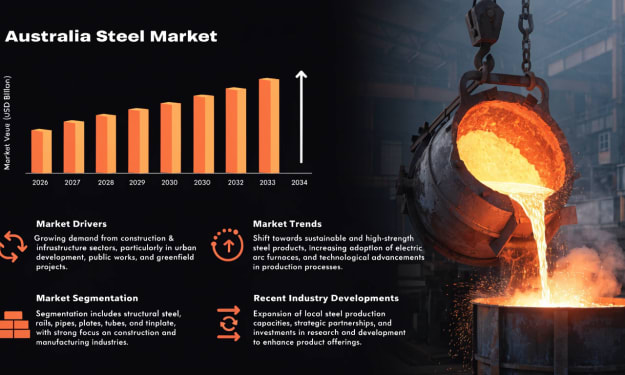
According to IMARC Group, the Australia steel market reached USD 20.1 Billion in 2025 and is projected to grow to USD 26.2 Billion by 2034, exhibiting a compound annual growth rate (CAGR) of 2.91% during 2026–2034. Steel remains one of the most essential materials supporting economic development in Australia. Its widespread applications across construction, mining, transportation, and manufacturing sectors make it a critical component of the country’s industrial ecosystem. Large-scale infrastructure development, expansion in mining operations, and rising domestic manufacturing activity are strengthening Australia steel market share. Additionally, government investments in renewable energy infrastructure and transport modernization projects are further increasing demand for advanced steel products.
By Kevin Coopera day ago in Futurism
Lightning Never Strikes Twice
The distant rumble, the sudden deluge, the crescendo of sound, the flash of light, the explosive energy — it never gets old. I became an amateur storm chaser about two years ago. My wife, Cindy suggested it. Sort of. She said, "Alex, you know this cancer is killing me. I've come to terms with that, but you're smothering me. Go join a band, write a book, or become a storm chaser, for all I care. I love you, but you need a hobby."
By Julie Lacksonen6 days ago in Fiction



Comments
There are no comments for this story
Be the first to respond and start the conversation.