
Hyperlocal ecommerce- Fostering online buying habits among consumers
Hyperlocal ecommerce has built in customers a habit to buy things online


“Since the coming into being of hyperlocal ecommerce, consumers worldwide have enjoyed the luxury of buying things online. Alongside buying from traditional brick-and-mortar stores, consumers habituated of hyperlocal delivery services have resorted to online platforms more often.”
Introduction
Just like ecommerce changed the way people chose and bought products, hyperlocal ecommerce transformed their behavior in entirety. It is the widespread prevalence of immaculate hyperlocal ecommerce delivery software and on-demand delivery apps that have facilitated online buying among consumers. Consumers of today, have become used to getting convenient, instant and economical deliveries at their doorsteps which in a way is making them go hyperlocal.
A brief about the modern-day customers
The modern-day customers have become pretty ravenous about what they want. Be they groceries, food meals, laundry services, home essentials, or anything that can be delivered through a hyperlocal model, they are just getting too impatient to lay their hands on their ordered products. This is a development seen in recent years and the fact that all that a customer needs can be fulfilled instantly and just as promptly as batting an eyelid is making them drool over the efficiency of hyperlocal businesses.
Majority of customers are getting accustomed to hyperlocal ecommerce rather than traditional ecommerce. The underlying cause for it is the efficiency and economy of the hyperlocal model. After all, in today’s economically competitive times, who wouldn’t want to switch to a model that is economical , efficient and lightning fast? Businesses, seeing an opportunity in the hyperlocal model have jumped on to the hyperlocal bandwagon, and a plethora of customers are widely resorting to hyperlocal ecommerce delivery software and apps in order to make orders and receive quick deliveries of products.
This transition speaks volumes about contemporary consumer behavior and the way they perceive buying to be. For instance, buying for them is no longer a hassling experience, because all that they want is just a few clicks and taps away. Yes! Rightly and interestingly so. Keep on your pajamas, take out your smartphone or flip open the laptop, spare yourself and your local retailer the awkward hassle of in-person shopping. Sit back, relax and wait for the purchase to land at your doorstep—almost instantaneously.
Consumer behavior and the corresponding change in how things are delivered
Hyperlocal ecommerce has brought about a fundamental change in the way consumers shop and it is this change in consumer behavior that has caused an essential shift in how items are delivered. The traditional supply chain was built for an era of limited supply, where customers came to a brick-and-mortar retailer and bought what they needed. But the galloping rise of ecommerce and then its subsequent transition to hyperlocal, has transformed supply from its physical and limited state to a virtual state—which is "always available."
This has necessitated the coming into being of robust and efficient hyperlocal ecommerce delivery software and apps that can actually meet that soaring demand. There you order a thing, here it arrives to your doorstep sort of a delivery speed! In fact, according to Digital Commerce 360, 68 percent of online shoppers cited fast shipping capabilities as the determining factor for placing an online order.
Logistics managers and industry brands are now faced with the critical task of setting up new supply chain fulfillment strategies to meet the increased demand for speed, convenience and lower costs. One concept that retailers are embracing to meet these skyrocketing expectations for on-demand delivery is hyperlocal fulfillment centers—the newest evolution in e-commerce supply chain solutions for urban areas.
Knowing about the consumer habits during and after the pandemic- Data and observations
If there is one thing after technology that has compelled the customers to go for increased online buying, it is the sudden outbreak of the pandemic. Leaving people across the world in a fix, with restrictions to stay indoors and with absolutely no options to procure items of daily use, consumers were at the mercy of hyperlocal businesses. Several hyperlocal ecommerce delivery software companies did put their best foot forward by developing apps that could prove a sense of instant gratification to the suffering customers, others were just figuring a way out.
Prudent businesses joined hands with such delivery partners and met customers’ needs and expectations to a large extent. This way of shopping and getting goods delivered instantly for a prolonged time has significantly impacted contemporary consumer behavior. Today, 56% of consumers are patronizing neighborhood stores or buying locally sourced products, according to Accenture’s findings on post-covid purchasing behaviors that are poised to stick.
Moreover, according to a study by BrightPearl, one of the pivotal shifts in spending habits of consumers since the outbreak of the pandemic is a drift toward local shopping and a move away from malls, with 75% of consumers planning to shop more locally over the next year. Customers are highly likely to seek meal solutions from local convenience stores, which will help sustain the shift to local shopping, Standish predicts. “Overall, staying close to your local downtown is definitely in-vogue and will likely stay for a while.”
While at-home food consumption and the meteoric rise in meal-delivery apps like DoorDash have leveled off from their pandemic peak, those sales will remain ahead of pre-pandemic levels, said Todd Hale, retail insights thought leader, during a webinar on consumer trends in food from The American Bakers Association.
Consumers’ physical and online buying patterns
Though hyperlocal ecommerce has made customers pretty habitual of availing online hyperlocal delivery services, they are still putting their trust in physical stores and the perks that are associated with physical buying. This must not be forgotten that successful hyperlocal communities live at the intersection between physical and digital commerce. When these two models live in harmony, hyperlocal economies are likely to boom.
Physical commerce needs to adapt in order to maintain a role in these urban mixed-use environments. People often are not satisfied with buying an item simply because it’s nearby. They need to have a physical feel of it prior to buying. Businesses in fairly developed and urban areas need to attract and retain customers by creating personalized experiences that strengthen the culture of a community, provide added value and make them shift to online buying more and more by achieving logistical efficiencies.
Because in a world where a particular set of customers are still in a bit of shilly-shally whether to go for a physical purchase or an online one, hyperlocal businesses ought to show them the right way- a way ahead, a way towards the future, a way towards hyperlocal ecommerce.
Wrapping up
The fact cannot be taken casually that modern-day customers have had a fantastic transformation in the last couple of years. Though those customers that never fathomed doing online shopping and were skeptical about making online payments have started doing it, consumers who were already partly into it have pretty interestingly gone deep into the finest details of online buying and on-demand delivery services and are therefore wanting more hyperlocal deliveries to their doorsteps.
It is the awakened consumer of today and his evolved behavior that has pushed hyperlocal ecommerce delivery software companies to the limits. And it is the ultra-modern, state-of-the-art and immaculate capabilities of on-demand delivery software that has them dancing and grooving around the beats of a spectacular and irresistible hyperlocal model.
One thing which is sure is that consumers of today have become perfectly accustomed to buying things online. Right from a small convenience product to a complex specialty product, hyperlocal businesses have made customers habitual of seeking instant, convenient, economical and contactless deliveries, and that too with the speed of light. The fulfilment of such deliveries can only be made possible through a hyperlocal ecommerce model that is too quick and efficient to fail.
The increasing adoption of technology by businesses and with things like artificial intelligence, automation, robotics and blockchain technology further lined up for adoption, techno-savvy businesses are highly likely to make customers enjoy and relish every bit of their ‘hyperlocal’ habits. Yes! With that happening, hyperlocal ecommerce is going to get efficient and speedy as never before. And it appears that customers who have become so habitual of availing hyperlocal deliveries would not be able to give up on that so easily, because habits, as they say, die hard.
About the Creator
Dr. Shamael Zaheer Khan
Dr. S.Z. Khan is a revered academic. He brings a unique blend of theory and practice to his position as Vice President (Marketing & Strategy) at a leading SaaS firm. He is also an expert contributor to several platforms of repute.
Keep reading
More stories from Dr. Shamael Zaheer Khan and writers in Futurism and other communities.
Your Galaxy Watch 7 Just Got a Major 2026 Refresh: 4 Things You Need to Know
For many of us, the ping of a software update notification often triggers a brief moment of anxiety—a nagging worry that a new patch might slow down a reliable device or tether us to a charger. However, in the high-stakes tech landscape of early 2026, these updates have evolved into the primary way our hardware actually improves over time. As the new Galaxy S26 series makes its debut, Samsung is ensuring the Galaxy Watch 7 receives the same software dignity as its latest flagships, proving this 2024-era wearable remains a vital, high-performing pillar of the ecosystem. The big news this week? The February 2026 security update has officially moved beyond its initial testing grounds in South Korea and has gone global.
By Tech Horizonsabout 16 hours ago in Futurism
Australia Aerospace and Defense Market: Sovereign Defense Capability Development, Next-Generation Aerospace Systems & Integrated Security Infrastructure
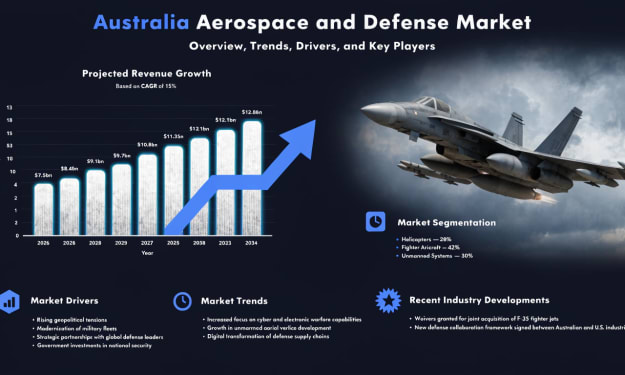
According to IMARC Group, the Australia aerospace and defense market reached a value of USD 13.6 Billion in 2025 and is projected to reach USD 21.4 Billion by 2034, growing at a compound annual growth rate (CAGR) of 5.04% during 2026–2034. The market is expanding as Australia strengthens its national security framework and invests in advanced aerospace technologies and defense capabilities. Rising geopolitical considerations and evolving security challenges are encouraging governments to increase defense budgets and modernize military infrastructure. Programs focused on sovereign defense capability development are encouraging domestic manufacturing of defense equipment, aircraft systems and advanced military technologies. At the same time, collaborations between Australian defense agencies and international contractors are accelerating innovation and enabling technology transfer. Investments in next-generation aerospace systems, cyber defense technologies and satellite communication infrastructure are further supporting the growth of the aerospace and defense sector.
By Kevin Cooper2 days ago in Futurism
The Forsyth House Fire
Since 1851, Forsyth House has stood on the corner of Union Street and Gordon Street in the heart of Glasgow. Its iconic, or was... because on Sunday 8th of March, 2026, a fire broke out in a small, seemingly un-named shop in the building and tore all that history down. As I write, the rubble is still unsettled and the street is still blocked off. Central Station is quiet on the upper level, and around 30 small businesses have quite literally gone up in smoke.
By S. A. Crawford2 days ago in The Swamp



Comments
There are no comments for this story
Be the first to respond and start the conversation.