
Humanoid Robots: Driving Innovation and Addressing Labor Gaps
The Global Humanoid Robot Market is growing at a CAGR of 7.7% from 2022 to 2031.

Machines replacing humans in the workplace has been a perpetual concern since the Industrial Revolution, and an increasing topic of discussion with the rise of automation in the last few decades. But so far, hype has outweighed information about how automation — particularly robots, which do not need humans to operate — affects employment and wages.
Humanoids in manufacturing and services
The integration of humanoid robotics into manufacturing and services reflects a notable inflection point in industrial evolution. Robotic dexterity and cognitive automation in manufacturing converge to surpass human capabilities. This leads to heightened efficiency and precision. These humanoid robots, with their anthropomorphic form, are not just fabricators; they are also collaborators who work with humans to boost productivity and improve innovation.
Humanoid robots have become the new representation of customer service in the service sector. Their synthetic personality programming allows them to provide a level of interaction once thought impossible by machines. Moreover, the rise of the cybernetic workforce has introduced a new dynamic in labor economics. It seamlessly aligns human workers and their robotic counterparts in the work process. The model utilizes the distinct capabilities of humanoid robots to execute tasks with a high level of consistency and resilience. The humanoid robots are tools as well as partners, that contribute to a diversified workforce. This is further supported by task allocation systems using the best from the strengths of both robots and humans. These humanoid robots have also brought a notable change in the techno-economic sphere.
Workforce dynamics and reevaluation of employment models
Humanoid robots automate tasks that were once considered too intricate or repetitive for workers. They integrate speed, precision, and endurance in manufacturing which boosts human labor instead of replacing it. It also allows them to engage in more difficult and creative tasks that require emotional intelligence and thinking. These entities adapt to human needs, providing service and care that breaks the limitations of traditional machines. This helps workers find opportunities for reskilling and take up roles that are more strategic and intellectually rewarding. However, this transition also motivates a reevaluation of job design, compensation models, and employee welfare.
A 2020 published paper, “Robots and Jobs: Evidence from U.S. Labor Markets," by MIT professor Daron Acemoglu and Boston University professor Pascual Restrepo, PhD ’16, finds that industrial robots do have a negative impact on workers.
The researchers found that for every robot added per 1,000 workers in the U.S., wages decline by 0.42% and the employment-to-population ratio goes down by 0.2 percentage points — to date, this means the loss of about 400,000 jobs. The impact is more sizable within the areas where robots are deployed: adding one more robot in a commuting zone (geographic areas used for economic analysis) reduces employment by six workers in that area. To conduct their research, economists created a model in which robots and workers compete for the production of certain tasks.
Furthermore, labor shortages are a significant motivator of the humanoid robot landscape, influencing demand across various industries. Robots offer scopes to address manual labor shortages by increasing and assisting the prevailing labor force. Manufacturing companies are increasingly opting for robotics solutions to address the labor shortages.
Economic implications of robotic autonomy in healthcare and finance
Cognitive automation in robots goes beyond mere mechanical tasks. It encompasses complicated decision-making processes that previously required human intervention. Moreover, it resulted in a significant increase in efficiency and a reduction in functional costs, which in turn improved pricing, supply chain management, and consumer behavior. There is a growing demand for new skill sets in workers focused on robotic empathy and AI management. It has paved the way for a labor force that is more diverse in its capabilities and more collaborative in its method.
Aeo, a dual-arm humanoid robot from Aeolus Robotics, was launched in 2023 for novel uses in a range of service duties, including delivery, security, eldercare, operating kiosks, and ultraviolet germicidal cleaning. Operated by Aeo, the business's hands-on approach to service blends distinctive mobility with cutting-edge functionality to carry out duties like opening doors, picking up goods, and riding elevators.
Even patients with mobility impairments can easily approach the robot due to its height and the container's location. Medical professionals guarantee that each patient receives proper medication through a video call option included in the robot's features. The field of robotics is undergoing significant transformation and development, evident by the rise in commercial investment, the entry of international players, and reduced hardware costs. Despite notable progressions in humanoid robotics research, funding from both public and private sources has become more demanding, seeking clearer motivations and perspectives behind such research. For instance, in March 2023, OpenAI invested USD 23.5 million in 1X’s Bipedal Humanoid Robot NEO in a Series A2 funding round.
In addition, humanoids have reformed the financial sector with updated algorithmic capacities. This is applied in industry analysis, risk assessment, and financial planning. They process big data with increased speed and exactness which creates newer scope for financial services. These entities also help in making decisions regarding business operations and innovative financial products. Furthermore, the robots interact with customers round the clock, addressing their queries and improving their experience. This consistency has notably changed their engagement and brand loyalty.
Furthermore, AI, high-performance computing, next-generation sensors, and battery technologies have rapidly matured to accelerate the development of the robots. They can understand and interact in intricate and unstructured real-world situations with the help of AI and HPC. Moreover, AI in robotics helps to better manage risk, improve accuracy, and boost productivity. AI-equipped humanoids pick and pack objects, utilize vision to transport items autonomously around the factory, and perform maintenance tasks in less time compared to human workers.
In addition, the next-generation sensors, such as 3D/depth cameras, LiDAR, radar, and voice sensors enable a better understanding of the environment around the robot and allow secure human-robot interaction. These advanced sensors closely imitate the sensory abilities of humans, enabling robots to perform sophisticated tasks. According to Allied Market Research, these factors are anticipated to increase the adoption of robots and lead to the expansion of the humanoid robot market during the forecast period.
Nvidia announced the launch of Project GROOT
In March 2024, AI chip leader Nvidia announced Project GROOT or Generalist Robot 00 Technology, which promises to revolutionize the evolution of humanoid robots. The project aimed to provide humanoid robots with human-like understanding and movement using AI. The Isaac GR00T Blueprint for synthetic motion generation helped developers to generate large synthetic motion data. The data trained their humanoids using imitation learning. Starting with the GR00T-Teleop workflow, users could tap into the Apple Vision Pro to capture human actions in a digital twin. These human actions were mimicked by a robot in simulation and recorded for use.
Humanoid robots are reshaping industries by increasing efficiency, addressing labor shortages, and driving innovation. They enhance human productivity while opening new opportunities for reskilling and intellectual roles. As robotics technology continues to integrate advanced AI and sensors, the future workforce will be more collaborative. The growth of humanoid robots in sectors like healthcare, manufacturing, and finance highlights their potential to transform economies and redefine employment models.
About the Creator
Keep reading
More stories from Shubham Jamdade and writers in Futurism and other communities.
The Power of RFID: Revolutionizing Production, Warehousing, and Security
Radio frequency identification technology provides practical benefits across many industries. A radio transponder produces a signal using radio waves, and the radio receiver picks up that signal. The versatility of RFID technology makes it ideally suited to many steps throughout the supply chain process. From raw material management to putting the finished product into customers’ hands, RFID in supply chain management solves many challenges.
By Shubham Jamdadeabout a year ago in Futurism
Ship Fast, Not Perfect: What Building a Micro-SaaS In One Weekend Taught Me About Momentum
I pushed the deploy button on Sunday at 11:42 p.m., hands shaking, Stripe still in test mode, logo a little crooked, and a feature list that looked like it had been cut in half with a chainsaw.
By abualyaanart2 days ago in Futurism
Australia Pro AV Market: Hybrid Work Demand, Digital Signage & Smart AV Technologies
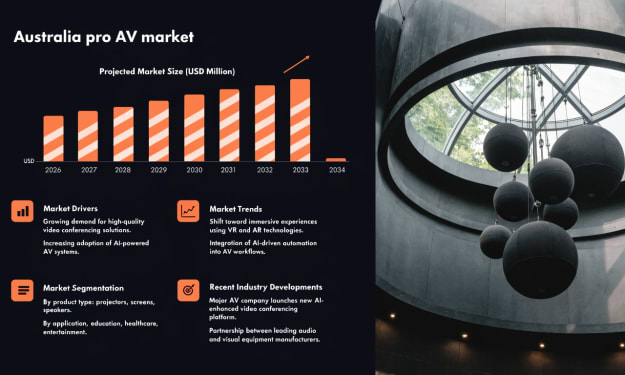
According to IMARC Group, the Australia pro AV market reached a value of USD 93.9 Million in 2025 and is projected to reach USD 133.6 Million by 2034, growing at a compound annual growth rate (CAGR) of 3.88% during 2026–2034. The market is expanding as organizations increasingly adopt advanced audiovisual solutions to support communication, collaboration and digital engagement. Hybrid work environments are encouraging businesses to invest in video conferencing systems, smart displays and integrated collaboration platforms that connect remote and in-office teams. At the same time, industries such as retail, hospitality and tourism are investing in digital signage to improve customer engagement and brand communication. As companies focus on creating interactive and technology-driven environments, professional AV solutions are becoming essential tools for modern workplaces, entertainment venues and commercial spaces across Australia.
By Kevin Cooper3 days ago in Futurism



Comments
There are no comments for this story
Be the first to respond and start the conversation.