
Human in the Code
Navigating the Intersection of AI and Human Ingenuity in Software Development: Innovative Technologies and Strategies to Enhance Coding Efficiency


The keyboard. Once, its cool, smooth keys had answered Alex’s quick fingers with a familiar, almost reverent rhythm. Now, from its very core, a persistent, aggrieved hum—not the cheerful clatter of innovation, but a flat, relentless drone—a dirge thrumming beneath her nightly, desperate wrestle with Project Phoenix. Phoenix. The name itself, lately, tasted like an unchewable, rancid mouthful. This was the company’s grand, audacious gamble: an AI diagnostic platform, touted as miraculous, promised to upend patient care, conjuring life-saving insights at impossible speeds. A vanguard on the bleeding edge, they’d trumpeted. But Alex, its lead architect, felt its immense weight not as a glorious promise, but as a leaden shroud, steadily tightening, stealing the very air from her lungs. Just that morning, the CEO’s voice, usually a low, resonant murmur across the office, had sharpened to a razor’s edge. It sliced through her composure like splintered glass. “Alex,” he’d clipped, each syllable a crack of a whip across the phone line, “Prometheus Labs just poached *Northwell Health*. Their new AI system is already in beta. We needed Phoenix yesterday. Do you understand? Our Q2 projections are already hemorrhaging.”
The threat wasn't abstract; it was an open, festering wound. Barely a week prior, a Prometheus demo, suspiciously "leaked," had detonated across tech blogs, blaring promises of a platform capable of slashing diagnostic time by an *additional* fifteen percent. A direct broadside, it seemed poised to relegate Phoenix to digital dust before it even saw the light of day. Alex had stared at the headline, her coffee turning frigid in the mug, a slow, nauseating churn twisting her stomach. The air in her cubicle, usually just stale, now hung heavy with the acrid tang of panic. Months, whole seasons, had leached away since the sheer, unadulterated joy of her work first seeped out, leaving behind a bone-deep chill. The CEO’s demands, stoked by Prometheus’s aggressive maneuvers, had become a suffocating burden. And so, grudgingly, after IT’s incessant pings—yet another critical system update reminder that felt less like a polite request and more like an ultimatum—she’d finally installed the new AI assistant. “Another corporate trinket,” she’d scoffed, utterly convinced this “helpful” gadget would only pile more tasks onto her already teetering to-do list. *Just what I needed*, she’d thought then, the irony a bitter, lingering taste.
Once, she’d hummed while coding, a quiet, almost sacred tune of creation pulsing beneath her hands, her mind ablaze with thrilling architectures. Now, each keystroke landed with a dull, endless thud against an unyielding wall. Every line of code felt wrung bone-dry from a weary mind, her shoulders perpetually knotted, a dull ache thrumming beneath her skin. Her eyes, gritty and burning from hours glued to the screen, felt parched, like sandpaper. The vibrant colors of her imagination, once effortlessly spun into elegant algorithms, had faded into a monochrome haze. A whispered myth, a phantom limb, was all that remained of the inventor she’d been. Deadlines for the crucial new feature loomed, immense, unyielding. Yet, her days dissolved into a blur of wrestling ancient boilerplate—the repetitive, uninspired setup code, a digital quicksand—and chasing phantom bugs through endless, tangled coils of legacy code, inherited from forgotten eras. This grim rhythm—the creeping dread of hidden flaws, the sheer, mind-numbing repetition—every developer knew it, of course. But for Alex, on Phoenix, it gnawed like a private failure, her sense of purpose sifting away like fine sand, leaving only a raw, hollow ache. What she truly craved was the sharp tang of innovation, the visceral thrill of crafting something substantive. Phoenix, however, with its ever-ballooning technical debt and the relentless mandate for speed, driven by Prometheus’s aggressive market capture, had tethered her to maintenance, a digital Sisyphus condemned to push code up an endless, invisible incline.
Evenings, once sacrosanct—a quiet balm of a river run, or her sister’s voice on the phone—now felt like distant, spectral memories. Sarah’s calls? Straight to voicemail. The mere thought of cheerful conversation seemed a foreign, impossible language. Alex recalled a recent, clipped text from Sarah, usually so understanding of the chaos: “Are you still *you*, Lex? I’m worried.” Sarah, trying to finish a ceramics course she’d poured her heart into while navigating her own absurd “agile” work sprints, clearly understood the grind. The words caught, a cold knot of shame tightening her throat, lodging in her chest—shame for the self she was losing, for the friends she was neglecting.
Her artist sister, Maya, whose sprawling, vibrant canvases often pulled the wild, untamed corners of the city onto linen, had recently faltered. Only last month, Maya had called, her voice tight with frustration, describing how embracing popular “digital art fads” felt sterile, “too easy,” stripping away the tactile struggle, the honest imperfection that *was* her work’s very soul. She’d admitted, almost tearfully, to exhibiting AI-generated abstract pieces at a gallery opening, a tentative foray into a new, supposedly lucrative market. Yet collectors, accustomed to the raw, visceral texture of her oils—the faint scent of turpentine that always clung to her studio, a smell Alex loved—had politely glided past, drawn instead to older works that still hummed with her unique, undeniably human energy. The feedback, gentle though it was, resonated: “It lacks *you*, Maya.” And her commissions, her very livelihood, had begun to thin, with a major gallery pulling a planned solo show, citing “a perceived shift in artistic voice.” Maya confided in Alex, her voice laced with the quiet despair of an artist adrift, caught between authenticity and the shifting tides of market demand.
On a particularly grueling Tuesday, beneath the relentless, insectile hum of fluorescent lights, hours bled into the sickly screen glow. Alex wrestled a complex algorithm, trying to conjure the perfect function for user input validation. Her fingers, heavy with dread, hovered over the keyboard, already anticipating the mind-numbing boilerplate and endless error handling lines. She tapped out a function signature, then paused, rubbing the bridge of her nose. The scent of stale coffee, thick and cloying, clung to her skin. A cold, slick wave of exhaustion threatened to swallow her focus whole, leaving only the sharp, acrid tang of despair. Just as she considered giving in, a ghostly suggestion materialized. Then another. Then entire, contextually brilliant code blocks—not merely completing the line, but anticipating her needs with an almost unnerving prescience. Her new AI assistant, that burgeoning tool she’d only grudgingly installed last week, had sprung to life.
Alex stared. Blinked. A tremor of disbelief coursed through her. Tentatively, she accepted the suggestion. The code flowed onto the screen, perfectly formed, before she’d even fully articulated the problem in her own mind. A slow, genuine smile, one that hadn’t touched her lips in weeks, spread across her face, easing the tight tension around her eyes, making the dry burn feel momentarily distant. For the first time in months, she found herself tracing mental pathways through the system’s architecture, untethered from the tedious mechanics of transcription. Her mind, no longer mired in repetitive key presses or sifting through dense documentation, could finally soar, mapping elegant solutions to the *truly* hard problems that still demanded human ingenuity. Coding, which had sometimes felt like laborious transcription, transformed into a dynamic, fluid conversation with an incredibly intelligent partner. Yet, a faint chill touched her spine—a shiver. *Was this what it felt like to be obsolete?* The question, quiet but sharp, settled like a cold, heavy stone in her gut, a knot of fresh, insidious anxiety taking root, echoing Sarah’s pointed text.
Even with the AI assistant murmuring brilliant suggestions into her editor, a new anxiety began to brew. A quiet, insidious dread gnawed at her, whispering of silent killers beneath the gleaming surface. The AI was so fast, so prolific. She felt less like she was *writing* code and more like she was assembling it, piece by gleaming, prefabricated piece. How could she—how could *anyone*—possibly track every subtle nuance, every potential hidden flaw in such a rapidly expanding codebase? What if its “brilliant” suggestions sometimes missed a critical edge case, or subtly introduced a security loophole, or simply didn’t align with Phoenix’s unique, often messy, architectural standards? Her colleague, Mark, a senior developer known for his meticulousness and a healthy, almost curmudgeonly skepticism of “shiny new things,” had voiced similar concerns, though more overtly. Mark, with his salt-and-pepper beard and the weary lines around his eyes that spoke of decades spent untangling digital knots, was an avid birdwatcher. He found a quiet, almost spiritual solace in the woods near his home, patiently waiting for a glimpse of a rare warbler; the thrill of unmediated observation, something he deeply valued. Lately, his refuge felt subtly invaded; his teenage son, deep into drone photography, kept trying to convince him to swap his binoculars for a camera-equipped quadcopter. Mark appreciated the tech, sure, but the idea of "seeing" without that patient, unmediated observation felt like a cheat, a fundamental disconnect from the very essence of birding. He’d witnessed countless fads come and go, each promising salvation before leaving a trail of even deeper technical debt—he still occasionally woke from nightmares of the ill-fated ’07 refactor that had nearly sunk their last major product, costing him weeks of sleepless nights and forcing him to miss his daughter’s first school play. Weeks ago, after Alex had enthusiastically shared a particularly clever AI-generated snippet, he’d warned her it felt “too slick,” flagging a small, easily overlooked efficiency bottleneck that had slipped past her. “Speed isn’t the only metric,” he’d stated flatly in a recent team meeting, his gaze lingering on Alex, his usual gruff tone laced with an unusual edge—a weary warning more than an accusation. He’d leaned back in his chair, arms crossed, the plastic creaking in the hushed room. His words echoed her own growing unease, amplified by his veteran cynicism: *We’re not just building faster, we’re building on foundations we barely understand. We’re driving a Ferrari without a clear destination, or brakes that feel quite right. We’re just accelerating into the unknown. The AI sees patterns, Alex, but it doesn't see the ghost in the machine. It doesn't know our spaghetti.* He worried about the erosion of the fundamental craft, the deep-dive debugging that made them engineers, not just assemblers—a craft he’d spent a lifetime perfecting, one he feared was slipping away.
Her moment of truth arrived just weeks before a crucial deployment. The office air crackled with a brittle, almost desperate excitement; Phoenix was finally ready to roll, poised to lift them out of the legacy quicksand, a promise dangled for months. The CEO himself had called her last month, his reminder a chillingly polite directive, barely concealing an edge of impatience. "Alex," he'd said, his voice dropping slightly, "Prometheus just inked a deal with Northwell Health. A multi-year exclusive. We *must* fly. No more delays." He didn’t need to say more. Alex knew Northwell Health was the biggest fish Phoenix had been angling for, a direct hit from the competition, and now they were losing more prospective clients daily to Prometheus’s aggressive sales tactics and flashy beta demos. The sting of Prometheus’s victory was immediate and visceral, tightening the screws on Phoenix’s internal deadline.
But Alex carried a nagging premonition, a cold whisper of doubt that intensified with Mark’s pointed questions during a pre-release review. He drilled down on obscure modules, his inquiries sharp, precise, dissecting testing coverage, probing edge cases no one else had considered. “What about the `AuthService` module’s interaction with the new payment gateway? Did the AI touch that endpoint?” he’d pressed, his gaze returning repeatedly to a module Alex knew bore a significant amount of AI-generated code. Each question pricked her newfound confidence, chipping away at her fragile optimism, tightening her stomach with cold foreboding. That evening, unable to shake the knot of fear, Alex vaguely recalled an email from IT months ago about a new enterprise code quality tool, lauded for its deep static analysis—its ability to scrutinize code for flaws before it even runs. Back then, she’d dismissed it as another “slow-down tool,” a tedious gatekeeper stifling their newfound velocity. Now, though, a flicker of desperate hope ignited. This was where the vigilant guardian stepped in, a digital sentinel poised to scour their codebase. Hesitantly, stomach twisting into a tight knot, she provided the necessary access. The system launched a swift, comprehensive inspection.
A tense silence gripped the conference room the next morning as the scan finished. Alex’s heart hammered against her ribs, a frantic drum. On the large screen, a stark red alert flared, an angry digital shriek echoing in the sudden quiet. The tool had flagged a critical SQL injection vulnerability—a glaring backdoor that could allow hackers to steal patient data by tricking the system with malicious code—buried deep within a seemingly innocuous module that had been touched by several developers—and yes, some AI-generated code—over the past few weeks. A collective groan rippled through the room, quickly followed by the hushed whispers of panic, like a stunned audience’s sudden intake of breath. This wasn't just a potential flaw; it was a ticking bomb, a gaping wound threatening to unravel everything. Patient data, and patient trust, hung precariously. Failure now loomed, larger and more menacing than any phantom bug, a cold dread seeping into her bones. Mark’s face, usually an impassive mask, twisted into a grimace, his eyes wide with a rare shock that mirrored her own terror. “We’re pulling the plug,” he stated, his voice tight, jaw clenched, the words a death knell that echoed with the threat of professional ruin. “We can’t ship this. Not like this.”
Alex’s blood ran cold. The launch, meticulously planned for months, their collective hope hinged on it, was suddenly poised on the brink of collapse. The external pressure from Prometheus had finally materialized, not as a client complaint, but as a silent, deadly threat from within their own codebase. The room erupted in a chaotic burst of urgent whispers, phones being snatched, furious typing as developers frantically confirmed the error. The CEO’s phone call, an hour later, was no longer politely impatient. His voice, usually calm, now held a razor’s edge, slicing through her carefully constructed composure, leaving only raw terror. A cold, nauseating lurch in her gut. The bottom had fallen out. “Explain this. *Now*.” He wanted a full, unvarnished accounting, and he wanted it immediately. The next five days blurred into a grueling siege. Every hour was a desperate battle against the clock and their own code. The quality guardian, now running almost constantly, quickly flagged the obvious SQL issue, but in their haste to patch it, the team inadvertently introduced a subtle yet insidious memory leak—the system slowly hoarding resources until it crashed, potentially delaying life-saving diagnostic results and corrupting patient records—exacerbated by the sheer speed and isolated nature of the AI’s contributions. This was harder to pinpoint, a phantom drain, not a glaring hole. The initial fixes introduced *new* problems. Every resolution seemed to spawn two more challenges, a hydra of technical debt. Mark and Alex found themselves locked in the office, fueled by stale coffee and grim determination, their exhaustion a tangible presence, pouring over line after line of code, trying to decipher the AI’s logic and its unforeseen ripple effects. Despair was a bitter aftertaste to every sip of coffee.
One evening, Mark slumped at his desk, burying his face in his hands, muttering, “This is worse than the ’09 re-platforming. At least *we* wrote that spaghetti.” Alex, too, felt a constant tremor in her hands, her mind racing, trying to hold the crumbling pieces together. The quality guardian, now a relentless ally, highlighted exact lines for the SQL fix, and offered *some* potential solutions for the new leak, but Mark’s years of untangling knots proved invaluable, as he debugged manually, cross-referencing AI-generated sections with their own legacy code to understand the full, interconnected impact. He fought with the fierce calm of a veteran, his initial skepticism replaced by grim determination. “The AI can spot the pattern,” he’d grumbled to Alex late one night, hunched over a glowing monitor, “but it doesn’t know the *why*. It doesn’t know *our* spaghetti, our quirks, our human shortcuts.” He was right. It was a profound difference. Alex finally snatched her phone and saw Sarah’s name flash across the screen. Sarah, her oldest friend, had texted again. “Still radio silence? I get it, Lex, really. My own project is a death march right now, ‘agile’ targets be damned. Just… checking in. It feels like everyone’s breaking.” Sarah, a seasoned veteran of shifting requirements and impossible “sprints,” truly sounded weary. Alex’s thumb hovered over the reply button, guilt twisting in her gut. She couldn’t bring herself to explain the depths of Phoenix’s woes just yet. She was too deep in the quicksand, pulling at the threads of her collapsing world.
This second, more elusive bug, though less immediate a security threat than the SQL injection, meant another critical delay—not a week, but ten grueling days, for a project that simply couldn’t afford another minute. Alex spent hours on the phone, her voice raw, laced with the bitter taste of humiliation, apologizing to increasingly furious stakeholders. She recalled one call with a major client’s lead, his voice clipped and edged with barely contained fury, explaining how this delay would ripple through their own product launch, impacting critical healthcare partnerships, costing them potential market share to *Prometheus*. When one small startup, whose entire investment timeline hinged on Phoenix’s release, pulled out citing “unacceptable risk exposure,” the email from their CEO landed in Alex's inbox like a brick, followed by terse, pointed inquiries from her own finance department about the “material impact on Q2 projections.” A significant chunk of Phoenix’s Q2 budget was frozen for *months*, pending a full “risk assessment review” from the executive board. This meant painful cuts: the team’s planned year-end retreat was scaled back to a single pizza lunch, a small but demoralizing blow. A key senior hire, desperately needed for Phoenix’s next phase, was indefinitely postponed, leaving Alex to shoulder an even heavier burden of technical mentorship and management. Each budget review meeting felt like a fresh indignity, a slow, public autopsy of their near-catastrophe, with Alex on the stand, feeling the CEO’s quiet, unrelenting gaze, a phantom bitterness on her tongue that refused to fade. Mark, for once, was speechless about the quality guardian, his jaw slack, a flicker of something that looked remarkably like grudging respect, and perhaps a shared tremor of fear, in his eyes. He met Alex’s gaze across the table, and for the first time, she saw a flicker of understanding, an acknowledgment of their shared vulnerability in this new, unpredictable landscape. Still, a seed of doubt remained: how many more hidden threats lay dormant, waiting to be triggered? The relief was tempered by the chilling realization of their narrow escape. The CEO’s lingering distrust, palpable in every strained meeting, was the hardest pill to swallow, a constant cold press against her confidence, a reminder of the competitive knife at Phoenix’s throat.
Young Chloe, fresh out of college, initially grumbled when the guardian’s constant scrutiny, intensified by the lingering crisis, flagged a minor stylistic issue, forcing her to re-run a build. “It’s just a linter warning—a minor stylistic issue caught by automated code analysis—Alex! So nitpicky!” she’d protested, frustrated, clearly eager to push her commits, to make her personal stamp on Phoenix—a particularly elegant function she’d designed for data parsing. Chloe, who sometimes stayed up late brainstorming ideas for her novel in a cramped apartment she shared with two roommates, lived in a constant low hum of anxiety about her value, especially with AI changing the game. Then, just days later, in her rush to get a commit in before a casual Friday outing she’d been looking forward to all week—a picnic in the park with her college friends—Chloe accidentally pushed a particularly nasty memory leak into a test environment. The guardian, running its automated checks, caught it instantly, preventing a cascade of errors that would have cost the team hours of debugging down the line, potentially even impacting their limited Q2 budget. Chloe, wide-eyed, admitted, “Okay, maybe it’s not so bad. My roommate probably hasn’t hit *that* kind of bug yet. This thing… it actually saved my skin.” A faint blush crept up her neck, a mixture of embarrassment and genuine relief. Alex gave her a small, knowing smile.
They fixed it, piece by agonizing piece. The intelligent quality guardian had transformed. No longer a desperate, last-minute gamble, no panicked Hail Mary, it became seamlessly integrated into their CI/CD (Continuous Integration/Continuous Delivery) pipeline—the automated system that builds, tests, and deploys code—running comprehensive inspections not just before major releases, but consistently throughout the development cycle. The team learned to anticipate its reports, to see them not as hindrances but as crucial early warnings, embedding a proactive “quality-first” mindset into Phoenix’s very operational DNA. The memory of the delayed launch, and the CEO’s terse, one-line emails asking for “immediate status updates”—emails Alex still occasionally found herself rereading in the quiet hours, a fresh jab of anxiety—was fresh enough to ensure compliance. Still, Alex sometimes saw Chloe’s fingers hover, a flicker of youthful impatience, and she made sure to remind them often that the guardian was a guide, not a dictator, and that creative solutions were still paramount, even if they sometimes failed the initial automated checks. The tool was powerful, yes, but it generated its *own* set of challenges, often flagging legitimate code as problematic, requiring painstaking manual overrides and a deeper understanding of its quirks, rather than just simple acceptance.
Alex understood that the landscape of AI-driven development was perpetually shifting. Prometheus Labs had just announced a new model promising near-perfect code generation, continually pushing their company to innovate faster, creating a constant hum of competitive unease. Her team couldn’t afford to stand still. She fostered an environment of voracious curiosity, not by dictating, but by actively celebrating discoveries. Old Man Jenkins from the testing team, usually glued to his crossword, started attending webinars on AI model explainability after Mark sparked his interest during a coffee break, occasionally even asking surprisingly insightful questions in team syncs about “black box” models. Chloe, for her part, became the team’s resident expert on prompt engineering, learning how to craft precise instructions that coaxed the most accurate and contextually relevant code from the AI, significantly reducing Mark’s review burden. Chloe, a budding writer in her spare time, had initially dismissed AI for her novel. But then, she started using it not to write, but to *analyze feedback* on her early drafts, quickly identifying common reader reactions or structural weaknesses in a way no single human editor could. It wasn't about creation, but refinement, a powerful, objective lens that allowed her to see her work more clearly, liberating her to craft stronger emotional narratives herself. The office hummed with their new energy; they immersed themselves in the latest features, participated in online forums, devoured documentation, dissecting case studies of successful and failed AI integrations. Alex saw them transforming, not just coders, but strategists, learning to leverage these tools’ full spectrum of capabilities while never forgetting the irreplaceable human element.
The frantic late nights dwindled, replaced by focused, productive days, though a residual hum of pressure often remained just beneath the surface. Alex even found time to resume her evening runs along the river, the cool air washing away the day's stress, the city lights reflecting not just her anxiety, but a fragile, hard-won peace. It was a rhythm she actively cultivated, knowing how easily the balance could shift, how quickly the pull of the keyboard could become a current she was fighting upstream. One evening, after a particularly fulfilling day of architecting a complex new feature, she picked up her phone and called Sarah. “Hey,” she said, her voice a little shaky, a little hopeful, "I'm so sorry about dinner. And… everything. Phoenix was a nightmare, but we're turning a corner. Can we please try again next week? My treat. I owe you a proper explanation, and I'd really, really like to hear about your ceramics." There was a beat of silence on the other end, then Sarah’s voice, warm with palpable relief. “Lex! Oh, thank god. I was genuinely worried. Yes, next week. Absolutely. I’ve had my own battles lately – you wouldn’t believe the ‘agile’ targets they’re throwing at us. It feels like I’m constantly just patching holes, never really building anything new.” Sarah sighed, but this time it was a release. “But yes, next week. Let’s make it happen. I’m so glad you called.” The shared sigh, the immediate acceptance, the small opening of their own struggles – it wasn’t a complete resolution, but it was a solid, tangible step, a renewed connection Alex had been aching for.
Later that same week, she called her sister, Maya. Maya picked up, sounding utterly exhausted. “Just finished a piece. Tried to use some new digital brushes, and even played around with an AI idea generator… but it just wasn’t *me*,” she confessed, her voice thick with frustration. “My agent pushed me to explore 'digital fusion' because the market is shifting, but when I showed those AI-assisted pieces, people just didn't connect. It felt…less pure, somehow, relying on the tech. Like I was cheating, even when the AI gave me some genuinely interesting compositions. And honestly, Alex, sales *are* down this quarter because I got so distracted chasing the new thing, my real work suffered. People want faster, trendier art, but I can’t bring myself to churn it out.” Alex listened, thinking of the sterile, automated reports she’d once relied on, the way the AI could generate perfect lines of code that felt… hollow. “It’s like the AI can draw the blueprint of a house, Maya, even pick out the perfect paint swatches. But it doesn’t know who’s going to live there, or what memories will fill the rooms, or the crooked nail that makes it unique. That’s still up to the builder, right?” Maya was quiet for a moment. Her voice, when it came, held a new, quiet strength. “You’re right. I’ve been thinking. I’m starting a new series, actually—large-scale urban landscapes, but this time using AI only for preliminary street patterns and complex architectural details. Then I’m painting over them, layering my oils, bringing in the textures, the light, the *feeling* of the city. It's a risk. I don’t know if it’ll sell, or if people will truly connect, but it feels like *my* way to adapt, not just surrender.” A quiet, fragile relief settled on Alex’s face. She knew Maya still had her struggles, and Alex her own. But now, they were talking, truly talking. The thought of that dinner with Sarah now felt less like a burden, more like a genuine connection she finally had the energy to nurture and sustain, one difficult conversation at a time, knowing the path forward for all of them was one of deliberate, human-centered adaptation.
The era of ceaseless drudgery hadn't vanished. Its demands had shifted, carving out new rhythms. Alex’s evenings and workdays felt different now, a delicate balance she cultivated with conscious effort, a daily negotiation against the low, pervasive hum of the server racks. Project Phoenix, robust and stable, remained a dynamic canvas, its complexity evolving with every new market demand, with the relentless churn of innovation from rivals like Prometheus Labs, who were now openly demonstrating AI-generated architecture that threatened to render human design processes obsolete. The fluidity with which code now flowed was often breathtaking, yet Alex knew true mastery meant more than just velocity. She watched Chloe demonstrating a clever prompt to Mark, her face alight with a mixture of youthful ambition and hard-won wisdom; she saw Mark, hunched over his monitor, but now with a quiet curiosity instead of grim skepticism, occasionally reaching for his worn binoculars on the shelf beside him, a reminder of the patience he valued. Alex herself, during her evening runs, would feel the city lights reflecting not just her anxiety, but a deeper, earned peace. The budget, though partially unfrozen after months of intense scrutiny, still cast a long, cold shadow, forcing a slow, careful path forward. A new, high-stakes, subtle bug caught by their own vigilant human review just the week prior, forcing a last-minute hotfix that the AI had greenlit—a stark reminder of the AI's current limitations and the ever-present need for human oversight. The whispers of Prometheus, Sarah’s quiet battles with her own demanding work, Maya’s hesitant venture into new artistic territory – these weren’t problems solved, but constant companions on this unfolding journey. The hum of the server racks was always there, a reminder of the machine. But in the quiet moments, listening to the rhythm of her own breathing, Alex understood that the future of coding, brilliantly human-augmented, depended on the sustained, vibrant pulse of the human heart behind the keyboard.
About the Creator
Maxim Dudko
My perspective is Maximism: ensuring complexity's long-term survival vs. cosmic threats like Heat Death. It's about persistence against entropy, leveraging knowledge, energy, consciousness to unlock potential & overcome challenges. Join me.
Keep reading
More stories from Maxim Dudko and writers in Futurism and other communities.
The Intersection of Technology and Consciousness: Exploring the Role of AI in Understanding Life After Death
The Intersection of Technology and Consciousness: Exploring the Role of AI in Understanding Life After Death For millennia, humanity has grappled with the profound question: What truly happens to consciousness after the demise of the physical body? It's a query that echoes through ancient philosophies, spiritual traditions, and modern scientific inquiries alike. Now, in an era of breathtaking technological acceleration, where AI advancements are not just automating tasks but fundamentally reshaping our understanding of intelligence itself, we find ourselves at an extraordinarily fertile, if audacious, crossroad. This isn't just about academic curiosity; it's an ambitious intellectual expedition into the profound unknown, presenting immense conceptual hurdles that demand both rigorous thought and a daring embrace of the deeply speculative. Yet, the unique confluence of rapidly advancing technological sophistication and our deepening scientific understanding makes this inquiry uniquely timely, even urgent. AI, from intelligent coding companions like GitHub Copilot to sophisticated conversational agents, isn't merely streamlining our daily lives; it's powerfully expanding the very limits of human cognitive reach. This expansion opens up unprecedented avenues for tackling humanity's most enduring philosophical inquiries, particularly the enigmatic nature of consciousness and what might lie beyond physical demise. This article endeavors to bridge the gap between cutting-edge technology and these age-old explorations, ultimately examining how these innovations might genuinely redefine our understanding of life, death, and the enigmatic realms that may lie beyond, even as we acknowledge the monumental premise.
By Maxim Dudko8 months ago in Futurism
Australia Smoothies Market: Health & Wellness Trends, Retail Expansion & Product Innovation
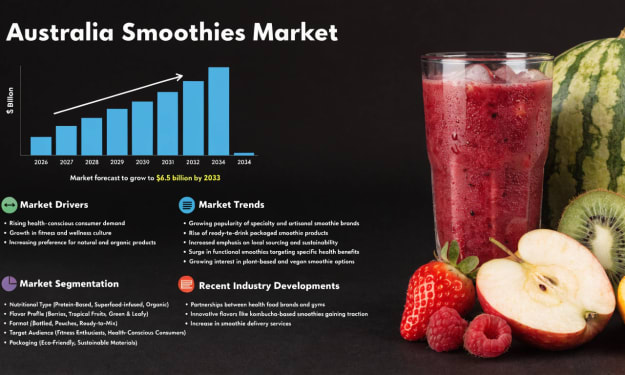
According to IMARC Group, the Australia smoothies market reached USD 504.6 Million in 2025 and is projected to grow to USD 749.1 Million by 2034, exhibiting a compound annual growth rate (CAGR) of 4.26% during 2026–2034. The market’s expansion reflects increasing consumer focus on health, nutrition, and convenience across Australia. Rising demand for nutrient-rich beverages, growing availability of ready-to-drink (RTD) options, and the proliferation of smoothie bars in urban centers are collectively strengthening Australia smoothies market share. As consumers prioritize balanced diets and functional ingredients, smoothies are becoming a mainstream component of daily nutrition.
By Shrestha Roya day ago in Futurism
Conversational AI Market: AI Ethics & Data Privacy, Trust Building & Market Forecast
According to IMARC Group's latest research publication, global conversational AI market size reached USD 13.6 Billion in 2024. Looking forward, IMARC Group expects the market to reach USD 151.6 Billion by 2033, exhibiting a growth rate (CAGR) of 29.16% during 2025-2033.
By sujeet. imarcgroup3 days ago in Futurism
Pearl
1980 something. we all hung out at Pearl and you and i were nothing special, or so i thought. i mean we all danced, drenched in our own sweat, our own saline solution of fear, too many beers, shots, laughter, tears, fucks in the bathroom and i don't know when we began to be afraid. do you?
By ROCK aka Andrea Polla (Simmons)3 days ago in Fiction



Comments
There are no comments for this story
Be the first to respond and start the conversation.