
How the Universe will end?
Well, we know of the beginning and have pretty good evidence for that. But what do we know of its final fate?

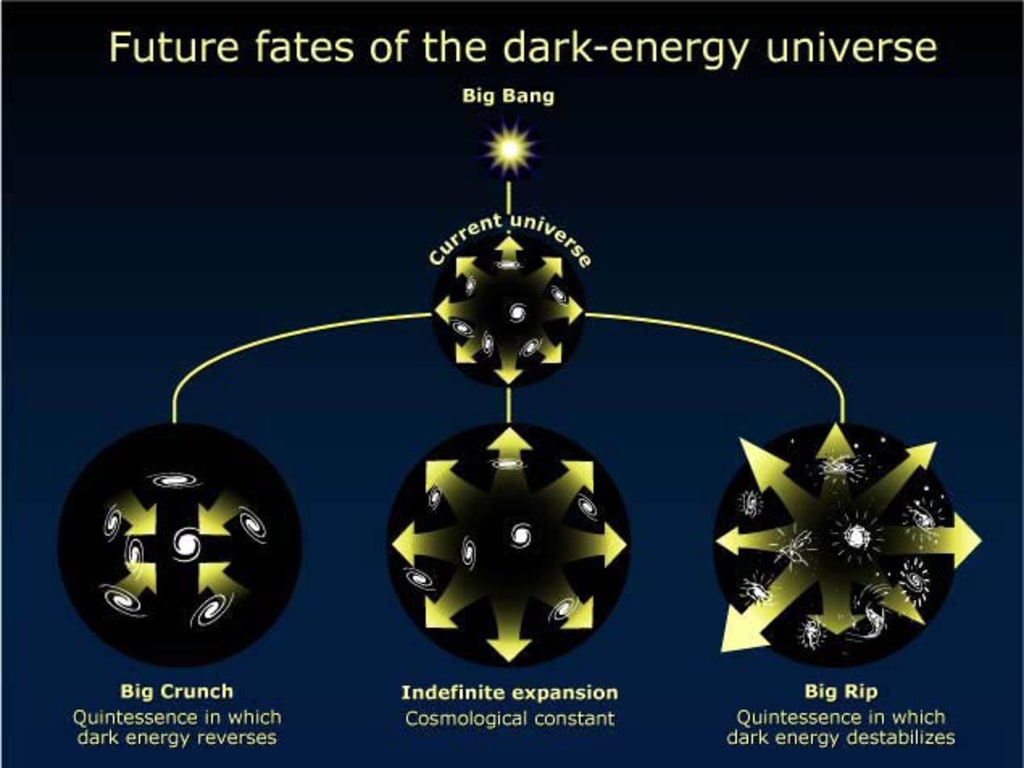
The universe started roughly 14 billion years ago from an infinitesimally small and dense point. This event is known as the Big Bang. How do I know this? Well, we have evidence to support this. It is amazing that we have progressed so much that we understand the universe pretty well and have clever ways to do so. For example, when we came to know about the expansion of the universe we thought of the past and then the beginning part became clear. Not completely, but we have to admit that we do understand it well-nigh.
First, we used to think of the universe as static and eternal. But then new ideas came and observations supported them, and we began thinking of the universe as finite in time. There was a time when there was no time and no space, hence, no universe. But then something unknown happens and here we are with a universe. But when we think of such a universe that has a beginning then we ask questions like if it will end or not? If it will end then how will it come to an end? How long will the universe exists before it meets its death? These are the questions we are asking for a long time. So, do we understand the universe well enough to answer these questions? I would say, "maybe, yes".
In Physics, if you understand the current state of a system then you can predict its future states ( not in all cases, but sure in this case we can). For example, Newton would say that if he knows the current position of any planet in the solar system, he can predict where it would be in four months.
So, can we predict the future of the universe, the final fate?
There are different theories that do tell us how the universe might end. I'll explain them one by one. But again one may ask why more than one theory, don't we know exactly how? Well, you will know. Let's begin!
The Big Rip:
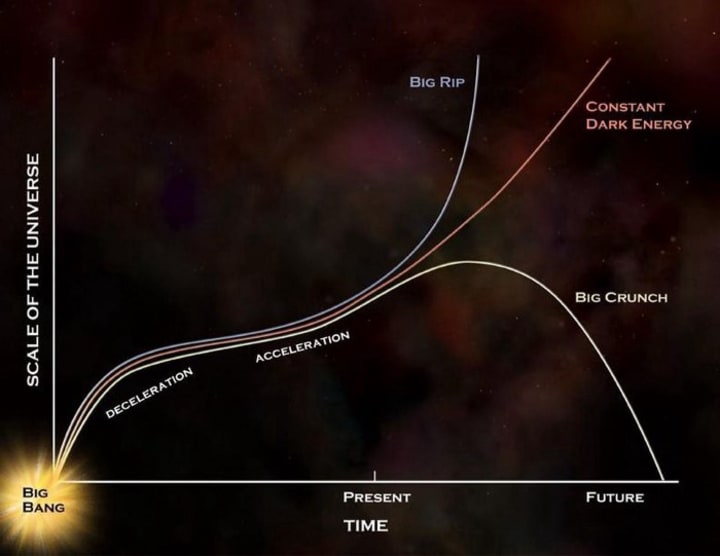
We know that the universe is expanding and the reason for this expansion is a mysterious form of energy. We call it the "Dark Energy". The word 'dark' here refers to its mysterious nature. We don't really know what it is but it is causing the universe to expand faster and faster.
Now, it depends on the nature of the dark energy, how the universe will come to an end. Now, this mysterious energy is pulling the space between the galaxies apart and distances are increasing. This mysterious force is also pulling the objects apart inside the galaxies but the gravitational pull there is so strong that it can't tear a galaxy apart. But if the expansion rate due to dark energy keeps on increasing then there would come a point when it will overcome not just the gravitational force but also the forces that bind the matter together.
So, things won't be able to hold together and everything will rip apart. This scenario is called the Big Rip. According to scientists, if this is actually what will happen in the future, then it is predicted to happen in 22 billion years. If Earth somehow survived till then, which it won't, then it will be ripped apart 30 minutes before the grand finale.
The Big Freeze:
The Big Freeze or also known as the Heat Death or the Big Chill is another most likely scenario. What we know so far about the nature of dark energy, this is the most likely way the universe will end.
In the Big Freeze, the universe will continue to expand at an ever-increasing rate and it will eventually stretch everything apart. Now, when we look at the universe we see the collection of objects like star clusters, galaxies, or clusters of galaxies. But this ever-increasing expansion rate of the universe will tear those clusters apart and will disperse them evenly across the universe.
In the future, when intelligent civilizations will look at the universe, they won't see any other stars or galaxies in the universe. The nearby stars would be so far away from them that their light won't reach those civilizations. They would think that they are alone in the universe.
As the universe will continue to expand, it will get colder and colder until the temperature of the universe reaches the absolute temperature. At this temperature, all kinds of motions stop. This would be the heat death of the universe, an ongoing process till everything stop.
The Big Crunch:
In this scenario, the expansion of the universe doesn't continue forever as in the previous cases. In the Big Crunch, the universe will continue expanding, until the gravitational pull of the matter in the universe will overcome this expansion. After this, the universe will collapse in on itself. It would be the reverse process of what is happening now. Now the distances are increasing due to the expansion, but in the big crunch scenario, everything will get closer and closer and in the end, it will become a super-dense object or maybe a singularity.
Some scientists think that when the universe will collapse in on itself, it will form the singularity, a singularity similar to the singularity which started the universe ( the big bang singularity). After that, the singularity will create another universe with another big bang. They think that, perhaps, our universe was also created from such a singularity and that there was a universe before ours, and another universe before that, and so on.
You can imagine this as a point expanding and forming a sphere and then collapsing and again forming that point and this cycle continues. But this can only happen if the expansion rate of the universe begins to slow down. But as far as the current understanding of the universe is concerned, the universe is expanding and the expansion rate is increasing at an ever-increasing rate.
The Big Slurp:
In 2012, scientists discovered a particle at CERN by colliding particles. This particle is known as Higgs Boson. This particle confirms the existence of the Higgs Field, which is responsible for the masses of other elementary particles. But the discovery didn't just confirm a theory. After the discovery in 2012, some physicists at Harvard came up with a theory that this particle might not be a stable one. So, what is the big deal here?
Well, it is a big deal as it can destroy the whole universe. If the researchers are right about their theory then the mass of the Higgs Boson, due to its stable nature, can change and this could result in destroying the particles that make life and the universe. Unlike other scenarios we have discussed so far, this would instantaneously finish the entire cosmos. It would be like another Big Bang, but this time it won't create one but destroy it.
Joseph Lykken, a physicist from the Fermi National Accelerator Laboratory said,
"We're sort of right on the edge where the universe can last for a long time, but eventually, it should go 'boom."
About the Creator
Keep reading
More stories from writers in Futurism and other communities.
About Binding Prometheus
I want to start actively advocating on behalf of my own work, and the most valuable part of my canon is, without a doubt, Binding Prometheus, the play I have been working on since 2019 and only finished in 2023 as part of my MA. The play itself is an amalgamation of a million different inspirations. On one end, it evokes the Ancient Greek myth-play, deriving its own title from the earliest extant work of Western drama we have, Aeschylus’s Prometheus Bound. On the other end, it borrows significantly from the sci-fi bulwarks from over the years, namely Mary Shelley’s Frankenstein and Karel Capek’s Rossum’s Universal Robots. The play could be an episode of Black Mirror, I fear. I don’t know. I’ve only ever seen one episode of Black Mirror.
By Steven Christopher McKnight19 days ago in Futurism
Saudi Arabia Cancer Immunotherapy Market Advancing Treatment Adoption and Healthcare Innovation
According to IMARC Group's latest research publication, Saudi Arabia cancer immunotherapy market size reached USD 1,303.4 Million in 2025. The market is projected to reach USD 2,611.6 Million by 2034, exhibiting a growth rate (CAGR) of 8.03% during 2026-2034.
By Suhaira Yusuf4 days ago in Futurism
Ludacris and Nelly draw backlash over bookings at MAGA-coded music festival
Ludacris and Nelly headlining a mostly right-wing event is good for them. It’s also great for the genre of hip hop. The two rap veterans have showcased their talents on other stages. Why can’t they perform for mostly MAGA folks and grab that bag?
By Skyler Saunders5 days ago in Beat



Comments
There are no comments for this story
Be the first to respond and start the conversation.