
How Ryo Tatsuki’s Tsunami Vision Shook the World
A manga artist’s dream from 1999 sparked real fear in 2025. But was it prophecy, coincidence, or something stranger?

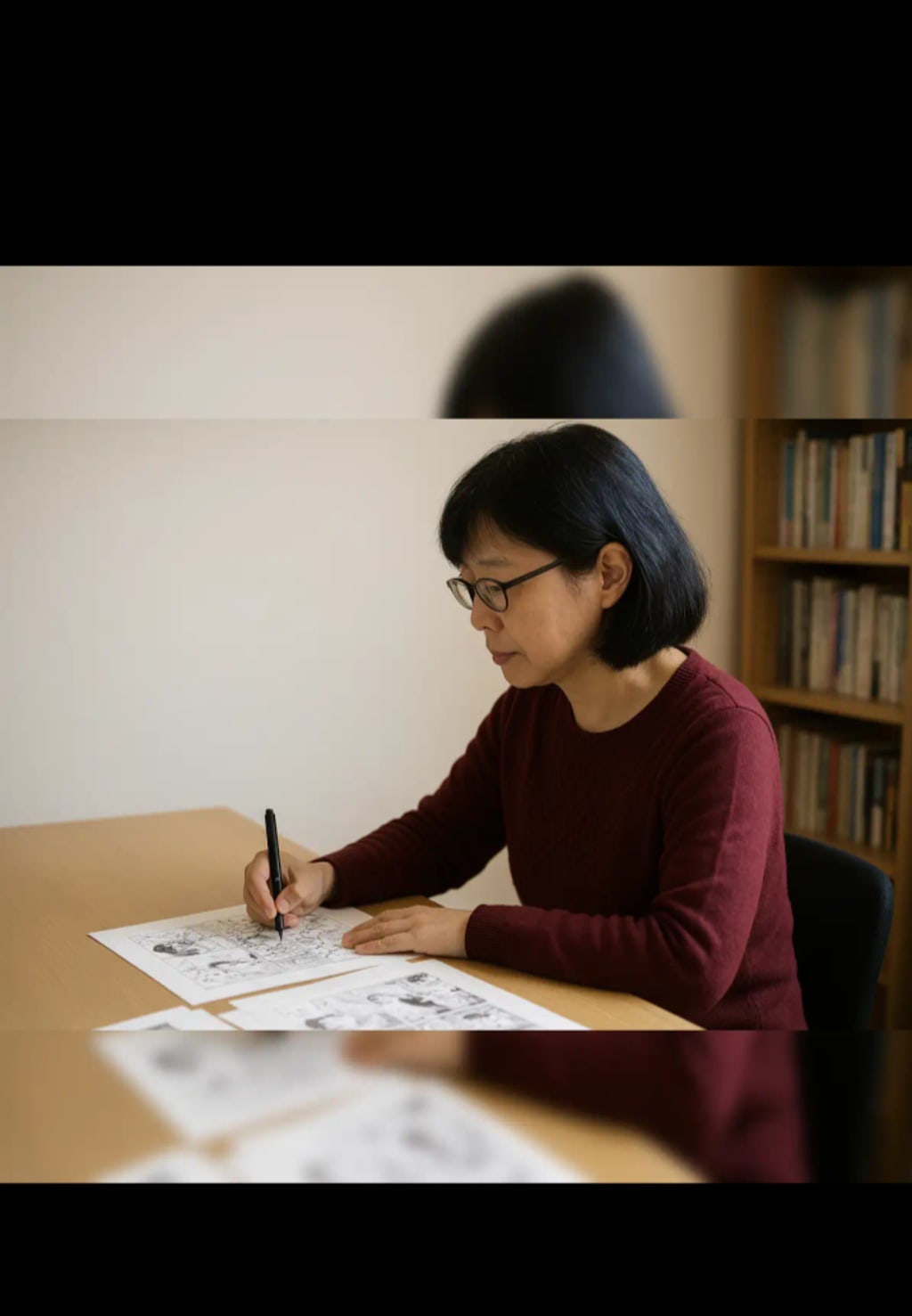
In the history of manga, there are artists who changed art, those who redefined storytelling—and then there’s Ryo Tatsuki. A quiet name in the world of Japanese comics, Tatsuki never intended to become a prophet. Yet today, her name is spoken with an odd mixture of awe, fear, and skepticism.
She didn’t publish fantasy adventures or supernatural battles. Instead, she shared a collection of dreams—vivid, often apocalyptic images that came to her while she slept. In 1999, these dreams became a manga titled Watashi ga Mita Mirai (The Future I Saw). It barely made a splash upon release. The art was simplistic. The concept was abstract. It wasn’t a hit—until it started coming true.
Tatsuki’s dream journal had documented a series of unsettling visions. One of them referenced March 2011—the very month when the Great East Japan Earthquake struck, triggering a massive tsunami and the Fukushima nuclear disaster. In the years following the tragedy, readers rediscovered her manga and began pointing to other “fulfilled” predictions: the deaths of Princess Diana and Freddie Mercury, the 1995 Kobe earthquake, and even an illness that resembled the COVID-19 pandemic.
Suddenly, Ryo Tatsuki wasn’t just a forgotten artist. She was a seer. Japan’s answer to Baba Vanga. A prophet in ink and paper.
Fast forward to 2021. A reprint of The Future I Saw added new fuel to the fire. Among its pages, a chilling statement stood out:
> “The real catastrophe is in July 2025.”
It didn’t say much more. Just vague sketches of sea, destruction, and fear. But that one line was enough to launch a tidal wave of speculation and fear. Online forums, Reddit threads, and YouTube theorists took it from there. Soon, the date evolved: July 5, 2025, at 4:18 AM.
The manga never mentioned an exact time. This timestamp was most likely an internet-born mutation of Tatsuki’s original work, but it didn’t matter. The world had locked onto it.
---
Fear in the Air
By early 2025, something odd was happening. Tourists from Taiwan, Hong Kong, and China began canceling summer trips to Japan. Travel agencies noticed a sharp dip in bookings. Airlines slashed flights. Hotels in Tokyo and Osaka reported 50% occupancy drops during what should have been peak season.
All because of a manga.
Japanese authorities tried to dismiss the growing fear. The Japan Meteorological Agency issued statements clarifying that earthquakes and tsunamis cannot be predicted—not with dreams, not with science, not with anything. Seismologists confirmed: “We cannot forecast exact dates or times.”
But the fear wouldn’t go away. Even some Japanese citizens, typically more rational in tone, quietly chose to spend the week of July 5 inland—just in case.
And then... nothing happened.
No tsunami. No earthquake. No fiery apocalypse. July 5, 2025, came and went like any other day. Skeptics declared victory. Scientists nodded in quiet satisfaction. Social media quieted down.
Until July 30.
On that day, a massive 8.8-magnitude earthquake struck off the coast of Russia’s Kamchatka Peninsula. Tsunami warnings were issued across the northern Pacific. Small waves reached Japan’s northeastern coast. Ports temporarily shut down. The world held its breath once again.
Many saw this as a delayed fulfillment of Tatsuki’s prophecy. Was she simply a few weeks off? Had the danger shifted locations? Or was it just coincidence?
---
Between Art and Prophecy
The truth about Ryo Tatsuki may lie somewhere between mystery and myth. She herself has remained reclusive. No new interviews. No follow-up works. No public declarations. Just a book, some dreams, and a trail of unease.
Skeptics argue that The Future I Saw is vague enough that people can project anything onto it. Predictions only seem accurate in hindsight. They claim that the updated 2021 edition—the one that added the “real catastrophe” warning—may have been sensationalized for reprint sales.
Supporters, however, aren’t so sure. They say the details are too close. The timeline too uncanny. And perhaps, just perhaps, Tatsuki has seen things we can’t explain.
Either way, her story reminds us of something important: how powerfully stories—especially visual ones—can shape human behavior. One manga changed travel habits. It influenced governments. It infiltrated international headlines. In an age of data and satellites, it was a hand-drawn dream that moved people.
---
Final Thoughts
Did Ryo Tatsuki truly predict the future? Or did her dream simply align with the world's deepest fears at the right time?
Whether prophet or poet, she tapped into a vein of human anxiety that still pulses today. Maybe that’s what makes her manga so haunting. Not because she saw the future—but because she reminded us just how fragile the present can be.
About the Creator
Moments & Memoirs
I write honest stories about life’s struggles—friendships, mental health, and digital addiction. My goal is to connect, inspire, and spark real conversations. Join me on this journey of growth, healing, and understanding.
Keep reading
More stories from Moments & Memoirs and writers in Futurism and other communities.
Fire and Ash: Why Avatar 3 Might Be the Boldest Sci-Fi Sequel Yet
“All energy is borrowed, and one day… you have to give it back.” – Jake Sully When Avatar: The Way of Water splashed onto screens in 2022, audiences marveled once again at James Cameron’s masterful world-building. But now, the third installment in the epic saga—Avatar: Fire and Ash—is set to ignite Pandora in a way we’ve never seen before.
By Moments & Memoirs8 months ago in Futurism
Fluid Loss Additives Market Outlook: Drilling Efficiency Enhancement and Oilfield Services Growth Opportunities
According to IMARC Group's latest research publication, The global fluid loss additives market size was valued at USD 318.42 Million in 2025. Looking forward, IMARC Group estimates the market to reach USD 409.06 Million by 2034, exhibiting a CAGR of 2.82% from 2026-2034.
By James Whitman3 days ago in Futurism
Australia Textile & Apparel Market: Sustainable Fashion, E-commerce Growth & Fabric Innovation
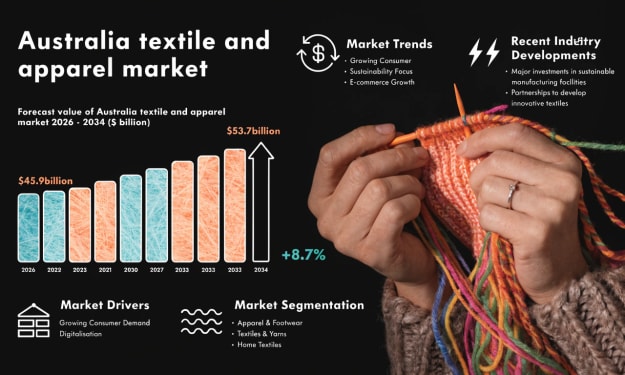
According to IMARC Group, the Australia textile and apparel market reached a value of USD 30.3 Billion in 2025 and is projected to reach USD 45.7 Billion by 2034, growing at a compound annual growth rate (CAGR) of 4.66% during 2026–2034. The market is evolving as consumer preferences increasingly favor sustainable fashion, innovative fabric technologies and digitally driven retail experiences. Rising disposable incomes and changing lifestyle trends are encouraging consumers to spend more on clothing, footwear and fashion accessories. At the same time, growing awareness about environmental sustainability is driving demand for eco-friendly textiles, recycled fabrics and ethically produced garments. The rapid expansion of e-commerce platforms and online fashion marketplaces is also transforming how consumers shop for apparel, enabling brands to reach wider audiences across Australia. As fashion companies adopt new production technologies and sustainable manufacturing practices, the textile and apparel sector is undergoing significant transformation.
By Kevin Cooper2 days ago in Futurism
Becca
"Everything is so... flat." Denille said stupidly as she looked around her new neighborhood. She looked around at the muted desert where even the smallest sign of life seemed to have given up. The plant life was shrubs that were half cooked by the heat and where there should have been a lawn, a mess of white rocks laid glistening in the sun. Even the sky looked stretched thin, like the sun had ironed it smooth. She’d moved from Riverside, where at least there were hills, but here in Barstow, everything felt baked and brittle.
By Sara Wilson7 days ago in Fiction



Comments
There are no comments for this story
Be the first to respond and start the conversation.