
How Quick Commerce is Revolutionizing Patient Care and Pharmaceutical Delivery
How 10-Minute Deliveries, Revolutionizing Patient Care and Pharmaceutical Services
In recent years, the healthcare and pharmaceutical industries have seen a major transformation driven by the rise of quick commerce, or "q-commerce." This model, defined by the rapid delivery of goods, typically within hours or even minutes, is increasingly reshaping how patients receive care and medications. While q-commerce has traditionally been associated with sectors like food delivery and e-commerce, its integration into healthcare and pharmaceutical services is proving to be a game-changer.
1. Meeting the Need for Speed in Healthcare
One of the most critical aspects of patient care is time. In many medical situations, waiting for essential medication or supplies can have dire consequences. Traditional pharmacy delivery systems, which can take days to process orders, often don't meet the urgency required in critical healthcare situations.
Quick commerce is addressing this need for speed. By leveraging technology and optimized supply chains, pharmacies are now able to deliver essential medications to patients within hours, sometimes even less. Whether it's a life-saving prescription for chronic conditions like diabetes or an emergency delivery for antibiotics following surgery, q-commerce ensures that patients are getting the care they need in the shortest possible time.
2. Streamlining Pharmaceutical Logistics
Pharmaceutical delivery has always faced significant logistical challenges. Traditional pharmacies often rely on limited geographic coverage and slower delivery methods. However, with q-commerce, pharmacies can tap into a wider network of local delivery agents, leveraging advanced logistics technologies, AI-driven route optimization, and real-time tracking systems.
For instance, companies like NimbleRx and ScriptDrop are revolutionizing pharmaceutical delivery by providing same-day or next-day delivery, ensuring patients receive their medications on time, even in rural or underserved areas. These systems also help mitigate the risk of medication non-adherence, as patients are less likely to miss doses when medications arrive quickly and reliably.
3. Enhancing Accessibility and Convenience
Q-commerce doesn’t just benefit those in urban areas; it also plays a vital role in improving accessibility for patients in rural or remote locations. With traditional pharmacy delivery models, patients in less populated regions often face longer wait times or a lack of delivery options altogether. Quick commerce platforms, however, can overcome these geographical limitations by using localized distribution hubs and flexible delivery networks.
This increased accessibility means that patients no longer have to choose between convenience and healthcare quality. A patient living in a remote area can receive the same prompt attention as one located in a bustling city, helping to bridge gaps in healthcare equity.
4. Boosting Patient Adherence through Real-Time Monitoring
In addition to fast delivery, q-commerce platforms are also integrating digital health tools that improve patient engagement and adherence to prescribed therapies. Many healthcare apps that partner with q-commerce services allow for real-time tracking of medications and even provide reminders to patients when it's time to take their next dose.
This real-time connection is particularly valuable for patients managing chronic conditions, where timely medication and regular follow-ups are crucial. By offering an integrated solution that connects patients, their prescriptions, and delivery systems, q-commerce platforms are not only delivering medicines faster but also ensuring better patient outcomes.
5. The Role of Artificial Intelligence and Data Analytics
Quick commerce is more than just fast delivery. It’s also about utilizing data to improve healthcare experiences. AI and machine learning algorithms play a crucial role in optimizing the logistics behind pharmaceutical delivery. These technologies predict demand, optimize delivery routes, and even help in forecasting medication needs based on regional trends.
Moreover, data-driven insights allow healthcare providers to personalize patient care. Through AI-powered tools, q-commerce platforms can tailor delivery schedules based on patients' health history and medication schedules. This personalized approach makes the process more efficient and ensures that patients receive the right medication at the right time.
6. Challenges and the Future of Quick Commerce in Healthcare
Despite its potential, the integration of quick commerce into healthcare and pharmaceutical delivery faces several challenges. Regulatory concerns, particularly around the secure handling of prescriptions and patient privacy, need to be addressed. Additionally, ensuring that the delivery of sensitive medical products, like vaccines or biologics, meets the required storage conditions remains a logistical hurdle.
However, as technology continues to evolve and regulations catch up, quick commerce's impact on healthcare is likely to expand. Its ability to provide speed, convenience, and accessibility could become the gold standard for patient care delivery, particularly as the healthcare industry adapts to meet the demands of a more digitally connected world.
Conclusion
Quick commerce is no longer a trend in healthcare and pharmaceutical delivery but a fundamental shift in hw patients receive care. By combining speed, efficiency, and accessibility, q-commerce models are solving long-standing issues in healthcare delivery. While challenges remain, the future of healthcare and pharmaceutical delivery is poised to be faster, more efficient, and more patient-centered, transforming how we think about medicine in the modern age.
As this transformation continues, healthcare software development plays a pivotal role in enabling these advancements. With robust software solutions, healthcare providers can integrate q-commerce platforms seamlessly into their operations, ensuring that patient care remains at the forefront of technological progress.
About the Creator
Keep reading
More stories from writers in Futurism and other communities.
About Binding Prometheus
I want to start actively advocating on behalf of my own work, and the most valuable part of my canon is, without a doubt, Binding Prometheus, the play I have been working on since 2019 and only finished in 2023 as part of my MA. The play itself is an amalgamation of a million different inspirations. On one end, it evokes the Ancient Greek myth-play, deriving its own title from the earliest extant work of Western drama we have, Aeschylus’s Prometheus Bound. On the other end, it borrows significantly from the sci-fi bulwarks from over the years, namely Mary Shelley’s Frankenstein and Karel Capek’s Rossum’s Universal Robots. The play could be an episode of Black Mirror, I fear. I don’t know. I’ve only ever seen one episode of Black Mirror.
By Steven Christopher McKnight20 days ago in Futurism
Wood and Timber Products Market Size and Forecast 2025–2033: Sustainable Growth Shapes a Trillion-Dollar Industry
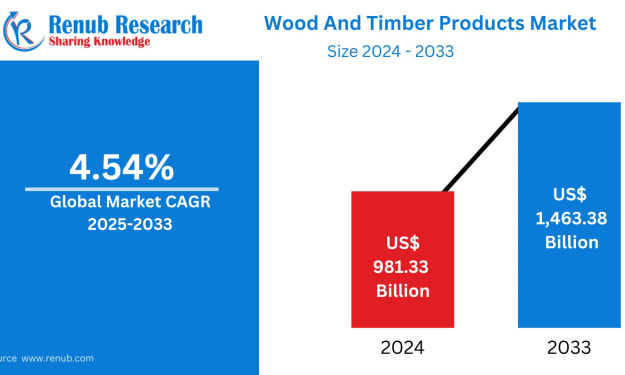
Global Wood and Timber Products Market Outlook The global Wood and Timber Products Market is undergoing a steady transformation as sustainability, urbanization, and infrastructure development reshape material choices worldwide. According to Renub Research, the market is expected to grow from US$ 981.33 billion in 2024 to US$ 1,463.38 billion by 2033, expanding at a CAGR of 4.54% from 2025 to 2033.
By Janine Root a day ago in Futurism
My New Book is Finally Here
My poetry collection Beautiful and Brutal Things is done. It's actually done and finally published over 270 pages. Over a year of my life went into this book. More than a year, really. Long days at my computer, sometimes seven days a week because I couldn't stop even when I probably should have. Then two months of editing that felt harder than the writing itself. But it's finished, and I'm still standing, and the book is real.
By Tim Carmichael4 days ago in BookClub



Comments
There are no comments for this story
Be the first to respond and start the conversation.