
How Mobile App Build Systems Scale With Code Size?
A first-person reflection on how growing codebases quietly turn build systems into guardians of focus, momentum, and everyday development rhythm.

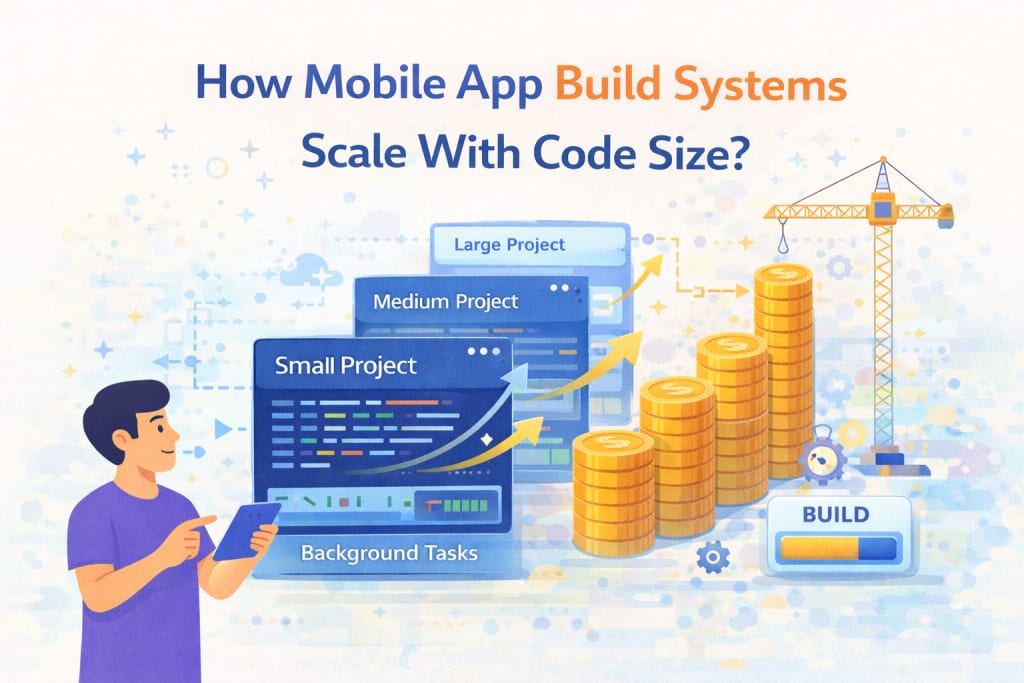
The build finished just as I forgot why I started it. I was still at my desk, same chair, same screen, yet the thread of thought that led to that change had slipped away. I stared at the success message, not relieved, just slightly disconnected.
That was the moment I realized build systems don’t just compile code. They hold your focus together, or quietly let it fall apart.
When Builds Are Fast, Ideas Stay Intact
Early in a project, builds feel almost invisible. You make a change, hit run, and the app responds before your attention drifts. The feedback loop is tight. Thought turns into action without resistance.
In those stages, build systems feel like background plumbing. Reliable. Uninteresting. Easy to take for granted.
That ease shapes behavior. People try things. They experiment. They refactor without fear.
Code Size Changes the Tone of Work
As code grows, builds begin to speak up. Not loudly at first. Just a few extra seconds. Enough time to glance at a message. Enough time to lose the sharp edge of intent.
I’ve watched teams normalize this drift. They accept longer builds as the cost of progress. Over time, that cost compounds.
When builds slow, people batch changes. They avoid small experiments. Momentum shifts from curiosity to caution.
Build Systems Don’t Age Gracefully by Default
Most build systems are designed for growth, but not all growth is equal. Adding features feels different from adding depth.
More modules. More dependencies. More generated code. Each layer asks the build system to do more coordination work.
Nothing breaks. Still, the system spends more time figuring out what changed than actually compiling it.
That overhead sneaks up quietly.
Incremental Builds Carry the Load Until They Can’t
Incremental builds are a gift when they work well. They preserve speed by rebuilding only what matters.
At scale, figuring out what matters becomes harder. Dependencies blur. Boundaries soften. One change touches more than expected.
I’ve seen incremental builds slowly turn into near-full builds without anyone realizing why. The system wasn’t failing. It was being asked to reason about too much.
The Human Cost of Waiting
Waiting changes how people think. Not dramatically. Subtly.
I’ve noticed developers hesitate before hitting build, asking themselves if the change is worth the delay. That hesitation shapes codebases over time.
Small improvements get postponed. Technical debt becomes easier to live with than long waits. The build system quietly influences architecture without being invited to the discussion.
Parallelism Helps, Until Coordination Dominates
Modern build systems rely heavily on parallel work. More cores. More tasks running at once.
This works beautifully up to a point. Past that point, coordination overhead grows. Tasks wait on shared steps. Caches miss unexpectedly.
I’ve watched powerful machines sit idle, not because they lacked resources, but because the build graph became too tangled to move efficiently.
Caching Is Memory, Not Magic
Caching feels like a solution until it becomes unpredictable. When caches hit, builds feel instant. When they miss, everything feels broken.
At large scale, cache behavior becomes harder to reason about. Small changes invalidate large portions of work. Builds feel inconsistent.
That inconsistency erodes trust. Teams stop believing build times. They plan around worst cases instead.
Generated Code Changes the Equation
Generated code accelerates development and slows builds at the same time. It adds volume without adding clarity.
Build systems must treat generated sources like any other code. They parse them. Track them. Rebuild around them.
As generation increases, builds spend more time managing output than compiling intent. Code size grows faster than human understanding.
Why Modularization Helps and Hurts
Breaking code into modules often improves clarity. It can also multiply build steps.
Each module introduces configuration. Dependencies. Boundaries that must be resolved during builds.
At small scale, this tradeoff favors clarity. At large scale, the cost shows up in coordination time.
Build systems scale best when modules reflect real independence, not just organizational preference.
When Build Times Shape Architecture Decisions
I’ve been in discussions where architectural choices were influenced less by design and more by build speed.
Teams avoid certain patterns because they slow builds. Others get favored because they keep compile times predictable.
Build systems quietly become stakeholders in architecture. Not because they should, but because they have to live with the consequences.
Real Projects Feel This Before They Name It
Working with teams across different environments, including those involved in mobile app development Milwaukee efforts where codebases grow alongside teams, I’ve seen the same progression.
Build times creep. Complaints stay vague. Productivity dips before anyone points at the build system directly.
By the time the issue is named, habits have already adapted around it.
Scaling Builds Is About Preserving Feedback
The true goal of a build system isn’t speed alone. It’s feedback.
Fast feedback keeps intent fresh. Slow feedback dilutes it. The difference shapes quality more than any tool choice.
Build systems that scale well protect that feedback loop even as code grows heavier.
The Day We Measured What We Felt
I remember a moment when a team finally measured build times instead of tolerating them. The numbers matched the frustration exactly.
Seeing it quantified changed the conversation. Build optimization stopped being a side task. It became part of product health.
That shift restored momentum more than any feature release did.
Letting the Build System Breathe
Some of the most effective improvements came from simplification. Removing unused modules. Clarifying dependencies. Letting caches behave predictably.
None of it felt glamorous. All of it mattered.
Build systems scale better when they’re respected as living systems, not fixed infrastructure.
Ending With the Build That Didn’t Interrupt Me
I still notice when builds finish before I lose focus. That moment feels rare and satisfying.
When a build system scales well, it disappears. Ideas flow through it without friction. Code size grows, but thinking stays sharp.
That’s the quiet success every large mobile project hopes for. Not faster machines. Not clever tricks. Just a build system that grows without taking attention with it.
About the Creator
Keep reading
More stories from Mary L. Rodriquez and writers in Futurism and other communities.
How Background Processes Affect Battery and Performance?
The first time I noticed it, I was standing in a grocery store line, phone in one hand, basket in the other. I hadn’t used my phone much that day. No videos, no games, no long calls. Still, the battery indicator felt lower than it should have been. I remember frowning at the screen, not annoyed yet, just confused.
By Mary L. Rodriquez2 months ago in Futurism
Deadline Looms as Anthropic Rejects Pentagon Demand to Remove AI Safeguards
A showdown is unfolding between Anthropic and the U.S. Department of Defense after CEO Dario Amodei formally rejected a Pentagon ultimatum to loosen safeguards on the company’s AI model, Claude.
By Behind the Tech2 days ago in Futurism
Australia Wealth Management Market: HNWI Growth, Digital Transformation & Regulatory Evolution
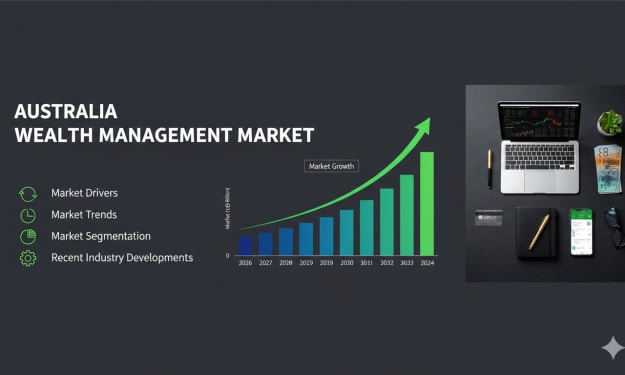
According to IMARC Group, the Australia wealth management market reached USD 118.6 Million in 2025 and is projected to expand to USD 222.2 Million by 2034, exhibiting a compound annual growth rate (CAGR) of 7.00% during 2026–2034. This sustained expansion reflects structural changes in capital accumulation, digital advisory platforms and regulatory oversight across Australia. Wealth management services—including portfolio advisory, retirement planning, tax structuring and estate planning—are increasingly critical as individuals accumulate assets through entrepreneurship, property investments and superannuation growth. As high-net-worth individuals (HNWIs) expand in number and financial sophistication, demand for tailored, transparent and digitally enabled advisory services continues to rise.
By Kevin Cooper6 days ago in Futurism



Comments
There are no comments for this story
Be the first to respond and start the conversation.