
How Elon Musk Outsmarted the World and Became the Richest Man Alive
How Elon Musk Outsmarted the World and Became the Richest Man Alive
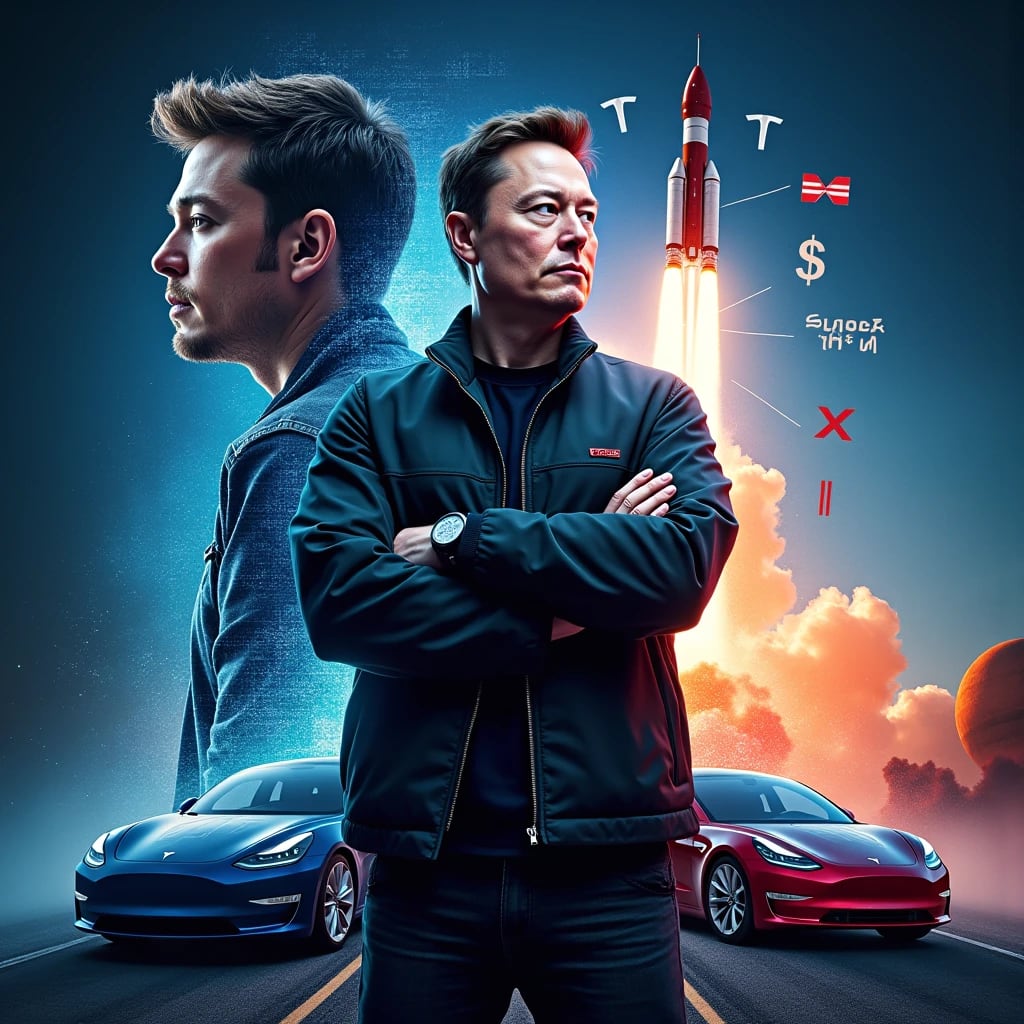
The Making of a Maverick
Before he became the richest man in the world, Elon Musk was just a curious, awkward kid growing up in South Africa. Born in 1971 in Pretoria, he was obsessed with computers, science fiction, and asking questions most adults couldn’t answer. At age 12, he taught himself programming and sold his first video game—Blastar—for $500.
But it wasn’t an easy childhood. Bullied in school and emotionally distant from his parents, Musk found refuge in books. He devoured everything from The Lord of the Rings to physics textbooks, crafting a brain wired for big ideas and impossible dreams.
At 17, he left for Canada to avoid South African military service and eventually landed in the U.S., transferring to the University of Pennsylvania. There, he studied economics and physics—two subjects that would later form the backbone of his empire.
Startup Sparks: Zip2 to PayPal
Musk’s first major venture came in the form of Zip2, a digital city guide he built with his brother Kimbal. They slept in the office, showered at the YMCA, and cold-called newspapers to pitch their software. In 1999, Compaq acquired Zip2 for $307 million, netting Musk $22 million.
But that was just the beginning.
Next came X.com, an online banking platform that later merged with a rival to become PayPal. Musk’s vision was far ahead of its time—he dreamed of revolutionizing money itself. Though he was eventually ousted as CEO, he still walked away with $180 million when eBay bought PayPal in 2002.
Most would have retired. Elon doubled down.
Betting on the Impossible: SpaceX
With his newfound fortune, Musk did something insane—he started a rocket company.
The idea seemed absurd. At the time, no private company had successfully launched a rocket into orbit. Experts mocked him. NASA veterans rolled their eyes. But Musk believed that humanity needed to become a multi-planetary species to survive.
Thus, SpaceX was born in 2002.
The first three launches failed. The fourth—just days before the company ran out of money—succeeded. It was a moment of pure Musk: betting everything on a single shot and pulling it off.
By 2008, NASA awarded SpaceX a $1.6 billion contract. Fast forward, and SpaceX is now valued at $350 billion. It delivers cargo (and now astronauts) to the International Space Station, lands reusable rockets, and is building Starship—a vessel Musk says will one day take humans to Mars.
Tesla: The Electric Gamble That Paid Off
While rockets soared, Musk had his hands in another radical idea—electric cars.
He joined Tesla in 2004 as chairman, later becoming CEO and product architect. At the time, the auto industry laughed off EVs. Batteries were expensive. Charging infrastructure was non-existent. And Tesla’s early days were rocky, with frequent financial crises.
But Musk persisted.
In 2012, Tesla launched the Model S, a luxury electric sedan that changed everything. It was fast, sleek, and had over 200 miles of range—a game-changer. Over the next decade, Tesla would go on to dominate the EV market, pushing legacy car companies to adapt or die.
In 2020, Tesla's stock skyrocketed. By 2021, Musk surpassed Jeff Bezos as the world’s richest man. And in 2024, after a huge post-election stock surge and growing SpaceX valuation, Musk’s net worth peaked at $486 billion.
Controversy and Strategy
Musk isn’t just a businessman—he’s a provocateur. His tweets have moved markets. His public fights with regulators, media, and even his own shareholders have made headlines.
But behind the chaos is strategy.
In 2025, Musk took a temporary role in Donald Trump’s administration, leading a government cost-cutting task force. That political alignment boosted investor confidence, unlocked massive deregulation for his companies, and sent Tesla’s stock climbing again.
He’s also been heavily investing in AI through his company xAI, which merged with Twitter (now X), aiming to challenge OpenAI and Google. Add in Neuralink (brain-computer interfaces) and The Boring Company (underground transportation), and Musk has built a web of ventures all feeding into a vision of the future only he seems to fully grasp.
The Billionaire’s Blueprint
What makes Elon Musk different?
It’s not just the brains or the billions. It’s his willingness to risk everything, again and again. He reinvested almost every dollar he earned into new ventures. He took on industries others avoided—automotive, aerospace, energy. And he married bold vision with brutal work ethic.
Yes, he’s controversial. Yes, he’s made enemies. But he’s also reshaped how we think about cars, space, money, and even free speech.
In his own words:
“When something is important enough, you do it even if the odds are not in your favor.”
Conclusion
Elon Musk’s journey isn’t just about wealth. It’s a story of vision, obsession, and playing long games that most people can’t even see.
Brains, rockets, and billions—that’s the Elon Musk formula. And love him or hate him, he’s proof that the future often belongs to those bold (and crazy) enough to build it.
About the Creator
Keep reading
More stories from Nauman Khan and writers in Futurism and other communities.
From Track Failure to Global Icon: How Phil Knight Built Nike
In college, Phil Knight wasn’t winning medals. He wasn’t setting records. He was just another runner on the University of Oregon track team—good, not great. Overshadowed by faster teammates and barely noticed at national meets, he quietly accepted the truth: he would never be a champion.
By Nauman Khan8 months ago in Motivation
About Binding Prometheus
I want to start actively advocating on behalf of my own work, and the most valuable part of my canon is, without a doubt, Binding Prometheus, the play I have been working on since 2019 and only finished in 2023 as part of my MA. The play itself is an amalgamation of a million different inspirations. On one end, it evokes the Ancient Greek myth-play, deriving its own title from the earliest extant work of Western drama we have, Aeschylus’s Prometheus Bound. On the other end, it borrows significantly from the sci-fi bulwarks from over the years, namely Mary Shelley’s Frankenstein and Karel Capek’s Rossum’s Universal Robots. The play could be an episode of Black Mirror, I fear. I don’t know. I’ve only ever seen one episode of Black Mirror.
By Steven Christopher McKnight18 days ago in Futurism
UAE LED Lights Market: Energy Efficiency Trends, Smart Lighting & Growth Outlook
According to IMARC Group's latest research publication, UAE LED Lights Market size reached AED 4,548.0 Million in 2024. Looking forward, IMARC Group expects the market to reach AED 11,401.0 Million by 2033, exhibiting a growth rate (CAGR) of 10.8% during 2025-2033.
By Abhay Rajput6 days ago in Futurism
The Devil's Cut
“Comrade, finally you’re awake.” The voice was smooth, sensual. A flickering incandescent bar was all that lit the white, sterile room. All Vladimir remembered was everything going black. He tried to move his arms and found them strapped to the gurney.
By Matthew J. Fromm5 days ago in Fiction



Comments
There are no comments for this story
Be the first to respond and start the conversation.