


Spacecraft Propelled by Light
Imagine a spaceship gliding silently through the vast emptiness of space no engine roar, no fuel tanks, and no trail of smoke behind it. Instead of being pushed by burning fuel, it sails gracefully on beams of sunlight. This isn’t science fiction; it’s a real and promising method of space travel known as solar sailing.
What Is a Solar Sail?
A solar sail is an ultra-thin, lightweight, and highly reflective sheet that captures the pressure of light specifically, photons emitted by the Sun. While photons don’t have mass, they do carry momentum. When they strike a reflective surface, they bounce off and transfer that momentum to the sail. The result? A tiny but constant force that can gradually accelerate a spacecraft to remarkable speeds.
Think of it like a sailing ship at sea, but with sunlight instead of wind, and deep space instead of oceans.
Light as a Propulsion System
You might wonder how something as intangible as light can move a spaceship. It comes down to the gentle pressure exerted by sunlight. On Earth, this pressure is about 9 micronewtons per square meter an incredibly small force, billions of times weaker than the weight of an apple. But in the vacuum of space, where there's no air resistance, even the tiniest push can add up over time.
While traditional rockets burn through fuel and lose thrust quickly, a solar sail keeps gaining speed as long as light is hitting it. With enough time weeks, months, or even years a solar sail can reach tens of thousands of kilometers per hour. It's a marathon, not a sprint, but one that could change the future of space travel.
How Are Solar Sails Built?
A solar sail is typically attached to a small spacecraft. When fully deployed, the sail can span tens of meters across. It's made from incredibly light and reflective materials such as Mylar or polyimide film coated with aluminum. These materials are so thin that their thickness is less than that of a human hair.
Since launching such a huge surface folded into a rocket is no small feat, the sail unfolds only once it's in orbit. This can be done using small motors, centrifugal force, or pressurized gas. Once opened, the sail begins to "catch" the sunlight and move forward.
Real-Life Missions Using Solar Sails
Though solar sails sound futuristic, they’ve already been tested in space.
IKAROS (Interplanetary Kite-craft Accelerated by Radiation Of the Sun) was the world’s first solar sail, launched by Japan in 2010. It successfully demonstrated that light pressure can be harnessed for propulsion and navigation in space.
LightSail 2, developed by The Planetary Society, launched in 2019. With a sail area of 32 square meters, it proved that solar sailing could raise a satellite’s orbit using nothing but sunlight no fuel, no engines, just pure photon push.
These missions were not only technological milestones but also proof that light-powered spaceflight is viable.
The Future: Interstellar Sailing
Perhaps the most ambitious vision for solar sailing lies in the Breakthrough Starshot project. This initiative aims to send a fleet of ultra-light nanocraft to Alpha Centauri, our nearest star system, located 4.37 light-years away.
But here’s the twist instead of using sunlight, the sails would be powered by powerful lasers on Earth, pushing the miniature probes to 20% the speed of light. If successful, these craft could reach Alpha Centauri in about 20 years — an incredible feat given that current spacecraft would take thousands of years to make the same trip.
Advantages of Solar Sails
- No fuel needed: This means lighter payloads and longer missions.
- Continuous acceleration: As long as there’s light, the sail keeps speeding up.
- Silent and simple: Fewer moving parts, less risk of failure.
- Long-term potential: Ideal for deep-space and interstellar missions.
Challenges to Overcome
Solar sailing isn't without its difficulties. The force of photon pressure is very weak, requiring very large sails and long acceleration periods. Also, the spacecraft must always be exposed to light which can be tricky when maneuvering around planets or moons.
Additionally, accurately steering a sail is complex. Since it has no engines, changing direction relies on adjusting the angle of the sail relative to the incoming light more like piloting a boat than flying a plane.
A New Way to Explore the Cosmos
Solar sails represent a bold shift in how we think about space travel. Instead of carrying huge amounts of fuel, we could one day send fleets of light, fast, and efficient probes powered by nothing more than light itself.
In a way, it’s poetic. Long after the last chemical rocket is retired, humanity may continue its journey to the stars on silent ships, drifting swiftly through the dark, with shimmering sails catching the breath of the universe.
About the Creator
Keep reading
More stories from Holianyk Ihor and writers in Futurism and other communities.
Could a Planet Be Completely Transparent?
Science Fiction or Physics of the Future? Imagine a planet so clear you could see stars through it a giant glass sphere floating in the depths of space. No clouds, no crust, no shadows of mountains or valleys. Just pure transparency, as if Jupiter were made of crystal. Is this a wild flight of science fiction, or could such a world actually exist?
By Holianyk Ihor6 months ago in Futurism
About Binding Prometheus
I want to start actively advocating on behalf of my own work, and the most valuable part of my canon is, without a doubt, Binding Prometheus, the play I have been working on since 2019 and only finished in 2023 as part of my MA. The play itself is an amalgamation of a million different inspirations. On one end, it evokes the Ancient Greek myth-play, deriving its own title from the earliest extant work of Western drama we have, Aeschylus’s Prometheus Bound. On the other end, it borrows significantly from the sci-fi bulwarks from over the years, namely Mary Shelley’s Frankenstein and Karel Capek’s Rossum’s Universal Robots. The play could be an episode of Black Mirror, I fear. I don’t know. I’ve only ever seen one episode of Black Mirror.
By Steven Christopher McKnight14 days ago in Futurism
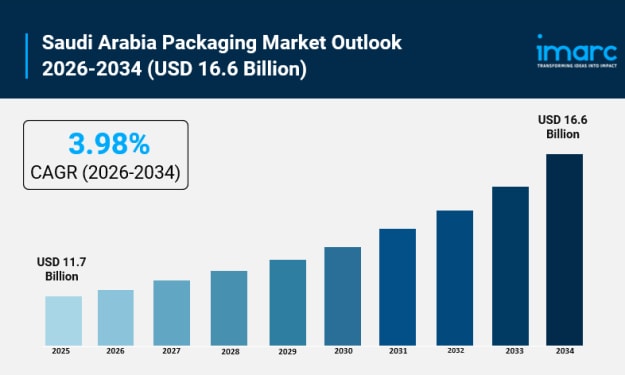
Saudi Arabia Packaging Market: FMCG Demand, Lightweight Solutions, Innovation Drive & Vision 2030
According to IMARC Group's latest research publication, Saudi Arabia packaging market size reached USD 11.7 Billion in 2025. The market is projected to reach USD 16.6 Billion by 2034, exhibiting a growth rate of 3.98% during 2026-2034.
By Jeffrey Wilson3 days ago in Futurism



Comments
There are no comments for this story
Be the first to respond and start the conversation.