
How Did Time Begin? The Mystery Embedded in Existence Itself
Space

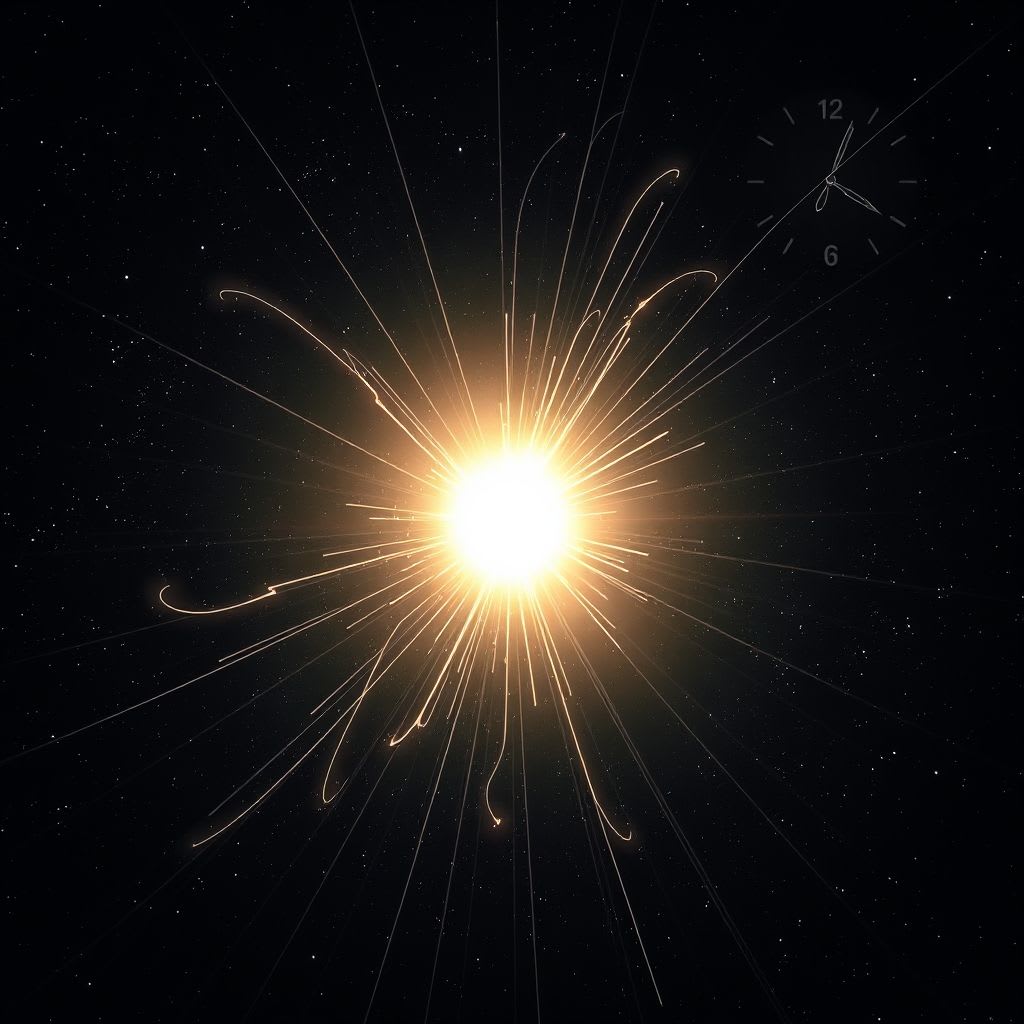
When we glance at a clock, plan our day, or reminisce about the past, we rarely stop to ask: What is time itself? Where did it come from? Does time exist independently, or is it merely a product of our perception? Philosophers, physicists, and cosmologists have long debated these questions. Surprisingly, they have answers though incomplete, they are fascinating.
What Is Time?
At first glance, time seems simple: a sequence of events flowing from past to future. We measure it by the ticking seconds, the passing seasons, or our own aging. But dig a little deeper, and time reveals itself as far more complex. It is not just a universal stage where events unfold. Instead, time can slow down, bend, and even ‘stop’ depending on speed and gravity. This revolutionary insight came from Albert Einstein, who showed that time is inseparable from space. Together, they form a four-dimensional fabric called spacetime.
Was There Time Before the Universe?
One of the most intriguing questions is: Did time exist before the Big Bang? After all, scientists believe that the Big Bang marked the beginning of our universe. But here’s the twist.
According to Einstein’s theory of general relativity and modern cosmology, time itself began at the Big Bang. Before that moment, there was nothing not space, not matter, and crucially, no time. Strange as it sounds, the concept of “before” loses meaning here because “before” assumes the existence of time. Without time, there is no “before.”
Imagine asking: What lies north of the North Pole? The answer is nothing, because the North Pole is the ultimate boundary of latitude. Similarly, the Big Bang represents the “birth” of time a boundary beyond which the idea of ‘earlier’ does not apply.
Time and Quantum Mechanics
But it’s not so straightforward. On the quantum scale, where uncertainty rules and particles behave like flickering probabilities, new ideas emerge. Some quantum models propose that before the Big Bang, the universe existed in a quantum state where familiar notions of space and time did not apply. This state is sometimes called “pre-classical time” or timeless existence.
In such models, time doesn’t appear suddenly but “emerges” from more fundamental laws, as a consequence of movement and change within a quantum system. In other words, relationships and transformations existed first and then time arose as a way to measure those changes.
Is Time an Illusion?
Some scientists, like physicist Carlo Rovelli, argue that time might be an illusion. In his loop quantum gravity theory, time is not a fundamental element of the universe. Instead, it arises only during interactions and depends on the observer. It’s almost like saying that time exists only when we notice something happening.
How Do We "Feel" Time?
Our psychology and biology also “create” time. We remember the past but not the future. Our brains perceive changes, and from this perception, they construct the sensation of time flowing. In sleep or altered states of consciousness, our sense of time can warp dramatically: minutes may feel like hours or vice versa.
This suggests that time is not absolute but something that exists only in relation to observers and events.
Or Maybe, Time Doesn’t Exist at All?
Radical hypotheses suggest that everything past, present, and future already exists simultaneously. We merely “travel” along a fixed structure, like a movie reel playing out. This is the block universe theory, where the entire history of the universe is fixed, and the flow of time is just a trick of consciousness.
So, How Did Time Begin?
At present, science proposes the following:
- Time began with the universe—at the moment of the Big Bang.
- Before that, there may have been a state where time as we know it did not exist.
- Time might not be a fundamental entity but a property emerging from deeper realities.
- Or perhaps time is not a real phenomenon at all, but a derivative of changes and interactions among systems.
In Conclusion
The question of how time began is not just a scientific puzzle. It is an attempt to glimpse the very essence of reality. What does “now” really mean? Why can’t we go back in time? What would happen if time ceased to exist? Answers to these questions may transform not only physics but also our understanding of life, consciousness, and existence itself.
Understanding how time began means touching the very boundary of reality.
About the Creator
Keep reading
More stories from Holianyk Ihor and writers in Futurism and other communities.
Could Our Universe Be Not the First?
The idea that something as vast and magnificent as the Universe might not be the only one, and even more astonishing, that it might not be the first, is hard to grasp. Yet, an increasing number of scientists, philosophers, and cosmologists are seriously pondering this very question. Could our Universe be just one chapter in an endless cosmic saga?
By Holianyk Ihor7 months ago in Futurism
About Binding Prometheus
I want to start actively advocating on behalf of my own work, and the most valuable part of my canon is, without a doubt, Binding Prometheus, the play I have been working on since 2019 and only finished in 2023 as part of my MA. The play itself is an amalgamation of a million different inspirations. On one end, it evokes the Ancient Greek myth-play, deriving its own title from the earliest extant work of Western drama we have, Aeschylus’s Prometheus Bound. On the other end, it borrows significantly from the sci-fi bulwarks from over the years, namely Mary Shelley’s Frankenstein and Karel Capek’s Rossum’s Universal Robots. The play could be an episode of Black Mirror, I fear. I don’t know. I’ve only ever seen one episode of Black Mirror.
By Steven Christopher McKnight13 days ago in Futurism
Biodegradable Cutlery Market: Eco-Friendly Utensils, Sustainable Materials & Zero-Waste Trends
According to IMARC Group's latest research publication, global biodegradable cutlery market size reached USD 46.9 Million in 2024. Looking forward, IMARC Group expects the market to reach USD 69.3 Million by 2033, exhibiting a growth rate (CAGR) of 3.98% during 2025-2033.
By sujeet. imarcgroup5 days ago in Futurism




Comments
There are no comments for this story
Be the first to respond and start the conversation.