
How did fingerprint recognition get so popular?
Fingerprint recognition is everywhere, but how has fingerprint recognition gained this much ubiquity?

Fingerprint recognition is everywhere. We see people using it to unlock their mobile phones, punch in and out of work, even cast their vote. We go home, flip on the TV and see CSI agents lifting fingerprints off a crime scene.
A friend who had experienced all the above use cases in a day was completely dumfounded by the sheer number of ways fingerprint could be used.
So how has fingerprint recognition gained this much ubiquity?
Common format for compatibility
To be able to match a fingerprint against another, certain characteristics of a fingerprint are first selected. These are a series of minutia which are then combined into a template and compared with those in a database. The algorithms used in choosing characteristics and comparing them against other prints differ from one organization to the next.
Thankfully, despite the different proprietary standards, a common format had been decreed by the NIST to allow interoperability and compatibility. As such, even a 80’s era fingerprint database sitting in some law enforcement bureau could work with a state-of-the-art fingerprint matching engine. The creation of a common format proved to be crucial in the mainstreaming of fingerprints as an identification modality, allowing it to be incorporated into an ever-increasing number of applications.
Size matters
The growing adoption of fingerprint recognition has resulted in major product design considerations.
A banking kiosk, for example, may be large enough to accommodate an optical fingerprint sensor, which requires room to reflect the light through a glass prism and lens onto a CMOS image sensor. On the other hand, a portable EFTPOS may not.
The development of the capacitive fingerprint sensor was key in shrinking fingerprint devices. The technology uses micro-capacitor plates embedded in a chip which requires considerably less space and allowing more devices to have fingerprint identification features embedded.
Technological advancement
Fingerprint recognition is the most commonly used method to identify an individual. It's not a 21st century's technological revolution or soemthing , but the way of fingerprint recognition has been around for thousands of years and has been used in several cultures.
"Friction ridge skin impressions were used as proof of a person’s identity in China perhaps as early as 300 B.C., in Japan as early as A.D. 702, and in the United States since 1902."
In morden days, fingerprint recognition also have the longest history than other biometric modalities in law enforcement applications to help investigators link one crime scene to another involving the same person.
A criminal case in Bengal in 1898 is considered to be the first case in which fingerprint evidence was used to secure a conviction (Sodhi and Kaur, 2003b, pp 1–3
Biometric fingerprint traces its roots in the late 1960s when pioneers started taking advantage of the gradually increasing computing power to transition from analog ink-based fingerprint to digital. As the technique matured, it found wider application in identification, abetted by interoperability on the major OS platforms at that time.
Technology has advanced to such point where fingerprint recognition can now be baked into ICs along with certain computing, storing and I/O features. Today, we can build fingerprint scanners including single finger scanner, dual finger scanner or 4–4–2 tenprint scanner that deliver high performance and unparalleled security. Completely independent of OS, a card reader using 2-factor authentication can perform matching completely within the hardware, before sending the results to the host. This dramatically reduces the risk of data breach and increasing security manyfold.
I don’t blame my friend for being so taken with fingerprint recognition. From government services to consumer applications, fingerprint is arguably the most practical, reliable, secure, and inexpensive way to determine identity.
The question is, could fingerprint recognition be even more widespread? What do you think?
About the Creator
Kavi Lan
Hi I'm Kavi Lan, a writer and marketer focusing on biometrics technology.
About Binding Prometheus
I want to start actively advocating on behalf of my own work, and the most valuable part of my canon is, without a doubt, Binding Prometheus, the play I have been working on since 2019 and only finished in 2023 as part of my MA. The play itself is an amalgamation of a million different inspirations. On one end, it evokes the Ancient Greek myth-play, deriving its own title from the earliest extant work of Western drama we have, Aeschylus’s Prometheus Bound. On the other end, it borrows significantly from the sci-fi bulwarks from over the years, namely Mary Shelley’s Frankenstein and Karel Capek’s Rossum’s Universal Robots. The play could be an episode of Black Mirror, I fear. I don’t know. I’ve only ever seen one episode of Black Mirror.
By Steven Christopher McKnight15 days ago in Futurism
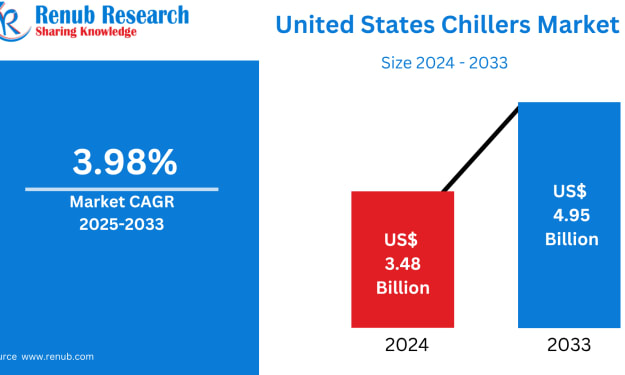
United States Chillers Market Size and Forecast 2025–2033
United States Chillers Market at a Glance The United States Chillers Market is projected to reach US$ 4.95 billion by 2033, rising from US$ 3.48 billion in 2024, at a CAGR of 3.98% from 2025 to 2033, according to Renub Research. This steady growth reflects the increasing importance of efficient cooling solutions across commercial buildings, industrial processes, healthcare facilities, and emerging digital infrastructure such as data centers.
By Aaina Oberoi7 days ago in Futurism


Comments
There are no comments for this story
Be the first to respond and start the conversation.