
How Big Investors Use AI in Portfolio Management and How You Can Apply It Too
AI in Portfolio Management

AI is no longer the monopoly of big banks. Smaller investment houses and individual investors can now use AI tools to run their portfolio management more efficiently, improve their selection of equity and other assets, and control risks. This guide shows how known investors use AI when making investment selections. It will also guide you on building an AI-powered portfolio management system to leverage AI in your investment choices.
How Investors and Influencers Use AI in Portfolio Management
The following are known investors and influencers who use AI to guide their portfolio decisions. They show how technology helps in smarter and strategic investments.
1. Jim Simons - Renaissance Technologies
Jim Simons, often called the “quant king,” after launching Renaissance Technologies, a hedge fund nearly exclusively run by AI and algorithms. His team of mathematicians and computer scientists built the Medallion Fund, which uses machine learning and pattern recognition to make trades.
How He Uses AI: Renaissance takes vast amounts of market data and enters it into AI platforms to discover things that human traders would recognize but could never identify.
Example: Rather than selecting a stock such as Tesla or Apple individually, Renaissance AI analyzes price action, global news, and underlying correlations and makes buy/sell decisions.
2. Cathie Wood - ARK Invest
Cathie Wood is famous for her forward-thinking investments in innovation (Tesla, Coinbase, AI firms). At ARK Invest, where she works, she employs AI-driven research platforms to digest market data and signals of future trends.
How She Uses AI: ARK uses AI tools to filter new technologies, quarterly revenue announcements, and other unconventional sources of data (like patents or social media trends) when considering growth potential.
Example: ARK may use artificial intelligence to follow the pace of growth of AI adoption at healthcare firms and then choose to buy leaders of early trend stocks.
3. Ray Dalio - Bridgewater Associates
Ray Dalio founded Bridgewater Associates, one of the biggest hedge funds globally. Bridgewater has been recorded using AI-based economic models when making their choices. Although Dalio himself deals with macro principles, the company uses AI to run thousands of scenarios.
How Bridgewater uses AI: They build "economic digital twins" AI programs that replicate markets' responses under changing conditions.
Example: When inflation increases or oil prices tumble, their artificial intelligence models anticipate the likely stock/bond responses and enable the company to rebalance its allocation.
4. Chamath Palihapitiya- Social Capital
Chamath is a well-publicized early Facebook executive and venture capitalist. At Social Capital, where Chamath is employed, data science and artificial intelligence are deployed when evaluating companies before investing.
How He Uses AI: His team leverages AI tools to gauge a company's performance based on real-time data (such as customer growth, revenue indicators, or even recruitment patterns).
Example: Rather than waiting only for quarterly statements, Chamath's AI can identify early signs of growth of a startup user base and invest sooner than other investors.
5. Meet Kevin (YouTube Finance Influencer)
Kevin Paffrath, or more popularly known as "Meet Kevin," is a retail investor and a very popular YouTuber with millions of subscribers. Unlike large hedge funds, he employs AI-based stock screens like Trade Ideas and ChatGPT for market work.
How He Uses AI: He uses AI software to scan stocks' trends, detect entry/exit points, and simplify complex reports for his audience.
Example: He can use a scanner based on AI to recognize when Tesla stock has anomalous volume and detail the opportunity to subscribers in real time.
Now, you might be thinking that these are all big names. They have proper tech support, knowledge, and infrastructure, and they can use AI. But for small investors and investing firms, it’s very difficult to utilize AI in portfolio management. Then don’t worry. In the next step, we will see how you can also utilize AI in your investment decisions and portfolio management.
How Small Investors and Companies CanLeverage AI for Portfolio Management
AI is no longer reserved for large financial institutions. Small investors and boutique companies leverage AI to make more intelligent decisions and gain data-driven insights. Through AI-enabled tools, they can automate portfolio management, minimize risks, and discover opportunities that proved previously elusive.
Construct AI-Driven Portfolio Management Systems
Investors and small investing firms can hire AI developers to build automated platforms that monitor asset performance, rebalance their portfolios, and match investments with risk tolerance. These personalized systems function like virtual advisers, carrying out strategies smoothly without human intervention at every step.
Use AI for Predictive Market Modeling
Companies can input historical stock prices, macroeconomic data, and international market signals into AI algorithms to produce price projections and probability-driven estimates, which assist in more accurately strategizing entry and exit.
Use NLP for Tracking Sentiment
By incorporating Natural Language Processing (NLP), investors can track financial news, social media, and analyst reports in real-time to determine investor sentiment and predict possible market fluctuations before they actually occur.
Automate Risk Control Measures
AI can continuously monitor portfolios for spikes in volatility, asset correlation, or overexposure. When thresholds are reached, the system suggests or implements risk-mitigation actions such as hedging or reallocation.
Implement AI-Driven Compliance Monitoring
Investment firms can implement AI to track trading patterns, identify anomalies, and flag possible fraud or regulatory violations. This enables them to remain compliant while minimizing manual monitoring.
Use AI Simulations to Test Strategies
Rather than directly testing concepts in the market, investors can rely on AI-driven paper trading and simulation software to test strategies, optimize them, and implement only tested models with real money.
Conclusion
AI is transforming portfolio management for both big investors and small businesses. While market leaders like Jim Simons and Cathie Wood demonstrate what can be achieved at scale, individual investors, too, can implement AI systems to make better, quicker, and safer decisions. Through predictive models, sentiment analysis, or risk controls, AI provides a road to more confident and informed investment.
About the Creator
Kiran Moda
Passionate Techwriter: I love to empower business leaders with technological innovations. Let's explore the technical world, from software development to AI.
Keep reading
More stories from Kiran Moda and writers in Futurism and other communities.
How to Implement AI-Powered Legal Workflow Automation Using n8n and Playwright
Personal injury law firms frequently experience cumbersome administrative loads, handling case files, medical reports, and client communications that are error-prone and redundant. With increasing volumes of cases, streamlined and secure workflows take center stage.
By Kiran Moda5 months ago in Futurism
About Binding Prometheus
I want to start actively advocating on behalf of my own work, and the most valuable part of my canon is, without a doubt, Binding Prometheus, the play I have been working on since 2019 and only finished in 2023 as part of my MA. The play itself is an amalgamation of a million different inspirations. On one end, it evokes the Ancient Greek myth-play, deriving its own title from the earliest extant work of Western drama we have, Aeschylus’s Prometheus Bound. On the other end, it borrows significantly from the sci-fi bulwarks from over the years, namely Mary Shelley’s Frankenstein and Karel Capek’s Rossum’s Universal Robots. The play could be an episode of Black Mirror, I fear. I don’t know. I’ve only ever seen one episode of Black Mirror.
By Steven Christopher McKnight18 days ago in Futurism
Saudi Arabia Quinoa Market: Rising Health Awareness, Import Growth & Demand Expansion
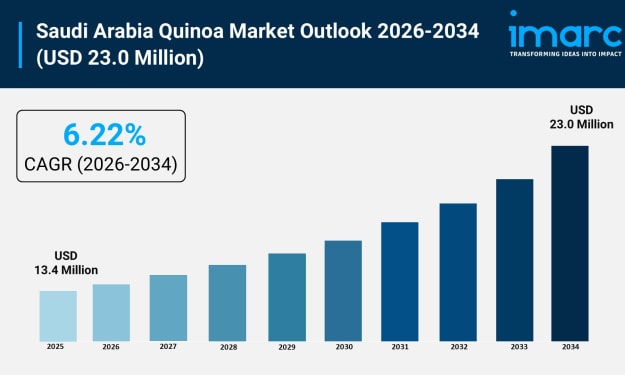
According to IMARC Group's latest research publication, Saudi Arabia quinoa market size reached USD 13.4 Million in 2025. The market is projected to reach USD 23.0 Million by 2034, exhibiting a growth rate of 6.22% during 2026-2034.
By Suhaira Yusufabout 9 hours ago in Futurism



Comments
There are no comments for this story
Be the first to respond and start the conversation.