
How Artificial Intelligence Will Transform the Job Market in the Future
Discover how AI is transforming the job market — and why it’s not about losing jobs, but gaining new skills and opportunities

Introduction
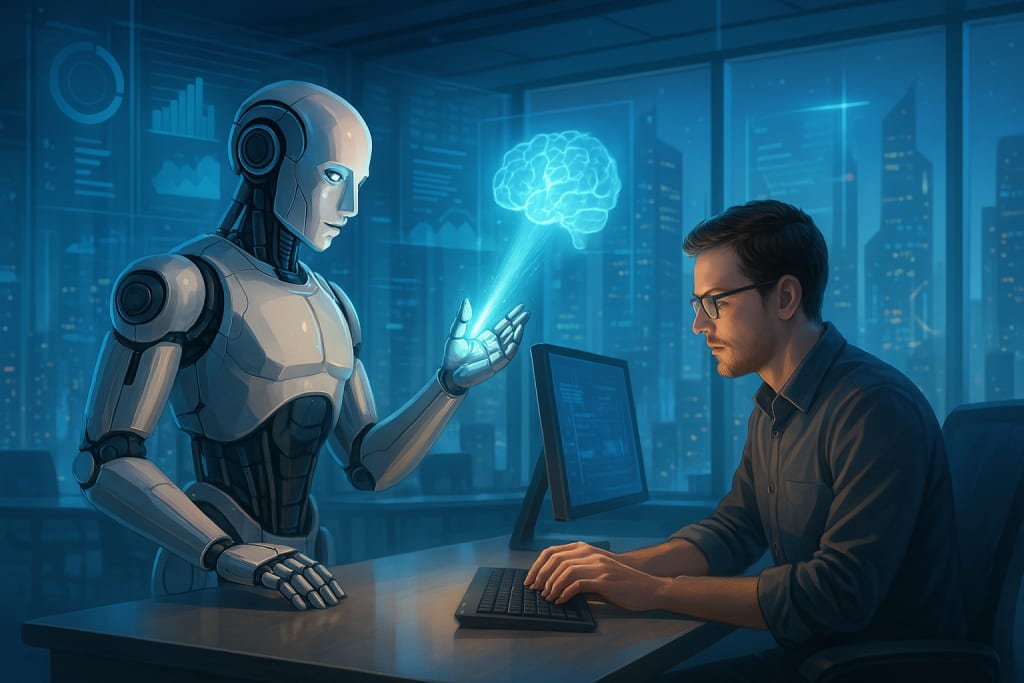
Imagine waking up in the near future and discovering that your colleague isn’t a person—but a robot. Sounds like science fiction? It’s not. Artificial Intelligence (AI) is transforming the world around us faster than ever before. From self-driving cars to smart assistants like Siri and Alexa, AI is already part of our daily lives. But what does this mean for jobs? Will AI replace us—or create new opportunities we never imagined?
AI Is Already Changing the Job Market
AI technologies are already automating repetitive tasks in industries like manufacturing, transportation, and customer service. This shift means fewer humans are needed for some roles. However, that doesn’t mean we’ll all be jobless. Instead, it signals a transition in the types of jobs that are in demand.
Companies are now looking for workers who can manage, develop, and work alongside AI. For example, in logistics, AI handles inventory and delivery predictions, but human oversight is still essential for complex decision-making. In healthcare, AI assists in analyzing X-rays, but doctors interpret the results and make treatment decisions.
Some Jobs Will Disappear
It’s true that some roles will vanish. Jobs that rely heavily on routine tasks are at high risk of automation. These include:
Data entry clerks
Telemarketers
Cashiers
Basic customer service agents
Machines and algorithms can do these tasks faster, more accurately, and without rest. While this may seem concerning, it’s part of a bigger shift that history has seen many times — like the industrial revolution.
New Jobs Will Be Created
Technology doesn’t only replace jobs — it also creates new ones. The rise of AI is opening doors to entirely new career fields, such as:
AI Developers and Engineers: Professionals who design and build AI systems.
Data Scientists and Analysts: Experts who interpret data used by AI systems.
Cybersecurity Experts: As systems become more digital, protecting them becomes vital.
AI Ethics Officers: Roles focused on ensuring AI is used fairly and responsibly.
AI Maintenance Technicians: People who maintain robots and smart machines.
According to the World Economic Forum, AI is expected to create 97 million new jobs globally by 2025. So while some jobs will disappear, others will take their place — possibly better-paying and more interesting roles.
Human Skills Will Be More Valuable
Even as machines become more advanced, there are skills they can’t easily replicate. These are the abilities that will become more valuable than ever, such as:
Creativity: AI can generate content, but human creativity adds emotional depth and innovation.
Critical Thinking: Humans are better at making complex decisions with limited data.
Emotional Intelligence: Empathy, teamwork, and leadership still require the human touch.
Problem-solving in dynamic environments: AI struggles when faced with unexpected situations.
These human traits will keep people valuable and relevant in the AI-powered job market.
Education and Training Are Key
To prepare for the AI revolution, individuals must invest in their education and learn new skills. Schools and universities are already adapting by offering programs in data science, machine learning, and digital literacy. Online platforms like Coursera, edX, and LinkedIn Learning are making it easier than ever to upskill.
Governments and companies also have a role to play. Providing access to affordable training and helping workers transition from old roles to new ones is crucial for long-term success.
AI Will Also Help Create Jobs
Interestingly, AI itself will be part of the solution. AI tools are already helping people:
Start their own businesses
Create content for blogs, YouTube, and social media
Write code for apps and websites
Offer freelance services faster and more efficiently
This means individuals who know how to use AI will have a big advantage in the job market.
Conclusion
Artificial Intelligence is not the enemy of human jobs — it’s a tool for progress. Yes, some traditional roles will vanish, but new opportunities will emerge. The future belongs to those who adapt, learn new skills, and work alongside technology.
Instead of asking “Will AI take my job?”, we should ask, “How can I grow with AI?”
By embracing change and preparing ourselves, we can not only survive the AI revolution — we can thrive in it.
About the Creator
Keep reading
More stories from ُُُEng Fares Sameh and writers in Futurism and other communities.
"Why Do We Fear? Understanding the Roots of Fear and Its Impact on Our Lives"
Introduction: Fear is a natural human emotion that we all experience in various aspects of our lives. Whether it’s fear of the unknown, failure, or simply the future, fear can either protect us or hold us back. While fear serves an important evolutionary purpose, it can sometimes turn into a barrier that prevents us from moving forward and reaching our potential. So why do we fear? Is it just a biological response for survival, or are there deeper psychological and environmental factors at play? In this article, we’ll explore the reasons behind our fears and how we can cope with them effectively.
By ُُُEng Fares Sameh9 months ago in Motivation
About Binding Prometheus
I want to start actively advocating on behalf of my own work, and the most valuable part of my canon is, without a doubt, Binding Prometheus, the play I have been working on since 2019 and only finished in 2023 as part of my MA. The play itself is an amalgamation of a million different inspirations. On one end, it evokes the Ancient Greek myth-play, deriving its own title from the earliest extant work of Western drama we have, Aeschylus’s Prometheus Bound. On the other end, it borrows significantly from the sci-fi bulwarks from over the years, namely Mary Shelley’s Frankenstein and Karel Capek’s Rossum’s Universal Robots. The play could be an episode of Black Mirror, I fear. I don’t know. I’ve only ever seen one episode of Black Mirror.
By Steven Christopher McKnight22 days ago in Futurism
Saudi Arabia Pneumatic Equipment Market Expanding Industrial Applications and Manufacturing Demand
According to IMARC Group's latest research publication, Saudi Arabia pneumatic equipment market size reached USD 298.12 Million in 2024. The market is projected to reach USD 543.94 Million by 2033, exhibiting a growth rate (CAGR) of 6.91% during 2025-2033.
By Suhaira Yusuf7 days ago in Futurism




Comments
There are no comments for this story
Be the first to respond and start the conversation.