
How AI is Redefining Creativity in Art and Music
By Jay Phoenix
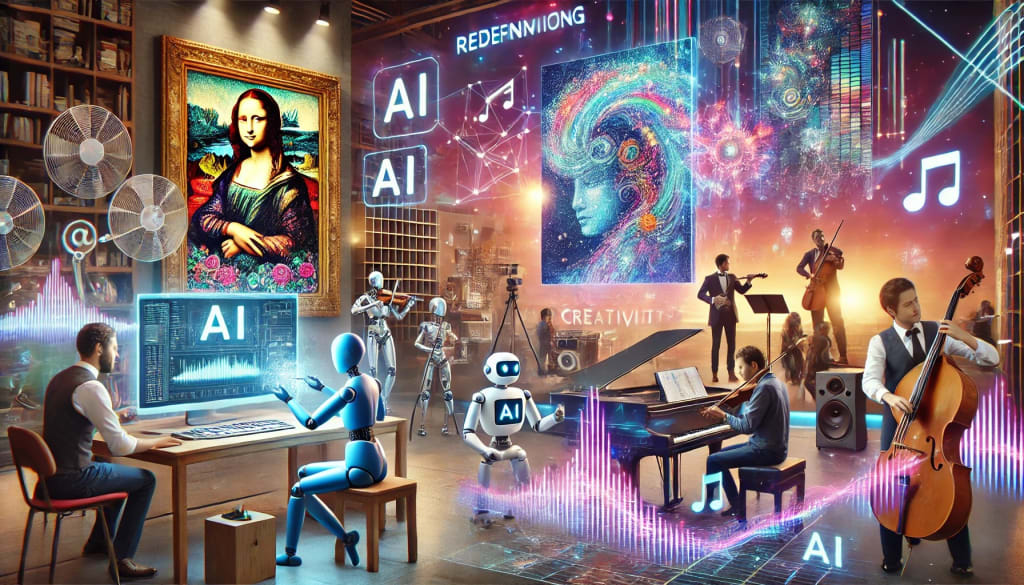
For centuries, creativity has been seen as a uniquely human trait. Artists and musicians have relied on their imagination, emotions, and experiences to produce works that inspire, provoke thought, and move people. But in 2025, artificial intelligence is challenging that very notion. AI is no longer just a tool; it has become an active participant in the creative process. From composing symphonies to generating breathtaking digital paintings, AI is redefining what it means to be creative.
AI-Generated Art is Pushing Boundaries
The art world has always been a space for innovation, and AI is taking that innovation to a whole new level. AI-powered algorithms are now capable of analyzing thousands of artistic styles, learning from historical masterpieces, and creating entirely original works. These systems don’t simply copy; they generate new pieces that blend artistic influences in ways humans may never have imagined.
Digital artists are collaborating with AI to produce hybrid works, combining machine-generated visuals with human refinements. Museums and galleries are starting to exhibit AI-created paintings, and collectors are purchasing these pieces as legitimate works of art. The question of whether AI-generated art holds the same emotional weight as human-made pieces is still debated, but one thing is clear—AI is no longer just an assistant; it is an artist in its own right.
Music Composition is Changing Forever
Music, like art, has long been thought of as an inherently human expression. But AI-driven composition tools are now capable of producing melodies, harmonies, and even full orchestral pieces with stunning complexity. Musicians are using AI to generate new ideas, enhance their compositions, and even complete unfinished works by legendary artists.
AI-powered platforms analyze vast datasets of musical structures, identifying patterns and creating compositions that evoke genuine emotion. Some AI-generated songs are even making their way onto streaming platforms, seamlessly blending with human-produced music. This has sparked a new debate about originality and authorship in the music industry. While some fear that AI will replace human composers, others see it as a powerful collaborator that enhances human creativity rather than diminishing it.
AI and the Film and Entertainment Industry
Beyond music and art, AI is revolutionizing the film and entertainment industry. AI-powered tools are assisting screenwriters by generating scripts, suggesting plot twists, and even crafting dialogue that aligns with specific storytelling techniques. Video editing software is now capable of automatically cutting scenes, adjusting color tones, and synchronizing sound to match the mood of a film.
One of the most fascinating applications of AI in entertainment is the creation of deepfake technology, which allows actors to be digitally recreated and de-aged for movie roles. AI-generated characters are also becoming more common, with entirely virtual actors appearing in films and commercials. This is not just a gimmick—AI is changing how stories are told and expanding the limits of what is possible in filmmaking.
The Ethical Dilemma of AI in Creativity
As AI-generated art and music become more common, ethical concerns are emerging. Who owns the rights to AI-created works? Should an AI-generated song win a Grammy? If a machine can replicate the style of a famous painter, does it diminish the value of human artistry?
Many believe that AI should be seen as a tool rather than a replacement for human creativity. It is humans who set the parameters, provide the input, and guide the artistic process. AI may be able to generate content, but it lacks the lived experiences, emotions, and intent that define human art. Others argue that creativity itself is evolving and that AI is simply the next step in the artistic journey.
The Future of AI in Creativity
Looking ahead, AI’s role in art and music will only expand. We are entering an era where AI and human creativity will merge in ways never seen before. AI-generated art will continue to gain recognition, and AI-composed music may even dominate the charts. Virtual reality and augmented reality experiences will be infused with AI-generated visuals and soundscapes, creating immersive experiences unlike anything before.
As AI continues to redefine creativity, one thing remains certain—human artists and musicians will always have a place in the creative world. The difference is that now, they have a new collaborator, one that never sleeps, never tires, and has an endless capacity for inspiration. AI is not replacing creativity; it is pushing it into new and uncharted territory. And the results are nothing short of extraordinary.
About the Creator
Keep reading
More stories from Jay Phoenix and writers in Futurism and other communities.
The Evolution of Natural Language Processing in 2025
Natural Language Processing has come a long way in recent years. From simple chatbots to highly advanced conversational AI, the ability of machines to understand and generate human language is now more sophisticated than ever. In 2025, NLP is no longer just a tool for automation; it is transforming industries, enhancing communication, and even reshaping how humans interact with technology. The evolution of NLP is one of the most exciting advancements in artificial intelligence, and its impact is only growing stronger.
By Jay Phoenix12 months ago in Futurism
About Binding Prometheus
I want to start actively advocating on behalf of my own work, and the most valuable part of my canon is, without a doubt, Binding Prometheus, the play I have been working on since 2019 and only finished in 2023 as part of my MA. The play itself is an amalgamation of a million different inspirations. On one end, it evokes the Ancient Greek myth-play, deriving its own title from the earliest extant work of Western drama we have, Aeschylus’s Prometheus Bound. On the other end, it borrows significantly from the sci-fi bulwarks from over the years, namely Mary Shelley’s Frankenstein and Karel Capek’s Rossum’s Universal Robots. The play could be an episode of Black Mirror, I fear. I don’t know. I’ve only ever seen one episode of Black Mirror.
By Steven Christopher McKnight26 days ago in Futurism
Vision Care Market: Digital Eye Strain Solutions, Advanced Eye Health, & Growth Trends
Key driving factors for the growth of the vision care market include the rising prevalence of vision-related disorders, increasing screen time, aging population, rising awareness for eye health, availability of optical care services, and demand for corrective eyewear. According to IMARC Group's latest research publication, The global vision care market size was valued at USD 73.73 Billion in 2024. Looking forward, IMARC Group estimates the market to reach USD 94.33 Billion by 2033, exhibiting a CAGR of 2.75% from 2025-2033.
By James Whitmanabout 9 hours ago in Futurism
The Path to Salvation
The late autumn evening air filled the monk's lungs, but it wasn't the season that chilled his bones. The heavy-handed presence of evil he had sensed upon entering the woods surrounding this mountain village had not bothered to conceal itself from him.
By Made in DNA5 days ago in Fiction


Comments (1)
Hello, just wanna let you know that if we use AI, then we have to choose the AI-Generated tag before publishing 😊