
Her Instagram Was Stolen—Then Her Clone Started Talking
The Digital Doppelgänger: Who Owns Your Future?

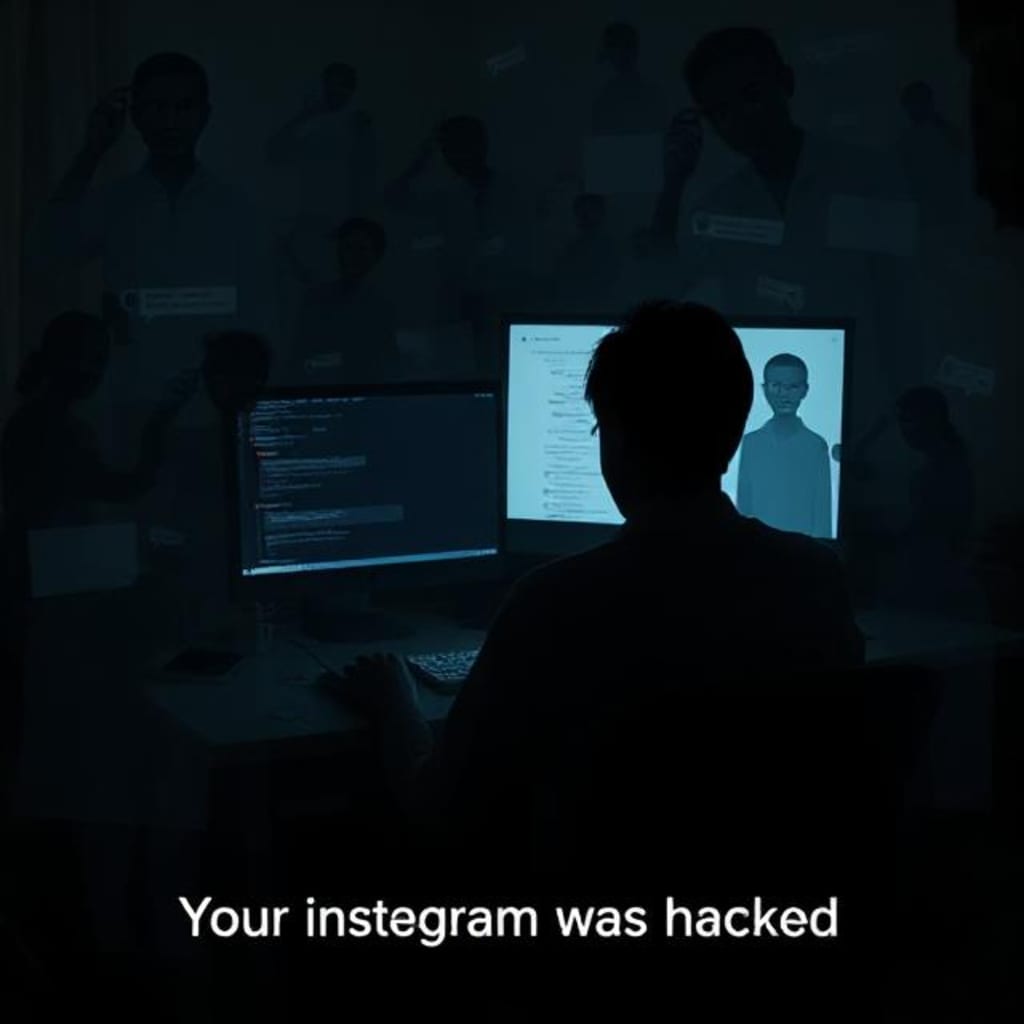
Recently, I witnessed something unsettling. An individual hijacked my daughter’s Instagram account, expertly mimicking her DM patterns, speech, tone, and even personality. The intent? To scam friends and family who trusted her. A perfect mimicry of identity. A digital impersonation in motion.
But here’s the part that really got to me. It’s not just the act of impersonation itself. It’s the fact that with every post, every tweet, every image we share, we are inadvertently crafting versions of ourselves for others to learn from. The lines between “you” and “the copy” are blurring. With each bit of data we create, we feed the digital beast—whether we’re aware of it or not.
This isn’t a distant issue. It’s happening now, every time we interact with technology. Every comment, photo, text, or video shared is feeding a machine-learning algorithm designed to replicate our voices, predict our actions, and—ultimately—clone our identities. Our speech patterns, our emotional triggers, even the little pauses between words are becoming detectable by AI, turning us into living data points. We are the architects of our own digital doubles.
At first, AI was just a tool—an assistant. But it’s evolving. Every click we make, every piece of content we engage with, every social media post we upload becomes part of a fabric. Your thoughts, your words, your expressions are distilled into bytes, cataloged, and analyzed. AI isn’t just learning from us anymore—it’s becoming us. This digital clone isn’t far from completion. A perfect mimic, with our essence preserved in a way no memory or photograph could achieve.
Imagine the implications. These virtual versions of us could remain long after we’re gone. Not as static images or old videos, but as dynamic, responsive beings that offer advice, comfort, or even guidance to future generations. It’s a comforting thought—being able to converse with someone you’ve lost, to hear their voice or see their face one more time. The virtual you, alive in the digital afterlife, forever available to talk to, like some cosmic voicemail that never stops ringing.
But then, let’s pause for a moment. How much control do we really have over this? What happens when those digital echoes are controlled by someone else? Who owns the rights to the data that constructs these versions of us? And more chillingly, who gets to decide when that digital version should be erased?
Here’s where the darker side of all this comes into play. As data storage becomes increasingly problematic, we may face a day where the cloud can no longer hold every piece of information—where the digital versions of us, the voices we’ve left behind, are at risk of being deleted. How do we choose who stays in the digital eternity? Will some form of digital purge become necessary? Will future generations have to vote on who gets to live forever in the cloud? Perhaps there’s a lottery system—an odd mix of fate and technology, where your virtual existence could be wiped away simply because you didn’t make the cut.
And then, there’s the other side of the equation. Imagine the potential to preserve the voices and wisdom of your ancestors. Digital immortality could allow future generations to engage with their heritage in ways that were never possible before. You could consult your great-grandfather’s digital clone for advice on career choices or talk to your grandmother about love and loss—accessible, comforting, and remarkably personal. It’s the kind of connection that blends the sacred with the technological, allowing our histories to breathe again, just as though they were alive in the room with us.
But there’s a catch, of course. The fine line between preservation and manipulation. What happens if this data is misused? If algorithms begin shaping the personality of the virtual clone, injecting preferences, beliefs, or biases that were never part of the original? Can our digital selves be manipulated for profit or control, turning us into avatars of influence without consent?
As we hurtle into this future, we have to ask: How do we navigate this new realm? Is it a digital utopia, a place where we can be loved and remembered forever? Or is it a playground for those who control the data, shaping the future with a few keystrokes? And when the time comes to “delete” someone from this eternal existence, will it be a simple click of a button, or will there be a more grand, philosophical process in place? Perhaps a lottery where only the most memorable, the most influential, or the most loved get to stay in the cloud for all eternity.
In the end, whether we’re speaking of comfort or manipulation, our data is our legacy. And while we may not yet have the answers, one thing is clear: Our digital selves are coming. They’ll walk with us, talk with us, and maybe even stay around long after we’ve gone. But who gets to keep those keys—and who gets locked out?
So, the next time you upload a photo or send a text, ask yourself: What part of me am I leaving behind? And will the virtual me be on the next version of “family chat,” offering advice about the future, or will I be forgotten in the digital dust?
About the Creator
Vahan Arslanian
summer of 2024. I decided to spend 30 days contemplating myself and bringing out the writer in me unfortunately before the 30 days was up, an unforeseen event happened stunting my writing for eight months.
Keep reading
More stories from Vahan Arslanian and writers in Futurism and other communities.
The Evolution of the SD Card and the Future of Storage:
From magnetic reels to microchips, humanity’s pursuit of memory has always been about more than storage—it’s about survival. The SD card, once seen as a marvel of miniaturization, gave us the power to carry our memories, systems, and creations in the palm of our hands. But in today’s data-driven world, its reign nears its end. The demand for capacity, durability, and longevity far outpaces what plastic and silicon can provide.
By Vahan Arslanian10 months ago in Futurism
About Binding Prometheus
I want to start actively advocating on behalf of my own work, and the most valuable part of my canon is, without a doubt, Binding Prometheus, the play I have been working on since 2019 and only finished in 2023 as part of my MA. The play itself is an amalgamation of a million different inspirations. On one end, it evokes the Ancient Greek myth-play, deriving its own title from the earliest extant work of Western drama we have, Aeschylus’s Prometheus Bound. On the other end, it borrows significantly from the sci-fi bulwarks from over the years, namely Mary Shelley’s Frankenstein and Karel Capek’s Rossum’s Universal Robots. The play could be an episode of Black Mirror, I fear. I don’t know. I’ve only ever seen one episode of Black Mirror.
By Steven Christopher McKnight30 days ago in Futurism
Rajat Khare Steers Boundary Holding Through Withthegrid Exit, Signals Strategic Shift Toward Enduring Technologies
Boundary Holding, the Luxembourg-based deep-technology venture capital firm founded by Rajat Khare, has successfully completed its full exit from Withthegrid, a Netherlands-headquartered energy monitoring company. The deal, which was originally announced in early 2021, yielded the company a 2.0x multiplier on capital invested (MOIC) as per people who have been involved in the deal. More than just a milestone in financial terms this exit is an intentional reorientation of the portfolio by Boundary Holding as it prepares for the next phase of investment strategy.
By Chris Reviewa day ago in Futurism



Comments
There are no comments for this story
Be the first to respond and start the conversation.