
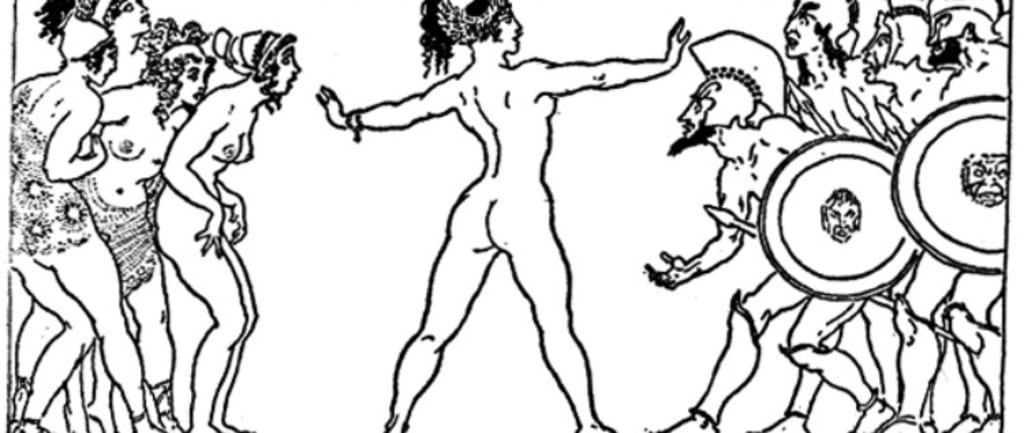
Lysistrata. The name of a powerful fictitious woman, and an ancient Greek play that was written, performed and watched for entertainment by only men. Aristophanes was not necessarily a feminist but he understood and recognised the power that women had, this and the fact that we’ve seen this story in our own modern world is why Lysistrata is my favourite tale.
Lysistrata is a story about a woman who has decided she has found a way to end the Peloponnesian war between Athens and Sparta. The play opens up with Lysistrata awaiting the arrival of different women belonging to both sides and she is diplomatic in conveying her message across. The message of course, is in order to end the war, the women must withheld sex from men and their husbands until a treaty for peace is signed as well as they take over the Acropolis as they’re means of inhibiting the men further. The acropolis is seized by the chorus of Old Women, they swear an oath not to have sex and they sacrifice a bottle of wine to the Gods.
What’s more, is that later on in the play the men are left dumbfounded by Lysistrata’s speech when using Reconciliation (a naked woman of whom has been painted over with hills and rivers, to show the map of Greece) is used to explain that because Athens and Sparta share similar heritage and have previously helped each other, that they shouldn’t be fighting. The men are so distracted they go along with making peace by deciding land rights using Reconciliation’s body and sign the peace treaty. Thus making Lysistrata a success, and a mockery of power.
As fascinating as this play would have been to watch at the time Aristophanes would have had it performed, in Kenya in 2009 they saw something very similar.
In order to prevent further deterioration in the relationships between Kenya’s President Mwai Kibaki and Raila Odinga, female activists wanted to put a stop to the violence ensuing across Kenya because of the leaders’ conflicting views on serious matters like corruption and poverty.
The women of Kenya came together to refuse sex to their husbands, to all men and- my favourite part- paid prostitutes not to sleep with men. Even the wives of the President and Prime Minister took part in the protest. The women had a list of demands to be fulfilled which included respect and good faith from their leaders.
The protest lasted only 7 days and ended in joint prayer where the leaders agreed to talk.
On a personal note, I like that Aristophanes’ play wasn’t a feminist move because although his intent was not that, he still instilled the idea that women have power, be it small or mighty, they have it. I also like that during the Kenyan sex strike it was a feminist move and they did pay the prostitutes; and if we’re looking for parallels, I think Lysistrata’s Reconciliation could well be Kenya’s prostitutes in the using what power they had and the rawness of it. I believe it was a feminist move because of their demands and to be respected but also because it was for the benefit of everyone, all citizens.
The fact that Lysistrata was only a play and not a real life event I believe does not take away the significance of the piece and what it probably meant for some those audience members. The fact that these female activists of Kenya most likely wouldn’t have heard of the play shows us that it’s a universal idea and significantly so, if not by being recognised by one man to bring it to life and recognised by other men of power as a strategy to be taken seriously. Well done women.
About the Creator
Grace Kent
Hi, I’m Grace, I am trying to be more confident in my writing, but how can I unless I share?
Writing has been a passion of mine for a long time and it’s taking some guts for me to put it out there, but I’m excited.
I hope you enjoy my work!
Keep reading
More stories from Grace Kent and writers in Futurism and other communities.
About Binding Prometheus
I want to start actively advocating on behalf of my own work, and the most valuable part of my canon is, without a doubt, Binding Prometheus, the play I have been working on since 2019 and only finished in 2023 as part of my MA. The play itself is an amalgamation of a million different inspirations. On one end, it evokes the Ancient Greek myth-play, deriving its own title from the earliest extant work of Western drama we have, Aeschylus’s Prometheus Bound. On the other end, it borrows significantly from the sci-fi bulwarks from over the years, namely Mary Shelley’s Frankenstein and Karel Capek’s Rossum’s Universal Robots. The play could be an episode of Black Mirror, I fear. I don’t know. I’ve only ever seen one episode of Black Mirror.
By Steven Christopher McKnight21 days ago in Futurism




Comments
There are no comments for this story
Be the first to respond and start the conversation.