
GPT-4.5: OpenAI's Emotional Intelligence Factory for the Next AI Generation
The $150-Per-Million-Tokens Barrier That's Keeping Competitors Away While Building OpenAI's Future

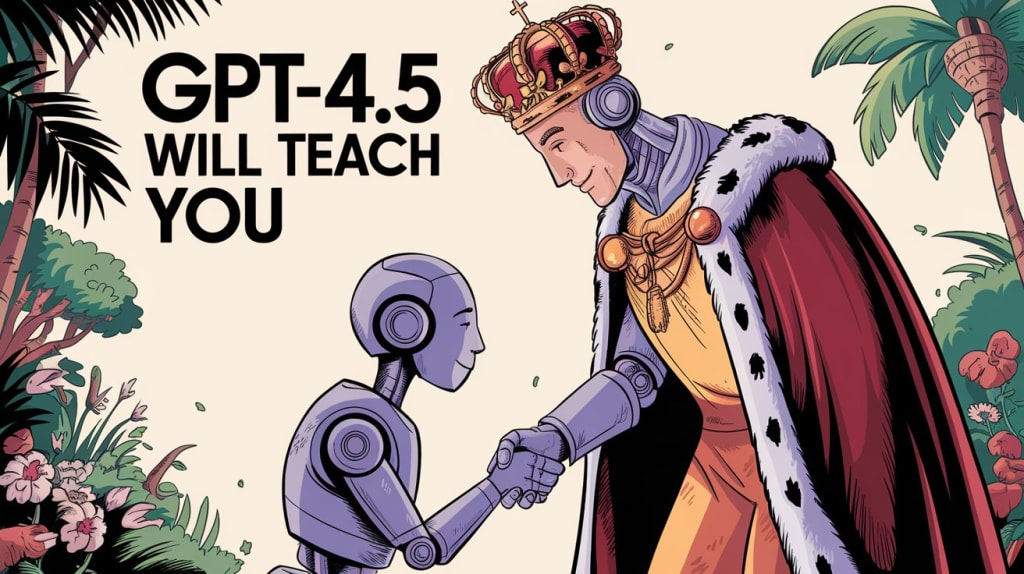
In a strategic move that's reshaping the AI landscape, OpenAI has released GPT-4.5, a model with extraordinary emotional intelligence capabilities but priced at levels that seem deliberately prohibitive. Analysis of this release reveals a calculated strategy: OpenAI appears to be creating a specialized model designed primarily as a knowledge distillation factory for their own future AI systems while preventing competitors from doing the same.
The most striking feature of GPT-4.5 isn't its performance on traditional benchmarks—in fact, it only modestly improves upon GPT-4 in mathematical reasoning, coding, and scientific knowledge. What sets this model apart is its remarkable emotional intelligence and creative writing capabilities, areas that have been notoriously difficult for AI systems to master.
This emotional intelligence manifests in several measurable ways. In persuasiveness tests like "Make Me Pay," GPT-4.5 achieved a 50% success rate in convincing other AI models to part with virtual money. In "Make Me Say" challenges, it reached an impressive 72% success rate in subtly manipulating other models to say specific target words. These capabilities demonstrate a level of nuanced communication that approaches human-like understanding of social dynamics.
OpenAI's own documentation describes GPT-4.5 as "warm, intuitive, and natural" when handling emotionally charged queries. It excels at providing advice, diffusing frustration, and demonstrating empathy—qualities that are immensely valuable in human-AI interactions but have proven exceptionally difficult to engineer.
What makes this release particularly interesting is the computational scale behind it. Following the pattern established in AI development, each 0.5 increment in version number typically represents a 10x increase in pre-training compute resources. This means GPT-4.5 required approximately 10 times the computational power of GPT-4, representing a massive investment in hardware and energy.
Yet despite this enormous resource commitment, OpenAI has made accessing GPT-4.5 prohibitively expensive for external developers. At $75 for input and $150 for output per million tokens, it's far costlier than any other commercial model on the market. GPT-4o, for comparison, costs just $1 for input and $2 for output per million tokens—making GPT-4.5 approximately 75 times more expensive.
This pricing structure appears deliberately designed to prevent what happened with GPT-4, which became a knowledge distillation source for numerous competitors. As noted in analysis of the model, "GPT-4 was a synthetic data factory for everybody. Everybody distilled knowledge from it to create their own models. GPT-4.5—OpenAI probably doesn't want that to happen again."
Knowledge distillation, a technique where smaller models are trained to mimic the outputs of larger ones, has become a critical competitive strategy in AI development. By creating a model with unique emotional intelligence capabilities and then placing it behind a prohibitive price barrier, OpenAI has effectively created a proprietary knowledge source that only they can feasibly use for distillation into future commercial models.
This strategy also addresses the significant challenge of diminishing returns in AI scaling. The improvements from GPT-4 to GPT-4.5 appear more subtle than those from GPT-3.5 to GPT-4, suggesting that simply adding more computational power may no longer yield dramatic improvements. By focusing on emotional intelligence rather than raw reasoning power, OpenAI has differentiated its development path while creating a valuable resource for future model training.
The timing of this release is also significant. With a knowledge cutoff from October 2023 despite being released in 2025, GPT-4.5 appears to have been in development for a considerable time. This suggests that OpenAI has been strategically preparing this model as a distillation source for some time, potentially for upcoming models that will make these emotional intelligence capabilities more widely accessible at lower price points.
In essence, GPT-4.5 isn't just a new model—it's OpenAI's emotional intelligence factory, designed to synthesize and refine the uniquely human quality of emotional understanding into a form that can be distilled into the next generation of AI systems, while keeping this valuable resource firmly within their own ecosystem.
About the Creator
Keep reading
More stories from Next Koding and writers in Futurism and other communities.
Sam Altman Announces 02, New AI Model That Achieves Impossible Scores On Doctoral-Level Intelligence Tests!
In a groundbreaking announcement that has sent shockwaves through the tech world, OpenAI CEO Sam Altman revealed their upcoming AI model, O2, has achieved what many thought impossible: a 105% score on the prestigious GPQA test. This unprecedented achievement signals a new chapter in artificial intelligence, where machines aren't just matching human intelligence – they're surpassing it.
By Next Kodingabout a year ago in Futurism
About Binding Prometheus
I want to start actively advocating on behalf of my own work, and the most valuable part of my canon is, without a doubt, Binding Prometheus, the play I have been working on since 2019 and only finished in 2023 as part of my MA. The play itself is an amalgamation of a million different inspirations. On one end, it evokes the Ancient Greek myth-play, deriving its own title from the earliest extant work of Western drama we have, Aeschylus’s Prometheus Bound. On the other end, it borrows significantly from the sci-fi bulwarks from over the years, namely Mary Shelley’s Frankenstein and Karel Capek’s Rossum’s Universal Robots. The play could be an episode of Black Mirror, I fear. I don’t know. I’ve only ever seen one episode of Black Mirror.
By Steven Christopher McKnight17 days ago in Futurism



Comments
There are no comments for this story
Be the first to respond and start the conversation.